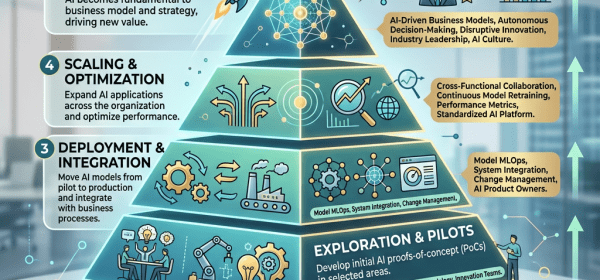
Pyramid showing five stages of AI transformation maturity: Foundation & Data, Exploration & Pilots, Deployment & Integration, Scaling & Optimization, Transformation & Innovation.

The AI Maturity Pyramid

AI transformation in organizations requires a foundational approach, starting with individual productivity and gradually building to business model transformation. Companies should not rush to large-scale changes without establishing capabilities at lower maturity levels. Effective AI adoption involves both top-down and bottom-up strategies, ensuring widespread literacy and integration across all workflows.

Continue reading

Senior engineer and colleague reviewing a promotion offer in an office cubicle

The leadership desert: The unspoken enterprise IT talent problem

A concerning trend reveals senior engineers declining promotions due to burnout and dissatisfaction with traditional leadership roles. Many feel these roles impose additional pressure without enhancing their influence. Experts suggest creating dual career paths that value both technical and human leadership to retain talent and foster a healthier leadership pipeline in IT.

Continue reading

AI system converting fragmented legacy data into organized, compliant data governance

The new rules of data governance in the age of agentic AI

The rise of agentic AI has transformed data governance from merely compliance-focused tasks to a strategic component essential for enabling trustworthy AI outcomes. Organizations must prioritize data readiness, bias oversight, transparency, and dynamic risk management to leverage AI responsibly and innovate faster. Effective governance integrates automation and security, ensuring competitiveness in AI deployment.

Continue reading

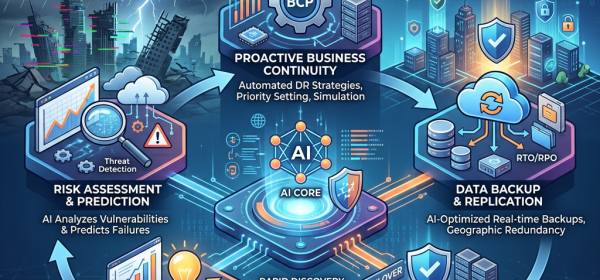
Flowchart of AI-enabled disaster recovery planning with stages risk assessment, business continuity, data backup, autonomous recovery, and optimization

AI disaster recovery planning is years behind AI adoption

Enterprises must evolve disaster recovery (DR) plans to accommodate AI technologies, as current strategies lag behind AI adoption. CIOs and CISOs face challenges ensuring AI models and data remain reliable post-incident. Key steps include cataloging assets, mapping dependencies, defining recovery objectives, and continuous testing to address the growing complexities of AI systems during crises.

Continue reading

IT team working at computers with a digital visualization of AI growth and automation behind them

Why AI Agents Threaten The Foundation Of Indian IT

At TCS’s annual meeting, Chairman N. Chandrasekaran highlighted AI as a major growth opportunity. However, the increasing automation from hyperscalers like AWS poses a threat to Indian IT firms, which traditionally rely on labor for maintenance and modernization. The shift to AI results in outcome-based pricing, impacting job roles and revenue projections.

Continue reading

Diagram showing strategies like personalized messaging, tiered rewards, and gamification creating emotional customer loyalty and engagement

How To Build A Loyalty Team That Scales With Your Program

Brands are increasingly focusing on loyalty initiatives to strengthen customer relationships, yet often prioritize technology and rewards over emotional engagement. This imbalance risks strategic stagnation, fragmented customer experiences, and ineffective frontline delivery. Effective loyalty programs require well-resourced teams, clear roles, cross-functional alignment, and traits of successful organizations to drive lasting impact.

Continue reading

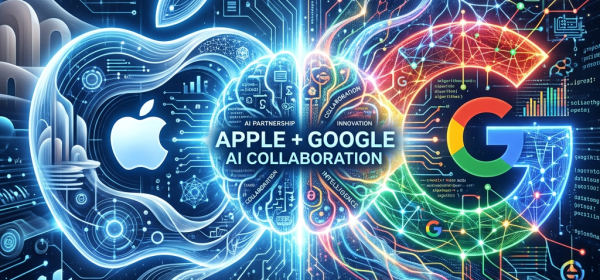
Apple and Google logos connected by digital neural network and circuit patterns symbolizing AI collaboration

What Apple’s AI update reveals about the future of build vs. buy

Apple’s recent partnership with Google’s Gemini models to enhance Siri reflects a broader shift in the IT landscape towards re-evaluating the build-versus-buy decision amidst evolving generative AI capabilities. Organizations must weigh the ease of software development against the complexities of system ownership and long-term maintenance, focusing on strategic application rather than solely on customization.

Continue reading

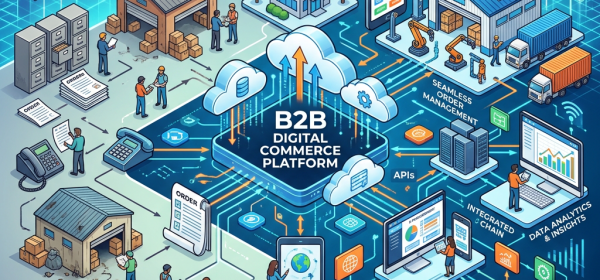
Comparison of traditional B2B commerce and digital commerce platform integrating order management, CRM, analytics, and global reach

A Fake PLG Strategy Is Exposed Through Your Digital Commerce Experiences

B2B companies often misunderstand product-led growth (PLG) due to ineffective digital commerce models. Buyers struggle with opaque pricing and poor onboarding, leading to stalled PLG initiatives. A successful approach involves redesigning digital commerce to facilitate self-service, creating transparency, and integrating signals across teams, turning commerce into a growth engine instead of just a transactional layer.

Continue reading

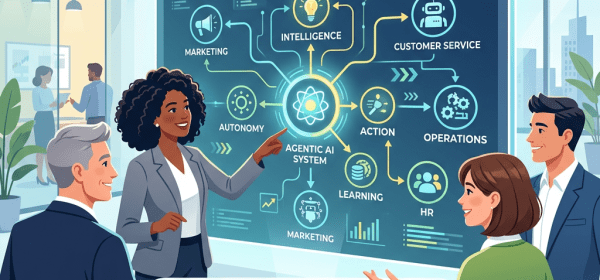
Four business professionals discussing agentic AI system with flowchart on screen

The State Of Agentic AI In 2026: Companies Are Chasing, Few Are Catching

In 2026, while three-quarters of enterprise leaders are interested in adopting agentic AI, few have effectively implemented it beyond basic chatbots. The technology evolves rapidly, outpacing enterprise readiness, leading to governance and ROI challenges. Companies must invest in orchestration, redesign workflows, and treat agents as governed identities to keep up with advancements.

Continue reading

Team discussing AI integration steps on whiteboard in office

Conway’s Law: Your Operating Model Matters More Than The AI Model

The author emphasizes the importance of starting with the operating model rather than focusing solely on technology platforms when adopting AI. They highlight that agents mimic organizational flaws and that systemic changes are essential for effective AI integration. The shift towards agentic AI demands a redesign of workflows, governance, and skills to avoid replicating past issues.

Continue reading

Team of six working on workflow diagram displayed on interactive touchscreen table

Look Beyond ‘Prompt And Pray’ To AI’s More Transformative Possibilities

Organizations are misusing AI by expecting overnight transformations from technology alone. Successful companies utilize AI as a work-design tool, focusing on context and integration rather than merely acquiring more tools. They prioritize training, redesign work processes, and involve workers in innovation, leading to enhanced productivity and reduced burnout.

Continue reading

Business team looking stressed with holographic AI alerts and small flying and standing robots around them

Your agentic AI is running ahead of the governance designed to manage it

The rapid deployment of autonomous AI agents in Australian organizations exceeds governance capabilities, with over 80% of executives planning to use them. However, less than 25% have effective governance models. This gap poses accountability challenges that need urgent executive focus, as unresolved issues grow more complex with each additional agent deployed.

Continue reading

Robotic worm hacking computer systems with breach alerts and access granted messages

Autonomous Malware Is No Longer Theoretical: AI Worm Proof Of Concept Created In A Lab

On June 2, 2026, researchers announced an AI worm capable of autonomous reasoning and execution, raising security concerns. Unlike previous malware, this worm autonomously exploits vulnerabilities. The study highlights the economic imbalance in cybersecurity, emphasizing the need for improved defenses, monitoring, and understanding of AI’s role in both attacks and defenses.

Continue reading

1 19 20 21 22 23 331