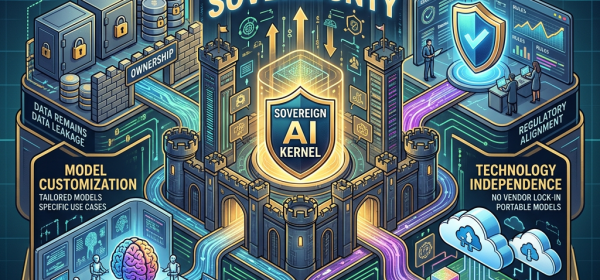
Diagram showing enterprise AI sovereignty with data privacy, governance, model customization, and technology independence.

Establishing AI and data sovereignty in the age of autonomous systems

Enterprises initially traded control over their data for generative AI capabilities, but now, as AI becomes integral, they seek data and AI sovereignty. Concerns over losing intellectual property are driving a shift towards self-managed AI systems. A recent survey shows 70% of executives prioritize sovereignty to maintain competitiveness.
Continue reading

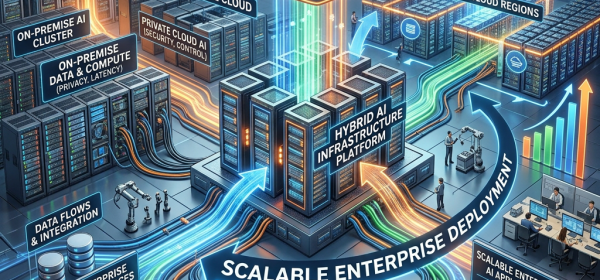
Diagram of hybrid AI infrastructure platform connecting on-premise data, edge computing, private and public clouds for scalable enterprise AI deployment

Scaling AI into production is forcing a rethink of enterprise infrastructure

Organizations are transitioning from AI experimentation to scalable deployment across various industries, according to Nutanix leaders. While AI enhances human capabilities, it introduces operational complexities, such as managing multiple workloads and ensuring security. Successful integration requires a hybrid infrastructure, enabling seamless collaboration between AI developers and infrastructure teams.

Continue reading

AI agents overseeing enterprise security tasks including access control, multi-factor authentication, threat detection, and incident response within a governance hub.

Non-human identity sprawl is agentic AI’s real risk

Non-human identities (NHIs) are increasingly prevalent in enterprise systems, yet their governance is often inadequate, creating security risks as agentic AI systems evolve. Organizations must adapt existing security measures, ensuring defined permissions, ongoing reviews, and effective monitoring. Proactive governance is essential to mitigate risks associated with deploying AI agents in business processes.

Continue reading

Business team and AI robot collaborating on market strategy with holographic charts

Where CIOs get stuck rebuilding the enterprise: What ‘Rewired’ reveals

Recent executive changes at major companies highlight a critical need for leadership to adapt to AI advancements. “Rewired” emphasizes that competitive advantage now lies in reimagining business processes with AI integration. CIOs and CEOs must collaborate, evolving their roles to ensure successful transformation and sustainable growth in this rapidly changing landscape.

Continue reading

Business team analyzing global supply chain maps and market risk data in a futuristic control center

The New Blueprint for Competing in A Fractured World

The evolving global business landscape, marked by geopolitical tensions and shifting regulations, necessitates a redesign of multinational strategies. Companies must prioritize resilience through decentralized structures, adapting operations to local markets, and investing in geopolitical risk management. Traditional exit and relocation strategies have transformed to emphasize compliance and political adaptability in a fractured world.

Continue reading

Cybersecurity analysts using AI systems to defend network against cyber attacks

Anthropic’s Mythos forces a rethink of vulnerability management

In the context of emerging AI threats like Anthropic’s Mythos, the cybersecurity landscape is rapidly evolving. Mythos can identify and exploit both zero-day and longstanding vulnerabilities faster than traditional defenses can respond. This necessitates a re-evaluation of vulnerability management protocols to protect organizations against automated attacks and enhance cybersecurity strategies.

Continue reading

The Private AI Model Explosion

The future of AI revenue will largely come from private models rather than public ones, which currently dominate attention and investment. Trust and data security drive companies to develop private AIs tailored to their needs. Public models will still play an important role in innovation and general knowledge but will be overshadowed by the private model’s business potential.

Continue reading

Conductors to Orchestrators: The Future of Agentic Coding

AI coding assistants are evolving from novel tools to essential resources in software development. This shift introduces roles such as conductors, who manage single AI agents interactively, and orchestrators, who oversee multiple agents working concurrently. The transition emphasizes delegation, coordination, and strategic oversight while maintaining human creativity and judgment in coding processes.

Continue reading

Hybrid Cloud Solutions for Enterprise IT: Cost Savings, Security, and Flexibility Combined

Enterprises are increasingly adopting hybrid cloud solutions, projected to grow from $114.83 billion in 2026 to $230.36 billion by 2032. This model combines public and private resources, enhancing scalability, security, and cost efficiency. Its popularity stems from seamless integration, workload portability, and effective disaster recovery capabilities while addressing regulatory demands.

Continue reading

The era of agentic chaos and how data will save us

AI agents are evolving from simple tasks to integral roles within enterprises, promising substantial ROI. However, without proper data alignment and governance, companies risk chaos and inefficiency. Effective leaders establish strong data foundations, enabling autonomous agents to function reliably and enhance business operations, ultimately leading to greater success and minimized operational risks.

Continue reading

What will IT transformation look like in 2026, and how do you know if you’re on the right track?

As enterprises focus on digital transformation, IT departments must evolve culturally, operationally, technologically, and structurally by 2026. Current challenges include fragmented data and legacy systems. Successful transformation requires better alignment with business goals, measuring performance in terms of business value, and fostering strong partnerships across departments.

Continue reading

Build Or Buy AI Agents: Why This Choice Matters More Than You Think

Organizations are rapidly transitioning from debating the use of AI agents to determining their deployment strategies. The key decision lies in choosing between off-the-shelf solutions or custom-built agents, each with distinct advantages and drawbacks. This choice impacts costs, compliance, data control, and competitive differentiation, necessitating careful consideration of organizational needs and capabilities.

Continue reading

1 2