
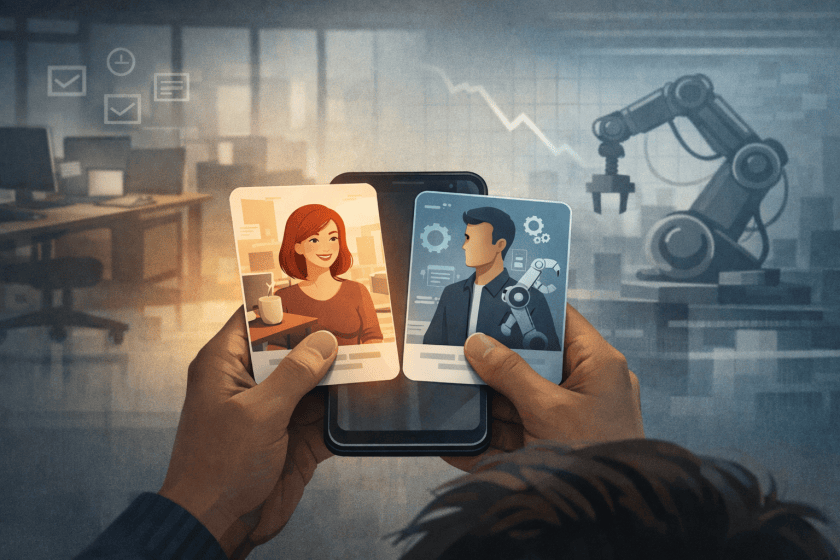
This is less a story about dating preferences in isolation than about how economic stress spills into intimate decision-making. The survey suggests some younger adults may treat AI-related work as a proxy for values, stability and future security. But that does not mean AI itself is directly “rewriting” dating rules across a generation. Self-reported attitudes on a dating app can reflect mood, identity signalling and cultural anxieties as much as consistent real-world behaviour.
That distinction matters for wellbeing. When job disruption becomes a relationship filter, romantic choices may start to carry the same pressure as career planning: choosing not just a person, but their exposure to automation risk. For readers, the health-relevant issue is the psychological load underneath this pattern—financial uncertainty, fear of replaceability and moral unease about technology’s social effects. Those pressures can heighten stress and make dating feel more transactional or defensive.
There are also important limits to what the findings show. A dating-app user survey is not the same as population-level evidence, and responses may be shaped by current headlines about layoffs, AI hype and cost-of-living pressures. People may also be reacting to perceived ethics or status, not only job security. In practice, someone’s resilience to disruption depends on far more than industry label alone, including adaptability, savings, support systems and the actual tasks their work involves.
The more useful takeaway is not that AI jobs are inherently attractive or unattractive partners, but that uncertainty about work is increasingly part of relationship screening. That has broader mental-health significance because chronic insecurity can influence trust, long-term planning and how safely people feel able to connect.
Employees of every age are still learning to use artificial intelligence (AI) tools, and to balance that workplace activity with their often skeptical, even hostile personal views of the tech. But no cohort seems more conflicted in that way than Gen Z, whose members are now even making decisions about who to date—or not—based on how potential partners use or are affected by AI.
That trend was revealed in a recent survey by dating app Hily of 2,900 Gen Z and Millennial platform users. The findings not only reflect a significant wariness—if not outright scorn—of the way AI tools may threaten jobs by automating their essential tasks. It also revealed how those younger people regard employment security as vital in deciding who they enter into relationships with. An illustrative example of that was the 33 percent of Gen Zers who said they’d “be less interested in dating someone whose job was building AI tools that replace human workers.”
Gen Z, it seems, isn’t all that keen about working with AI, but is even less eager to get close to people endangering jobs with the tech.
“Working in AI isn’t a neutral data point for many daters,” a Hily report on the survey results said—noting 22 percent of Millennials would also ghost a potential partner developing job-destroying apps. “For Gen Z especially, siding with AI has a cost.”
Refreshed leadership advice from CEO Stephanie Mehta
Why Smart Founders Say No to Big Deals
Why Smart Founders Say No to Big Deals
Not every client is worth taking. Inc. 5000 honoree LaToshia Norwood explains how successful founders spot the deals that aren’t built to last.
0 seconds of 45 secondsVolume 0%
Gen Z leading increasingly negative views of AI
Those findings coincide with a new Glassdoor analysis of employee workplace reviews on its platform. It found that in May, there were 240 percent more posts critiquing AI use in companies compared to the same month in 2025. Negative views of the tech in those comments rose from 41 percent last year to 51 percent in 2026, with Gen Z’s positive comments about workplace AI ranking lowest of all age groups at 33 percent.
Does that explain why Gen Zers are also most inclined to sprint away from a potential date who’s developing or working with AI tools that risk taking a job away from a human?
Not exactly, since that ethical position appears to be based on wider employment fears—as well as pragmatic rationalization about how the tech might also ease those concerns. Because of that overlap, it turns out AI can be as much relationship clincher as it may be a deal-breaker, depending on how it fits onto those other concerns.
The difference is all about how AI affects job security. While development or deployment employment endangering tech is a big no-no, Hily found 30 percent of Gen Z respondents said they would find a potential date more appealing if their work appeared to be protected from being replaced by apps.
Enjoyed this article? Sign up for our newsletter to receive regular insights and stay connected.