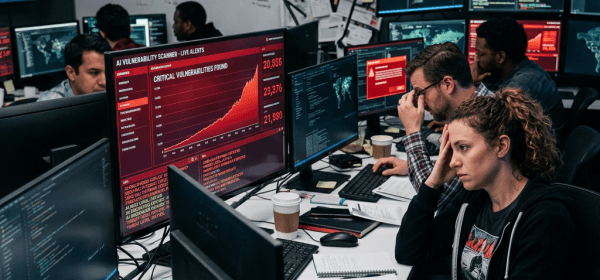
Cybersecurity analyst using multiple monitors to track AI-based cyber threat mitigation and network traffic in control room

Project Glasswing Shows That AI Will Break The Vulnerability Management Playbook

Project Glasswing, led by Anthropic and 11 tech companies, aims to enhance software security using advanced AI capabilities, particularly Anthropic’s Claude Mythos Preview. This initiative seeks to revolutionize vulnerability management by discovering zero-day vulnerabilities rapidly, necessitating an urgent shift in how organizations patch and protect their systems against potential exploits.

Continue reading

Diagram showing legitimate training data and malicious poisoned data flowing into an AI model funnel causing corrupted output

The hidden high cost of training AI on AI

Today’s AI models face a critical issue known as data poisoning, stemming from organizations flooding databases with AI-generated content. This practice dilutes original data quality, risking model degradation and ultimately impacting business decisions. To prevent irreversible damage, it is crucial to maintain a balance of real and synthetic data in training processes.

Continue reading

Cybersecurity specialist using AI defense system against hacker in control room

Is Mythos a blessing or a curse for cybersecurity? It depends on whom you ask

Anthropic’s Claude Mythos Preview AI model raises concerns about whether it aids cybersecurity defenses or malicious hackers. Released on April 9, it can identify and exploit software vulnerabilities quickly, prompting Anthropic to limit access for public safety. Experts debate its potential impacts, emphasizing a delicate balance between cyber offense and defense.

Continue reading

Team collaborating around interactive digital table showing world map and AI cybersecurity data

Apple, Google, and Microsoft join Anthropic’s Project Glasswing to defend world’s most critical software

A coalition of major tech firms, including Amazon and Google, has launched Project Glasswing, an AI-driven initiative aimed at enhancing global cybersecurity due to escalating threats. The project utilizes advanced AI capabilities and significant financial investments to tackle hidden vulnerabilities in critical software, reflecting urgent concerns about infrastructure risks and collaborative defense.

Continue reading

Cloud computing with shield and padlock icons securing data and files

Confidential computing resurfaces as security priority for CIOs

Confidential computing is gaining traction among CIOs as a vital security measure in the cloud era. It protects data in use by processing it within a hardware-encrypted environment, addressing risks associated with traditional data handling methods. As threats increase, 75% of organizations are adopting this technology to enhance data integrity and security.

Continue reading

Top Cybersecurity Best Practices Business Leaders Must Implement Today for Ultimate Business Data Protection and Enterprise Security Basics

In the digital era, cybersecurity is crucial for businesses to prevent data breaches, financial losses, and reputational damage. Key practices include using strong passwords, multi-factor authentication, regular employee training, and systematic data backups. Adapting to emerging threats, like AI-driven attacks, and maintaining compliance with regulations is essential for safeguarding business data and ensuring resilience.

Continue reading

Simplified security vs. concentrated risk: What CIOs should learn from Google’s Wiz deal

The European Commission approved Google’s $32 billion acquisition of cloud security firm Wiz, enhancing its cloud capabilities. As AI integration grows, security must be embedded into infrastructure design rather than treated separately. However, this consolidation raises risks, as reliance on a single provider may compress risk management and complicate compliance responsibilities for enterprises.

Continue reading

Google warns attackers are wiring AI directly into live cyberattacks

A new Google Threat Intelligence report highlights that threat actors are increasingly integrating artificial intelligence into operational attack workflows. It details the use of AI models in malware development and cyber operations, complicating detection efforts. Criticism arises regarding the implications for Google’s liability as attackers exploit its AI technologies.

Continue reading

Slamming the door on AI-based cybersecurity threats

The emergence of AI poses significant cybersecurity challenges for CIOs and CISOs, including internal vulnerabilities from poorly governed AI use. As AI automation enhances attack capabilities, organizations must address data security, application risks, and user access management. Proactive measures like automated responses and employee training are essential to combat evolving threats, including deepfakes.

Continue reading

The SOC of the future: How teams can see, know and protect more

The modern Security Operations Center (SOC) faces challenges due to disjointed tools and overwhelming alert volumes, hindering effective threat response. Future SOCs should embrace Detection-as-Code, continuous validation, and unified operations, integrating offensive tactics to enhance security. Investing in these strategies will transform SOCs into resilient, proactive entities by 2026.

Continue reading

AI Can Make You Multilingual Overnight — Or Create Chaos Just As Fast

GenAI and machine translation provide rapid multilingual capabilities, but treating localization AI merely as a tool undermines quality and brand trust, especially in low-resource languages. Organizations must invest in oversight and context to ensure accuracy and safety. Localization teams and providers play essential roles in managing this complex transition effectively.

Continue reading

When A Hosting Provider Becomes A Hostile Provider: The Notepad++ Compromise

The Rapid7 analysis of the Notepad++ compromise highlights a significant software supply chain vulnerability that resulted from a breach in the distribution process. Attackers exploited distribution points used by many developers, enabling access to multiple environments. Organizations are urged to enhance security measures, validate software sources, and manage open-source tools effectively to mitigate risks.

Continue reading

Generative AI hype distracts us from AI’s more important breakthroughs

On April 28, 2022, Paul McCartney’s concert showcased AI technology by recreating a lifelike John Lennon performance. This moment highlighted the contrast between generative AI, often misunderstood and overhyped, and predictive AI, which quietly enhances practical applications like medical diagnostics and disaster forecasting. Emphasizing predictive AI could yield more significant benefits.

Continue reading

Cyber experts warn AI will accelerate attacks and overwhelm defenders in 2026

Cybersecurity experts predict a transformative landscape in 2026, driven by AI. Attacks will escalate in speed and sophistication, potentially outpacing defenses. Autonomous systems will empower cybercriminals, leading to increased vulnerabilities, extortion, and ransomware. Organizations must adapt, balancing automation with human oversight to counter evolving threats effectively. AI’s impact is undeniable.

Continue reading

1 2 3 8