
AI can raise individual output while increasing enterprise rework, review burden, and hidden costs. IT leaders should focus on governance, end-to-end workflow metrics, and operating-model changes before scaling AI usage beyond experimentation.

AI can raise individual output while increasing enterprise rework, review burden, and hidden costs. IT leaders should focus on governance, end-to-end workflow metrics, and operating-model changes before scaling AI usage beyond experimentation.

This article matters to IT leaders because modernization success depends less on funding mechanics than on governance, incentives, and stakeholder trust. The key decision is how to fund shared value, adapt priorities mid-cycle, and avoid creating long-term operating liabilities with short-term money.

This article matters to IT leaders because AI adoption now requires tighter governance, spend visibility, and workforce enablement. The key decision is how to encourage experimentation without creating unmanaged costs, shadow AI, or policy gaps that outpace compliance and security oversight.

The opportunity is not just personal AI productivity but redesigning how teams plan, review, and decide. CIOs should evaluate governance, data exposure, and change-management requirements before making AI an active participant in meetings, steering forums, and portfolio processes.

AI is changing the CIO role from technology stewardship to enterprise orchestration. IT leaders should focus on federated AI governance, succession pipelines that emphasize data and business fluency, and burnout risk as responsibilities expand faster than operating models and funding.

The article matters to IT leaders because board oversight can age faster than digital strategy. CIOs should assess whether board expertise, committee structures, and learning mechanisms are aligned to upcoming AI, cyber, data, and transformation decisions rather than relying on legacy experience alone.
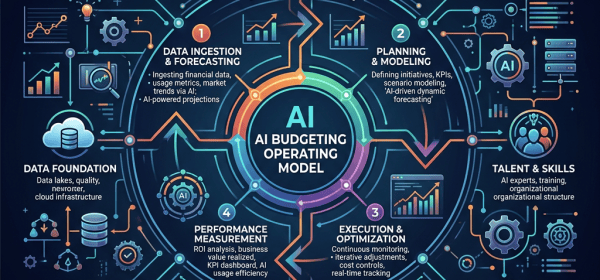
AI budgeting is becoming an operating-model challenge, not just a technology spend issue. CIOs need clearer ways to separate foundational investment, usage-based costs and vendor AI price increases if they want credible ROI, better governance and fewer surprises as adoption scales.

AI adoption is quickly becoming a test of leadership discipline, not just technical ambition. For CIOs, the real challenge is preventing fragmented experiments, weak governance and unclear accountability while building a value-led AI portfolio that balances speed, control and organisational readiness.

AI’s next challenge is not deployment but organisational redesign. For IT leaders, the real work is defining decision rights, accountability, oversight, and measurable business outcomes before AI sprawl turns promising pilots into unmanaged operational risk.

For CIOs, escaping the “IT person” label requires more than better messaging. It means reframing updates around enterprise trade-offs, shared accountability and business decisions so technology leadership is treated as strategic judgment, not just operational reporting.

Cyber incident disclosure is not just a legal or communications issue; it exposes whether security, legal, operations and leadership share a workable decision model. For IT leaders, the real challenge is building a repeatable notification process before the next ambiguous, high-pressure event arrives.

On July 25, Jeff Dean, a prominent Google engineer, addressed aspiring founders at Y Combinator’s Startup School before revealing his new venture, Discovery Loop. This startup aims to automate scientific methods, driven by Dean and fellow AI experts. Their goal is to revolutionize multiple fields through advanced machine learning and experimentation.

Agentic AI failure is often a process-design problem, not a model problem. For IT leaders, the real challenge is deciding where autonomy belongs, how to instrument it and which workflows are mature enough to handle machine-driven action without creating new operational risk.

Enterprise AI investment has shifted from hype to financial accountability, requiring CIOs to treat AI as a capital allocation challenge. With 59% of AI initiatives failing, organizations face a “proof gap.” Strategic leaders must focus on measuring outcomes, adopting disciplined frameworks, and evolving governance to ensure efficient decision-making and successful outcomes.