
Amazon EventBridge facilitates the construction of event-driven architectures through event routing, filtering, and transformation. CloudEvents provides an open-source format for interoperability, making integration easier. Using input transformers and API destinations, CloudEvents can be seamlessly published to downstream AWS services and third-party APIs, enhancing standardization and integration processes.
Tag: IT cloud computing
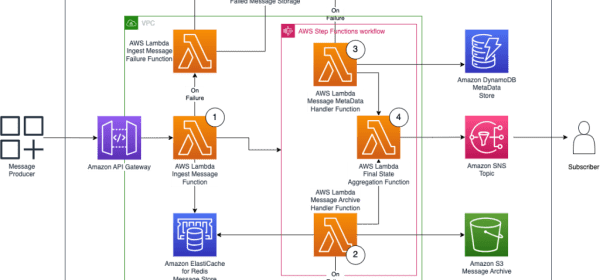
Building a serverless pipeline to deliver reliable messaging
This post discusses the challenges of providing audit trails for AI-assisted decision-making systems and presents a serverless architecture for reliable, performant, and traceable audit processing. It outlines the system’s architecture, data structures, solution walkthrough, deployment steps, testing methods, and concludes by highlighting the use of serverless services for scalable and reliable audit systems.

Databases architecture design
This article provides an overview of Azure database solutions, including RDBMS, big data, and NoSQL workloads. It offers resources to learn about Azure databases and paths to implement suitable architectures. Microsoft Learn provides learning paths for data professionals. Best practices for database design and management are also highlighted. For more information, visit the provided link.

SaaS and multitenant solution architecture
The article introduces the use of SaaS, startups, and multitenancy in software delivery. It explains that SaaS is a business model, startups are early-stage businesses, and multitenancy allows sharing components between tenants. The guidance is aimed at organizations building SaaS solutions. It also clarifies Microsoft Entra ID’s use of the term “tenant.”
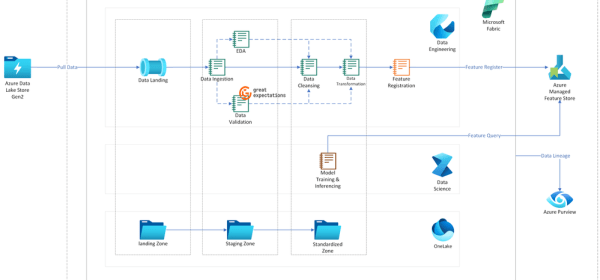
Build Your Feature Engineering System on AML Managed Feature Store and Microsoft Fabric
This article explains the process and benefits of building a feature engineering system using Azure Machine Learning managed feature store and Microsoft Fabric. It outlines the data flow, components, data validation, feature store, model training process, data lineage, potential use cases, and related resources for implementing the system effectively.

Search and query an enterprise knowledge base by using Azure OpenAI or Azure AI Search
This article discusses using Azure OpenAI Service and Azure AI Search to enable a ChatGPT-style question and answer experience for enterprise data. It covers two approaches: using Azure OpenAI embeddings for vectorized data and utilizing Azure AI Search for search and retrieval. The solution involves document ingestion, translation, vectorization, and query processing.
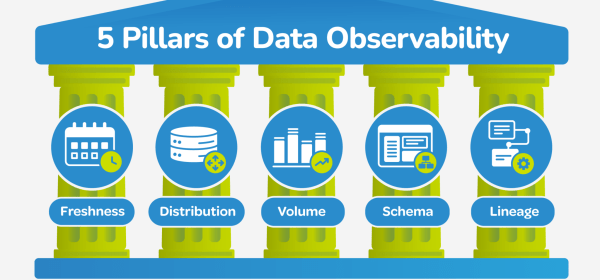
What Is Data Observability? An Essential Guide
Data observability provides comprehensive visibility into an organization’s data health, enabling prompt identification of discrepancies, pinpointing root causes, and enforcing corrective measures. The five pillars – freshness, distribution, volume, schema, and lineage – offer vital insights into data integrity. Implementing a data observability framework and leveraging reliable tools empower organizations to address issues swiftly.

A Reference Architecture for Siemens and Microsoft Customers in the Industrial AI Space.
This article introduces a reference architecture for integrating Siemens Industrial AI products with Azure. It enables seamless data flow from Siemens edge devices to Azure, simplifying monitoring and deployment of machine learning models. The architecture addresses challenges such as model visibility in Azure and ingestion of edge logs and metrics. It ensures reliability, security, cost optimization, operational excellence, and performance efficiency.

Mistral AI models now available on Amazon Bedrock
Mistral AI models are now available on Amazon Bedrock, offering high-performance options like Mistral 7B and Mixtral 8x7B. Users can access these models through the Amazon Bedrock console and programmatically using AWS CLI and SDK. The models excel in text generation, personalization, and code completion, making them versatile for various AI applications.

Monitor your AWS resources on your mobile device with AWS Console Mobile Application
AWS customers are utilizing AWS User Notifications through the AWS Console Mobile App to monitor vital AWS resources and receive real-time notifications. Users can configure push notifications for Amazon CloudWatch alarms, allowing them to promptly address issues from their mobile devices. This solution enhances resource monitoring and remedial actions for AWS users on the go.
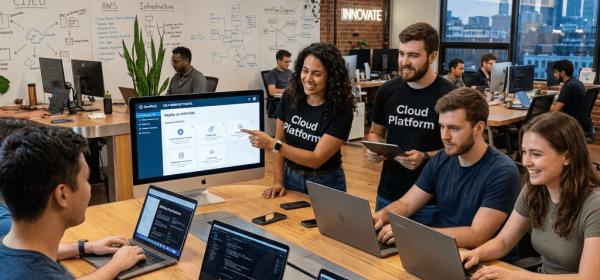
Delivering Business Value with Cloud Platform Teams
In the era of the cloud platform team, developers build on self-service infrastructure. Platform teams create tools and automation to empower developers and alleviate their workload. Challenges include indirect ROI, autonomy, and friction between teams. Best practices involve customer-centric design, decentralized decision-making, and measuring developer velocity to demonstrate impact.

Top Architecture Blog Posts of 2023
In 2023, the AWS Architecture Blog highlighted its top 10 posts, covering serverless retail solutions, intelligent document processing, disaster recovery, Kubernetes workload failures, event-driven architectures, ETL frameworks, AWS Step Functions, Well-Architected Framework updates, and multi-tenancy. The revamped 2022 post on cloud resiliency patterns also earned top honors. Additionally, special mentions were made for three older popular posts.
How to Determine the Right Cloud Deployment Model for Your Company
The most optimal cloud deployment model can significantly impact digital businesses. Understanding public, private, hybrid, and multi-cloud options is crucial for informed decision-making. Factors such as security, scalability, cost-effectiveness, and existing IT infrastructure influence the selection process. Partnering with an experienced cloud software development company can provide expert assistance for optimal deployment.
How EverQuote Underwent a Serverless Transformation using AWS
EverQuote, a leading online insurance marketplace, faced challenges modernizing their primary website to drive innovation and customer experience improvements. After evaluating architectural options, they transitioned to a powerful serverless infrastructure using AWS Lambda and other AWS services. This transformation resulted in significant performance improvements, a 7-11% increase in conversion rates, and approximately 400% cost savings.