Azure Purview can automatically discover, catalog, classify, and manage data across Microsoft SQL offerings, whether on-premises or in Azure.
The volume of data being generated globally is growing at an ever-increasing pace. Data is generated to support an increasing number of use cases, such as IoT, advertisement, gaming, security monitoring, machine learning (ML), and more. The growth of these use cases drives both volume and velocity of streaming data and requires companies to capture, processes, transform, analyze, and load the data into various data stores in near-real time.
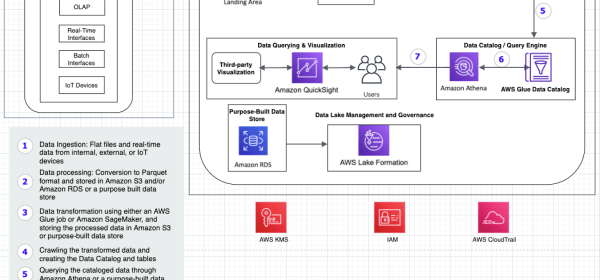
In recent years, the demand for business users to be able to consume, transform, model, and visualize large amounts of complex data from multiple heterogeneous sources has increased dramatically. To meet this demand in a cost-effective, scalable way, many large companies have benefitted from moving to cloud-based data platforms.
To show you how easy and quick it is to get started on AWS, we provide a one-click deployment for an extensible trading backtesting solution that uses Kinesis long-term retention for streaming data.
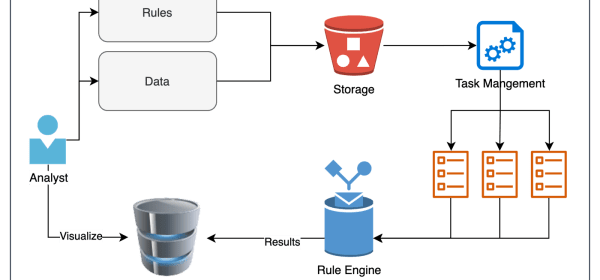
Businesses collect more and more data every day to drive processes like decision-making, reporting, and machine learning (ML). Before cleaning and transforming your data, you need to determine whether it’s fit for use. Incorrect, missing, or malformed data can have large impacts on downstream analytics and ML processes. Performing data quality checks helps identify issues earlier in your workflow so you can resolve them faster. Additionally, doing these checks using an event-based architecture helps you reduce manual touchpoints and scale with growing amounts of data.
With AWS Glue DataBrew, you can now easily transform and prepare datasets from Amazon Simple Storage Service (Amazon S3), an Amazon Redshift data warehouse, Amazon Aurora, and other Amazon Relational Database Service (Amazon RDS) databases and upload them into Amazon S3 to visualize the transformed data in a dashboard using Amazon QuickSight or other business intelligence (BI) tools like Tableau.
Data lakehouses are underpinned by a new open system architecture that allows data teams to implement data structures through smart data management features similar to data warehouses over a low-cost storage platform that is similar to the ones used in data lakes
I’m on a journey to help make machine learning (ML) and artificial intelligence (AI) more accessible to everyone.
This post uses the AWS CLI to establish cross-account audit logging for Amazon Redshift, as illustrated in the following architecture diagram.
Some of the most critical aspects of DaaS offerings are ease of management, security, cost-efficiency, workload isolation, and high resiliency and availability.
Recently, we helped a customer who was building their data warehouse on Amazon Redshift and had the requirement of using Microsoft Azure Active Directory (Azure AD) as their corporate IdP with MFA. This post illustrates how to set up federation using Azure AD and AWS Identity and Access Management (IAM). Azure AD manages the users and provides federated access to Amazon Redshift using IAM.
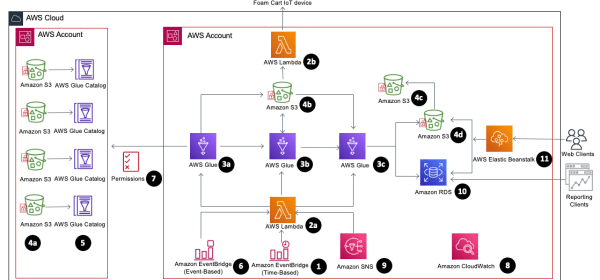
Many applications perform scheduled tasks. For instance, you might want to automatically publish an article at a given time, change prices for offers which were
The Global Investment Research (GIR) division at Goldman Sachs  is responsible for providing research and insights to the firm’s clients in the equity, fixed income, currency, and commodities
Apache HBase  is a non-relational database. To use the data, applications need to query the database to pull the data and changes from tables. In this