For technology leaders, the value of this piece is not in consumer psychology itself but in the mechanism it names: people rarely frame questionable choices as deliberate rule-breaking. They reclassify, rationalise or shift standards until the behaviour feels acceptable. In IT organisations, that matters because the same pattern can show up in privacy decisions, data handling, procurement exceptions, shadow IT, or “temporary” controls that become normal practice.
The management implication is that ethics and compliance fail less from policy absence than from threshold drift. If teams can repeatedly explain away minor exceptions, the organisation’s practical standard quietly moves. CIOs, CTOs and risk leaders should ask where that drift is already visible: Which exceptions are approved so often they function as policy? Which metrics reward speed or cost reduction without weighting control failures, customer harm or regulatory exposure?
This also points to a governance trade-off. Tightening controls can reduce rationalisation opportunities, but overly rigid processes can drive work into informal channels and make exceptions harder to see. The practical question is not simply whether to allow flexibility, but how to make exception handling explicit, time-bound and reviewable. That means clearer decision rights, named owners for risk acceptance, and a visible record of why a deviation was accepted and when it will be revisited.
For transformation leaders, the next questions are behavioural as much as procedural: how are leaders modelling boundaries, what language is used to justify shortcuts, and who challenges “everyone does it” reasoning? A strong control environment depends on tone, escalation routes and incentives that make it easier to surface uncomfortable trade-offs early rather than normalise them after the fact.
A look at the strategies consumers use to justify actions that conflict with their values.
Have you ever splurged on luxury products you couldn’t afford, turned down a donation request or indulged in unhealthy food while on a diet? You’re not alone. Even with the best intentions, people can behave in ways that – by their own and societal standards – are “bad” and have negative consequences for themselves, others and society.
Most of us want to see ourselves as good, virtuous people, but the choices we make can sometimes clash with this desired self-image. How do we reconcile this tension? In a paper published in Consumer Psychology Review, I introduce the Pathways for Avoiding Self-Sanction (PASS) model, which explains how consumers can escape guilt or self-punishment when they fall short of their own standards for good behaviour.
What does it mean to be virtuous?
Many consumers don’t have a problem with maintaining their standards for good behaviour – they may enjoy nutritious food or genuinely want to help others in need. However, at times, some people may feel tempted to buck these standards, leading them to act in ways they perceive as wrong, sinful or simply bad.
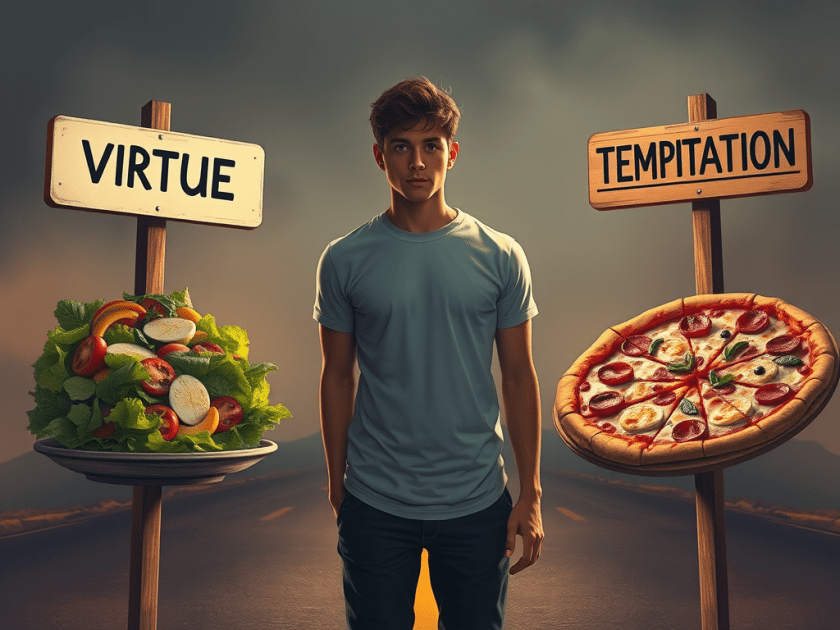
These situations typically involve either self-control or moral conflicts. The former arise when people must choose between short-term pleasure and long-term goals. Here, examples of virtuous choices include picking a salad over a pizza, saving money instead of overspending, and investing in experiences that support personal growth rather than pure enjoyment. In all these cases, consumers must forsake immediate gratification to benefit their future self.
Moral conflicts come into play when consumers need to weigh others’ or society’s welfare against their self-interest. Most people would like to view themselves as having good moral character. To maintain this self-image, they must avoid actions that signal disregard for the well-being of others and society and behave in ways that show they care – think volunteering, donating to charity and buying ethical products.
As defined in my study, someone is virtuous when they meet their subjective self-standards for self-control and moral character. But what happens when consumers are tempted to violate these standards by streaming content illegally instead of paying for it or skipping their weekly workouts to relax on the couch? Failing to resist temptation – and realising they’ve fallen short of their own standards – triggers self-sanction, where people judge themselves as lacking self-control, acting out of self-interest or even behaving unethically.
Avoiding self-sanction
When individuals knowingly breach their own behavioural standards, they anticipate the self-sanction that follows. In order to enjoy the benefits of these violations without the guilt, they may employ pre-emptive strategies.
This is where the PASS model comes in. It’s centred on the idea that consumers have a personal self-sanction threshold – the point at which they shift from seeing themselves as good to bad. These thresholds vary by individual and context. For instance, people may have higher diet and fitness standards when they need to lower their cholesterol or stricter moral standards when they know they’re being observed by others.
The PASS model assumes that people start on – and are motivated to stay on – the virtuous side of the boundary. When tempted to engage in behaviours that could push them to the “bad” side, they may follow one of three routes to avoid self-sanction: the self-based path, the behaviour-based path or the threshold-based path.
- Self-based path
Consumers may raise the level of their perceived virtue before breaking a standard, creating a buffer that lets them engage in bad behaviour afterwards without crossing their self-sanction threshold. By evaluating themselves as more virtuous initially, they feel entitled to – or even deserving of – a lapse they may otherwise avoid.
They can achieve this through virtuous actions (e.g. donating to charity before overspending), by perceiving themselves as making strong progress towards worthy goals, or by convincing themselves that they’ll engage in future good behaviour. These strategies elevate their initial self-assessment of how virtuous they are, so that subsequent violations don’t push them into “bad” territory.
- Behaviour-based path
Alternatively, people can reinterpret bad behaviour so that it no longer crosses their self-sanction threshold. Some downplay the severity of their actions by stretching or redefining the rules around what counts as a violation. Others shift how much responsibility they feel for their actions or take steps to minimise their agency (e.g. as my Original Postii/S002210311630021X?via%3Dihub" shape="rect">
other work shows, physically avoiding someone who seems to be soliciting donations).
Another strategy is to downplay the perception of harm caused by their actions, either by discounting negative consequences or exaggerating positive ones. As an example, people could justify not giving money to charity by questioning whether the organisation would use it effectively, or emphasise the benefits of sweatshop labour as a source of income and development in emerging economies when tempted by fast fashion. They could also partake in unethical consumption, such as returning used clothing against store policy, to “punish” the company if its corporate stance on a sociopolitical issue is opposed to their own.
- Threshold-based path
Consumers can also adjust their standards for what counts as a violation. In these cases, they may acknowledge the negative consequences of their behaviour, but either temporarily or permanently move their self-sanction threshold to allow for it.
They may do this on special occasions, on designated “cheat days”, if they believe they’ve experienced unfair suffering, or if they anticipate future regret about missing out on having fun in the present. People also take cues from those around them: seeing others litter, overeat or engage in disorderly acts might make them more likely to perceive this as acceptable. They may even encourage others to join in, thereby moving their own threshold to allow them to indulge as well.
Getting away with it
The PASS model offers an explanation for why consumers purchase unsustainable products, support unethical business practices, overeat, overspend and watch trashy reality shows – even if these actions contradict their self-standards for virtue.
It sheds light on how, in a world where consumers face increasing pressure to be ethical – be it by adopting more sustainable habits, supporting minority-owned businesses or advocating for moral causes – individuals can avoid “walking the talk” without suffering self-judgement. It might also explain why people give in to other harmful consumption patterns, such as excessive drinking, drug use or gambling.
Beyond consumer behaviour, the model also illuminates how industry practitioners avoid self-sanction for ethically questionable behaviour. Marketers or salespeople, for instance, may employ strategies to justify violating users’ privacy or misrepresenting attributes of their products, while maintaining a positive view of themselves.
The PASS model provides a flexible, comprehensive framework to explain how individuals navigate the evolving realm of virtuous consumption. By adopting the strategies outlined above, consumers can give themselves permission to engage in behaviours they might otherwise avoid – essentially allowing them to have their cake and eat it, too.
Edited by:
Rachel Eva Lim
About the author(s)
is an Assistant Professor of Marketing at INSEAD.
-
https://knowledge.insead.edu/marketing/how-do-we-excuse-our-bad-behaviour
Related