
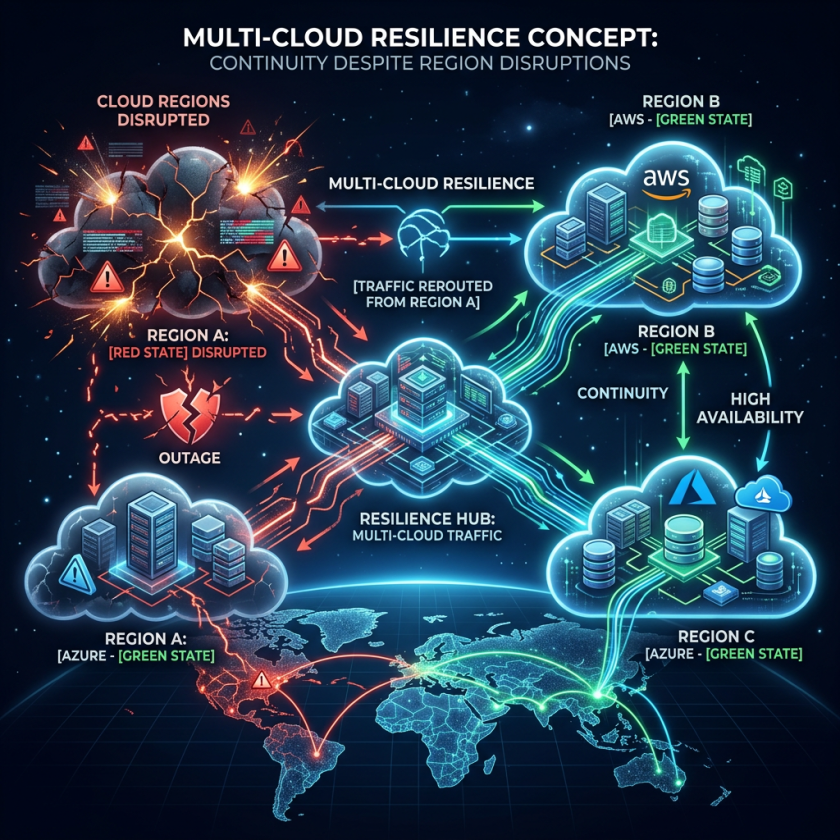
For the better part of a decade, the enterprise has embraced a convenient illusion: that the cloud is borderless. We spoke of availability zones and regions as if they were abstract logical constructs rather than physical buildings filled with servers, cables and cooling fans.
The blueprint for cloud resilience has long been built on a simple promise: geographic redundancy through availability zones. These physically separate data centers — all located within the same region — were designed to isolate failures. The theory was solid: An outage in one facility, whether from a software glitch or a severed power line, would not affect the others.
But that model is now being invalidated by a new class of systemic threats. Whether triggered by natural disasters, cascading grid failures or geopolitical conflict, these large-scale events can overwhelm an entire region at once
This regional model also contains a flawed assumption: that recovery tools will be available when needed. In reality, a provider’s management infrastructure often becomes a casualty of the very outage it is meant to manage. The subsequent advice for businesses in the UAE was simple: migrate to another region. For a regulated entity like a bank or hospital, data residency mandates mean there is no other region to migrate to, as data needs to stay within regional borders.
This scenario serves as a critical simulation for U.S. businesses in sectors like finance and healthcare, exposing a strategic blind spot many have yet to address. If a primary cloud provider in a key region is compromised, you aren’t just facing a delay; you are facing a total cessation of business with no legal escape.
The cost of the wait-and-see strategy
The core challenge in a regional outage is not a lack of technology, but the “fog of war.”
Most disaster recovery plans exist as static documents or runbooks in a digital folder. When a region goes offline, engineers are forced to improvise. They must build new network paths, reconfigure security tunnels and redirect traffic; all while the business is losing millions per hour.
The ongoing crisis reveals that recovery in these scenarios takes days, not minutes. That is because the “roads” between different cloud providers hadn’t been built yet. Attempting to build a bridge while the shoreline is on fire is a recipe for failure.
The pillars of modern data center resilience
The definition of reliability must evolve. True resilience is now about vendor portability; how easily you can move among clouds. Networking is no longer just plumbing; it is your insurance policy for business continuity.
To withstand future volatility, enterprise design must be upgraded in three specific ways:
-
Establish an escape hatch: Prebuild and encrypt connectivity between different cloud environments at the very start. Waiting for a crisis to connect to a secondary provider guarantees failure.
-
Separate the “brain” from the blast radius: Host your monitoring and command center in a completely different geography from your data. This ensures you maintain visibility when local infrastructure crumbles.
-
Automate your failover: A disaster recovery plan must be executable code, not a PDF. Resilience should be triggered with a single command, removing improvisation and human error.
Multi-cloud networking makes this possible. It creates a unified overlay that links a primary site to a standby site from a completely different provider. In this model, if a provider’s infrastructure fails, the network automatically reroutes all traffic in under 60 seconds. For organizations with data residency rules, this allows a split-compute strategy; keeping data local while shifting processing elsewhere. This approach turns a catastrophic recovery into a manageable, two-minute transition.
Incidents like the disruption in the United Arab Emirates demonstrate precisely why cloud strategy has moved from the IT basement to the boardroom. The strategic objective has therefore shifted: It is not enough to be “on the cloud”; enterprises must be architected to operate at a layer above it, creating a unified presence insulated from any single provider’s failure.
How resilient is your cloud infrastructure? Share your thoughts at [email protected].
Enjoyed this article? Sign up for our newsletter to receive regular insights and stay connected.