
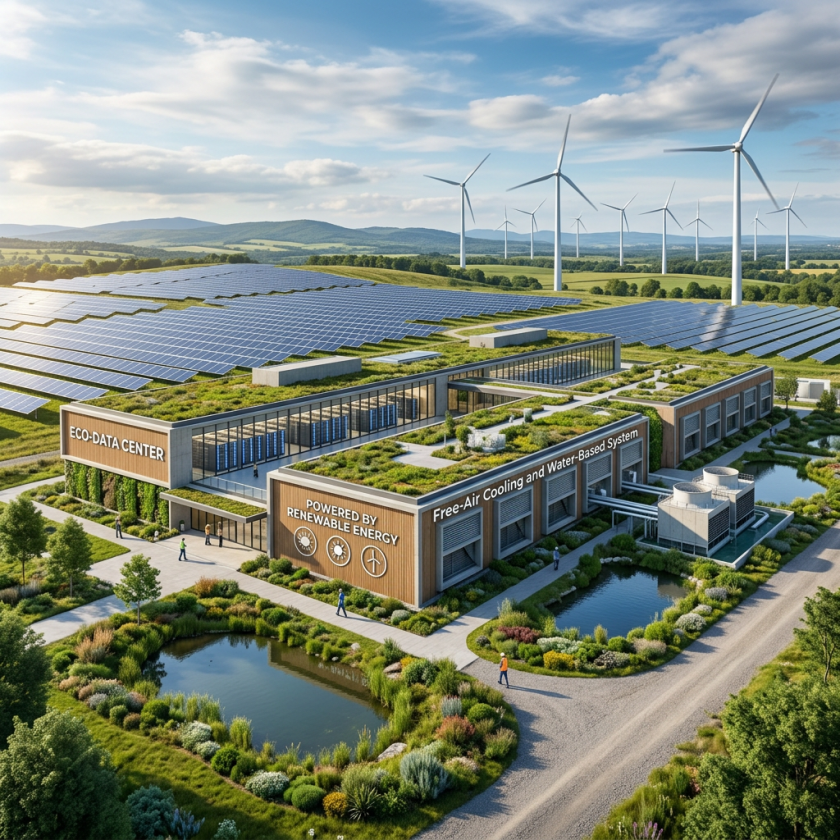
When I think about a sustainable data center, I think about more than just lowering the electric bill. To me, a sustainable data center is one designed and operated to reduce environmental impact while still delivering the performance the business needs.
That means using energy and water more efficiently, extending the life of equipment, reducing waste and finding smarter ways to cool and power critical infrastructure. A green data center is not defined by any single technology. It is the result of many decisions working together to make daily operations more responsible and resource-efficient.
Sustainability matters in data centers because their environmental footprint is outsized compared with their physical size. Even though data centers make up a tiny fraction of the world’s buildings, they consume a significant share of global electricity. That demand continues to rise as AI, cloud services and digital applications expand.
Related:Will 2026 be the year of data center restructuring?
I see two main reasons for this high energy use:
-
First, the hardware itself requires enormous amounts of power to run; and
-
Second, all of that equipment generates heat that must be removed continuously to keep systems stable.
Cooling is one of the biggest sustainability challenges. Traditional air conditioning can be extremely energy-intensive, and in some facilities, the cooling process also depends heavily on water. In large-scale environments, water consumption can become a major local issue, especially in regions already dealing with scarcity.
E-waste is also a major part of the sustainability conversation. Servers, storage arrays and networking hardware contain valuable materials that require significant energy and resources to mine and manufacture.
Practical steps toward data center sustainability
One of the first areas I look to improve is energy sourcing. Renewable energy can dramatically reduce a data center’s carbon footprint, whether it comes from on-site generation or through the utility provider.
Cooling strategy is another area offering significant opportunity. In the right climate, free cooling can reduce dependence on mechanical air conditioning by using naturally cold air or water to remove heat. That can lower operating costs and emissions. In higher-density environments, liquid cooling often makes even more sense. Techniques such as direct-to-chip cooling or immersion cooling are far more efficient at transferring heat than air, especially for compute-intensive workloads.
I also believe waste heat should be treated as a resource, not just a byproduct. In some cases, excess heat from the data center can be redirected to nearby buildings, industrial systems or community heating networks. Water recycling can help reduce pressure on local supplies, and thermal storage or cogeneration can create additional efficiency gains. These approaches require planning and investment, but they show how a data center can contribute positively beyond its own walls.
Inside the IT environment, we need to focus on using hardware more efficiently. Virtualization remains one of the most practical ways to reduce physical infrastructure requirements by consolidating workloads onto fewer machines. That lowers power consumption, reduces cooling needs and can delay unnecessary hardware purchases.
At the same time, I pay close attention to power usage effectiveness (PUE) because it gives me a useful measure of how efficiently the facility supports IT operations. Lowering PUE does not solve every sustainability issue, but it is an important indicator that the data center is using less energy for overhead.
Lowering PUE does not solve every sustainability issue, but it is an important indicator that the data center is using less energy for overhead.
Extending asset life is another principle I prioritize. Hardware does not become environmentally responsible simply because it is replaced with something newer. In many cases, maintaining, refurbishing or redeploying equipment can be more sustainable than constant refresh cycles.
Responsible IT asset disposition is essential when systems truly reach end of life. I want equipment to be sanitized, reused when possible and recycled properly when reuse is no longer viable. There is also value in purchasing quality pre-owned equipment when appropriate, because it keeps usable devices in circulation and reduces demand for newly manufactured products.
Sustainable operations begin with culture as much as technology. If the people designing, maintaining and operating the data center do not understand sustainability goals, progress will be inconsistent. Teams need training, clear expectations and leadership support so environmental impact becomes part of everyday decision-making. That includes choices about vendors, maintenance practices, cooling upgrades, energy contracts and procurement standards.
Not every facility can become highly sustainable overnight. That is why I would start with a feasibility assessment to identify what changes are practical, cost-effective and meaningful. Industry frameworks such as ISO 14001, ISO 50001, greenhouse gas accounting standards and green building certifications can help guide that work. Metrics matter as well. I want to track PUE, renewable energy usage, water consumption, heat output and recycling rates so I can measure progress rather than rely on assumptions.
Finally, sustainability is a continuous process rather than a finished state. There will always be new opportunities to improve efficiency, adopt better technologies, reduce waste and lower emissions. The most sustainable data centers are not the ones that make one big change and stop. They are the ones that keep evolving, measuring and improving over time.
What’s your advice for achieving a sustainable data center? Share them with us at [email protected].
Enjoyed this article? Sign up for our newsletter to receive regular insights and stay connected.