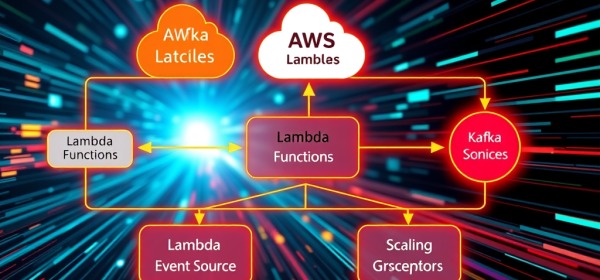
Improving throughput of serverless streaming workloads for Kafka

This post discusses optimizing AWS Lambda for processing Kafka stream records, focusing on high throughput and scalable consumption. It highlights two modes: on-demand and Provisioned Mode, detailing filtering, batching strategies, and performance metrics for efficient processing. Best practices are offered to improve performance while handling varying workloads effectively.
Continue reading

New Apple Study Shows LLMs Can Tell What You’re Doing from Audio and Motion Data

Apple researchers published a study examining how large language models (LLMs) can analyze audio and motion data for activity recognition. Integrating LLMs with traditional sensor data improves accuracy in identifying user activities. Using the Ego4D dataset, the study demonstrates LLMs’ potential to enhance activity analysis, even with limited data.

Continue reading

Microsoft Foundry: Scale innovation on a modular, interoperable, and secure agent stack

Microsoft Foundry is revolutionizing enterprise intelligence, allowing developers to create adaptable and intelligent agents through a secure, modular platform. Recent advancements include over 11,000 models, enhanced AI tools, and improved integration with Microsoft 365, empowering businesses to easily modernize applications and improve collaboration between developers and security teams.

Continue reading

Build production-ready applications without infrastructure complexity using Amazon ECS Express Mode

Amazon ECS Express Mode simplifies deploying containerized applications by automating infrastructure setup, including load balancing and auto scaling, through a single command. This feature allows developers to focus on application development while adhering to AWS best practices. It supports Infrastructure as Code and incurs no additional costs beyond standard AWS resources.

Continue reading

Introducing attribute-based access control for Amazon S3 general purpose buckets

Managing permissions for Amazon S3 storage resources is complex, especially in multi-tenant environments. The introduction of attribute-based access control (ABAC) allows organizations to use tags for simplifying user and role access permissions. This feature enhances security governance while reducing administrative tasks, making it easier for large organizations to manage permissions effectively.

Continue reading

The Trillion Dollar Problem

In a midsize SaaS company, disparate analytics tools lead to conflicting data interpretations between teams. The implementation of a semantic layer can resolve these discrepancies by establishing a single source of truth for metrics, enhancing data trust, and streamlining updates. This enables consistent, efficient, and self-service analytics across various platforms.

Continue reading

Three kinds of AI products work

The evolution of AI products shows three main successful types: chatbots like ChatGPT, coding completions such as GitHub Copilot, and agentic products that automate tasks. While chatbots often struggle against competition, agentic products are emerging in coding. There’s potential in AI-generated feeds and gaming, though clear strategies are still needed.

Continue reading

Vintage Large Language Models

The talk discusses vintage large language models (LLMs), which are trained on historical data, exploring challenges such as data contamination and the need for extensive datasets. These models offer potential in scientific forecasting and humanistic interactions, enabling insights into past knowledge. However, significant obstacles include data requirements and training costs.

Continue reading

RAG: The Intelligence Layer That Will Redefine AI’s Future in 2025 and Beyond

Retrieval-Augmented Generation (RAG) is revolutionizing AI by addressing the limitations of traditional language models, enhancing accuracy and real-time intelligence. RAG systems retrieve relevant information to ground responses in verifiable knowledge, significantly reducing errors. This architecture is rapidly gaining adoption, ensuring AI’s reliability and adaptability in critical applications and environments.

Continue reading

Can AgentFold Solve Search for Web Agents?

The AgentFold paper addresses the challenges of memory management in web agents, which either overload on details or oversimplify important information. By implementing a “context folding” approach, AgentFold allows agents to dynamically decide what to retain, compress, or consolidate, improving performance in long-horizon tasks without excessive infrastructure costs.

Continue reading

Snowflake Accelerates Data Migration with Datometry Technology

Snowflake is enhancing its AI Data Cloud by acquiring Datometry’s technology, which will expedite migrations from legacy systems like Teradata by up to four times and reduce costs by 90%. The integration aims to simplify code conversion and accelerate customer data journeys, while leveraging Datometry’s expertise for innovative solutions.

Continue reading

1 32 33 34 35 36 172