
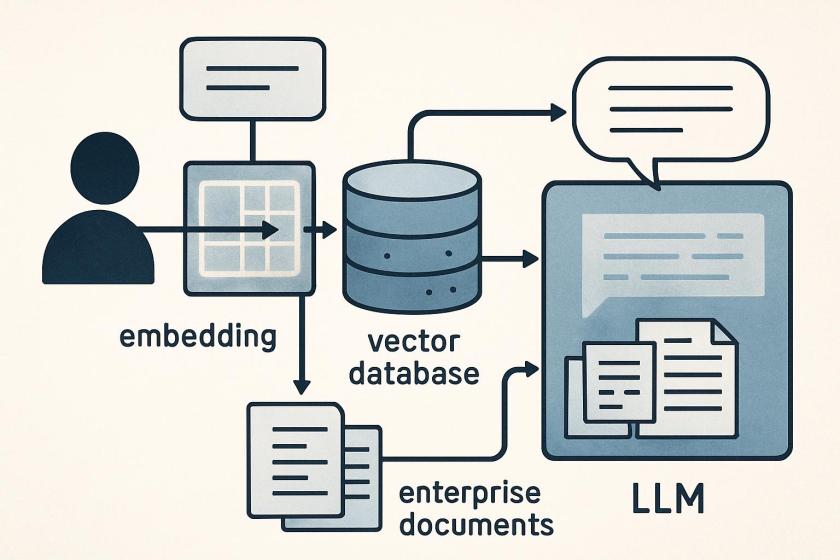
RAG changes the deployment model for enterprise AI. Instead of treating the LLM as the primary source of truth, teams must design a retrieval stack that feeds it current, governed context. That introduces architectural dependencies on document ingestion, chunking strategy, embedding generation, vector search, and source ranking. In practice, the quality of the retrieval layer can matter as much as the model itself.
The integration challenge is usually bigger than the model choice. RAG has to connect with existing knowledge systems such as file stores, content platforms, ticketing tools, policy repositories, and live business systems. That means dealing with inconsistent document formats, access control inheritance, metadata quality, and update latency. If those inputs are weak, the assistant may still sound confident while being grounded in incomplete or stale evidence.
From an operations perspective, RAG adds observable failure modes that teams need to monitor. Retrieval misses, poor context assembly, and prompt-overrun can all degrade answer quality without obvious service errors. Engineering teams will need evaluation pipelines, relevance testing, and traceability for which sources were used, especially where compliance, auditability, or regulated decisions are involved. The system is only as trustworthy as its evidence chain.
Security and governance become core design concerns. A retrieval layer can surface sensitive material if permissions are not enforced end to end, and real-time data access can widen the blast radius of misconfiguration. For that reason, RAG is not just an AI pattern; it is an enterprise architecture pattern that pushes identity, data governance, and reliability controls into the center of the GenAI stack.
What Exactly Is RAG?
Retrieval-Augmented Generation (RAG) enhances a large language model by giving it the ability to retrieve relevant information before generating an answer. Instead of relying solely on its training data, a RAG-enabled AI system searches through:- private knowledge bases
- business documents
- PDFs, manuals, and wikis
- research papers and reports
- vector databases
- real-time data sources
RAG effectively turns an LLM into a dynamic research engine.
How RAG Works
┌───────────────────────┐
 │ User Query │
 └───────────┬───────────┘
 ▼
 ┌───────────────────────┐
 │ Embed the Query │
 └───────────┬───────────┘
 ▼
 ┌──────────────────────────┐
 │ Retrieve Relevant Chunks │
 │ (Vector Database Search) │
 └───────────┬─────────────┘
 ▼
 ┌──────────────────────────┐
 │ Augment Model Context │
 │ (Add Retrieved Evidence) │
 └───────────┬─────────────┘
 ▼
 ┌───────────────────────┐
 │ LLM Generates │
 │ Evidence-Grounded │
 │ Output │
 └───────────────────────┘
Why RAG Matters Today
1. Static LLMs Cannot Stay Up to Date
LLMs are trained once. Their knowledge quickly becomes outdated:- new regulations
- new research
- internal company updates
- product changes
- evolving market data
2. RAG Reduces Hallucinations Dramatically
Hallucinations — plausible but incorrect answers — are a major barrier to reliable AI. A 2024 study found:- RAG-based systems improved factual accuracy by 10–20%
- In healthcare and legal domains, accuracy exceeded 91%
- Hallucinations dropped by 30–60% depending on the implementation
3. Adoption Is Growing at Record Speed
According to Grand View Research:- RAG market size in 2024: USD 1.2 billion
- Projected by 2030: USD 11+ billion
- CAGR: 49.1%, one of the fastest in AI
4. RAG Makes AI More Efficient
Instead of relying on massive, expensive models, organizations can pair:- smaller LLMs + large retrieval databases
5. Transparency and Explainability
RAG can show exactly which documents were used to answer a question. This is essential for:- compliance
- audits
- legal workflows
- enterprise governance
- safety-critical systems
The Road Ahead: How RAG Will Evolve in the Coming Years
The future of Retrieval-Augmented Generation is expanding far beyond today’s basic “retrieve and generate” pipeline. RAG systems will become more intelligent, multimodal, and autonomous — capable of handling complex tasks across diverse information formats. One major direction is multimodal RAG, where AI retrieves not only text, but also images, charts, audio recordings, videos, and structured datasets. This will enable deeper, context-rich reasoning — such as analyzing financial charts while cross-referencing written commentary, or interpreting product manuals alongside diagrams. Another major shift will be agent-driven RAG. Instead of relying on a single retrieval step, future systems will operate in loops: retrieving, verifying, refining, cross-checking sources, and producing answers with stronger evidence. This transforms AI into a dynamic research assistant rather than a one-shot responder. We will also see the rise of real-time RAG, where AI accesses live data streams, market updates, operational logs, and CRM changes, making its output truly current. Combined with the next generation of small, efficient models, on-device RAG will become mainstream, enabling secure and private AI directly on phones, laptops, and enterprise servers. Finally, hybrid architectures that merge RAG + fine-tuning will define next-generation intelligence: models that possess deep domain knowledge while continuously updating themselves through real-time retrieval. This hybrid approach will shape AI systems that are grounded, adaptive, and aligned with mission-critical information. Retrieval-Augmented Generation is not just an innovation — it is a turning point in how AI connects to real-world information. By blending the creativity of generative models with the reliability of retrieval systems, RAG offers accuracy, transparency, and adaptability that standalone LLMs cannot achieve. As enterprises expand their AI capabilities and as personal agents become more widespread, RAG will become the essential architecture enabling factual, real-time, trustworthy intelligence. The next era of AI will not be defined by model size alone, but by how well models can retrieve, understand, and apply knowledge. And RAG is the technology that makes that future possible.Enjoyed this article? Sign up for our newsletter to receive regular insights and stay connected.