
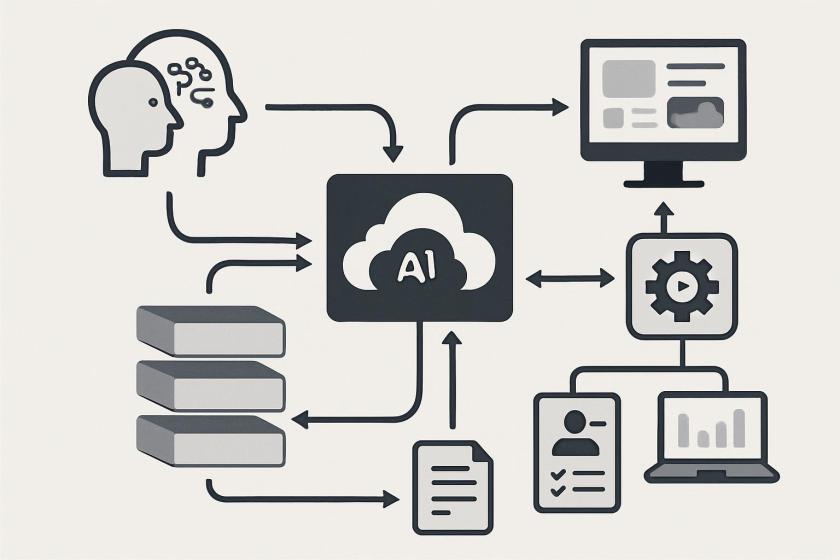
The practical signal here is not just model availability, but platform consolidation. Putting Claude and GPT frontier models behind Microsoft Foundry changes how teams design AI systems: model selection becomes a policy and routing problem inside one control plane, rather than a series of separate integrations, identities, and runtime conventions. For architects, that reduces surface area while increasing the importance of consistent governance, endpoint management, and workload separation.
Foundry’s Agent Service, MCP connectivity, and model router point to a pattern where agents are composed from reusable tools and governed execution paths. That creates a stronger fit for enterprise workflows than prompt-only applications, but it also introduces new dependencies: tool registration, API permissions, context handling, and traceability across multi-step actions. In practice, the hard part shifts from building a single model call to managing how the agent reaches data, systems, and deployment pipelines safely.
Operationally, the main trade-off is flexibility versus standardization. Modular Claude Skills, version control, and shared governance can improve reuse and consistency, yet they also require teams to treat agent behavior like production software: reviewed, tested, monitored, and updated. The more these skills are chained across workflows, the more reliability depends on clear ownership, rollback paths, and observability across each step.
There is also a cost and latency dimension. A router that can direct requests to different Claude tiers makes economic sense, but only if teams define when speed, reasoning depth, or cost efficiency should dominate. For cloud and platform teams, the strategic value lies in building AI systems that can be controlled centrally while still adapting dynamically to task complexity, security constraints, and changing business demand.
“We’re excited to use Anthropic Claude models from Microsoft Foundry. Having Claude’s advanced reasoning alongside GPT models in one platform gives us flexibility to build scalable, enterprise-grade workflows that move far beyond prototypes.” — Michele Catasta, President, Replit
Meet the Claude models: AI that delivers real results
According to Anthropic, Claude models are engineered for the realities of enterprise development, from tight integration with productivity tools to deep, multi-document research and agentic software development across large repositories.| Model | Strengths | Ideal use cases |
|---|---|---|
| Claude Haiku 4.5 | Fastest, most cost-efficient | Powering free tier user experiences, real-time experiences, coding sub-agents, financial sub-agents, research sub-agents, business tasks |
| Claude Sonnet 4.5 | Smartest model for complex agents and coding | Long-running agents, coding, cybersecurity, financial analysis, computer use, research |
| Claude Opus 4.1 | Exceptional model for specialized reasoning tasks | Advanced coding, long-horizon tasks and complex problem solving, AI agents, agentic search and research, content creation |
Evolving from monolithic apps to intelligent agents
Across the tech landscape, organizations are embracing agentic AI systems. Early studies show AI agents can help boost efficiency by up to 30% for teams and stakeholders. But the challenge for most enterprises isn’t building powerful apps; it’s operationalizing them and weaving them into real workflows. Industry surveys point to a clear pattern. 78% percent of executives say the primary barrier to scaling AI impact is integrating it into core business processes. Microsoft is uniquely positioned to address this integration gap. With Foundry, we’re bringing together leading-edge reasoning models, an open platform for innovation, and Responsible AI all within a unified environment. This empowers organizations to experiment, iterate, deploy, and scale AI with confidence, all backed by robust governance and security. This means building AI solutions that are not only powerful, but practical and ready to deliver impact at scale.“Manus deeply utilizes Anthropic’s Claude models because of their strong capabilities in coding and long-horizon task planning, together with their prowess to handle agentic tasks. We are very excited to be using them now on Azure AI Foundry!” — Tao Zhang, Co-founder & Chief Product Officer, Manus AI.
Claude in Foundry Agent Service: From reasoning to results
Inside Foundry Agent Service, Claude models serve as the reasoning core behind intelligent, goal-driven agents. Developers can:- Plan multi-step workflows: Leverage Claude in Foundry Agent Service to orchestrate complex, multi-stage tasks with structured reasoning and long-context understanding
- Streamline AI integration with your everyday productivity tools: Use the Model Context Protocol (MCP) to seamlessly connect Claude to data fetchers, pipelines, and external APIs, enabling dynamic actions across your stack.
- Automate data operations: Upload files for Claude to summarize, classify, or extract insights to accelerate document-driven processes with robust AI.
- Real-time model selection: Using the model router, customers can soon automatically route requests to Claude Opus 4.1, Sonnet 4.5, and Haiku 4.5. Lowering latency and delivering cost savings in production.
- Govern and operate your fleet: Foundry offers unified controls and oversight, allowing developers to operate their entire agent fleet with clear insight into cost, performance, and behavior in one connected view.
Claude Skills: Modular intelligence you can compose
With the Claude API, developers can define skills modular building blocks that combine:- Natural-language instructions,
- Optional Python or Bash code, and
- Linked data files (templates, visual assets, tabular data, etc.), or APIs
Custom Deep Research: Context that connects beyond a single prompt
Claude’s Deep Research capability extends model reasoning beyond static queries. It allows agents to gather information from live sources, compare it with internal enterprise data, and produce well-reasoned, source-grounded insights. This transforms agents from simple responders into analytical systems capable of synthesizing trends, evidence, and context at scale. Pricing| Marketplace Models | Deployment Type | Azure Resource Endpoints | Input/1M Tokens | Output/1M Tokens |
| Claude Haiku 4.5 | Global Standard | East US 2, West US | $1.00 | $5.00 |
| Claude Sonnet 4.5 | Global Standard | East US 2, West US | $3.00 | $15.00 |
| Claude Opus 4.1 | Global Standard | East US 2, West US | $15.00 | $75.00 |
Looking ahead
Our partnership with Anthropic is about more than just bringing new models to Foundry. It’s about empowering every person and organization to achieve more with AI. We look forward to seeing how developers and enterprises leverage these new capabilities to build the next generation of intelligent systems. Ready to explore Claude in Foundry? Start building today and join us in shaping the next generation of intelligent agents. Tune in to Ignite for more exciting Microsoft Foundry announcements: register today. The post Introducing Anthropic’s Claude models in Microsoft Foundry: Bringing Frontier intelligence to Azure appeared first on Microsoft Azure Blog.Introducing Anthropic’s Claude models in Microsoft Foundry: Bringing Frontier intelligence to Azure
Enjoyed this article? Sign up for our newsletter to receive regular insights and stay connected.