
Developed Market Public Debt: Risks And Realities

One underappreciated point for ETF investors is that “developed market debt” is not a single risk bucket. Country-specific fiscal rules, maturity structures and investor bases can create very different bond experiences even when the headline label looks similar. For portfolio builders, that matters because concentration in one sovereign market can leave duration exposure more tied to a single policy regime than many investors realize.
The next issue is the mix of rate risk and fiscal risk. When deficits stay elevated, longer-dated yields may embed a larger term premium over time, but that does not automatically mean every sovereign bond is impaired. The more practical question is how much compensation an investor is receiving for extending duration versus how much of the yield is being driven by issuance needs, central-bank normalization or inflation uncertainty. That distinction is especially important when comparing short, intermediate and long duration exposures.
For ETFs, structure can matter as much as macro views. A broad developed-market government bond fund can spread exposure across issuers, but it may also dilute the intended defense of the allocation if the investor is seeking a specific duration profile or currency stance. Investors should think about whether they are using sovereign bonds as a ballast, a source of yield, or a relative-value allocation. Those objectives call for different portfolio roles, not just different tickers.
Finally, rebalancing discipline remains central. If sovereign spreads widen or yields move higher, the impulse is often to abandon duration altogether. But in long-term portfolios, the more durable response is usually to revisit the source of the risk, the maturity mix, and the level of diversification already embedded elsewhere in the allocation. Developed-market debt may be a less dramatic story than the headlines suggest, yet it still requires a deliberate role in fixed-income construction.
Fiscal strains unveiled
As the world emerged from the pandemic, many feared that higher interest rates would cripple the private sector. These concerns, it turns out, were largely misplaced. Tight monetary conditions have not triggered broader financial instability. Systemic risks to global banking and nonbank financial markets appear contained. Households are borrowing less, and although there are pockets of weakness in the corporate sector, overall corporate debt has fallen in recent years. Instead, the public sector has borne the brunt of the post-pandemic financial strain. In developed markets, government debt sustainability has worsened in three key areas. First, large stimulus packages since 2020 – such as stimulus checks, furlough schemes, and energy subsidies – have significantly increased the stock of public debt. While inflation has eroded some of this increase, government debt as a proportion of GDP in advanced countries remains close to record highs, at levels only seen after World War II (see Figure 1). Figure 1: Developed market public debt is close to record-high levels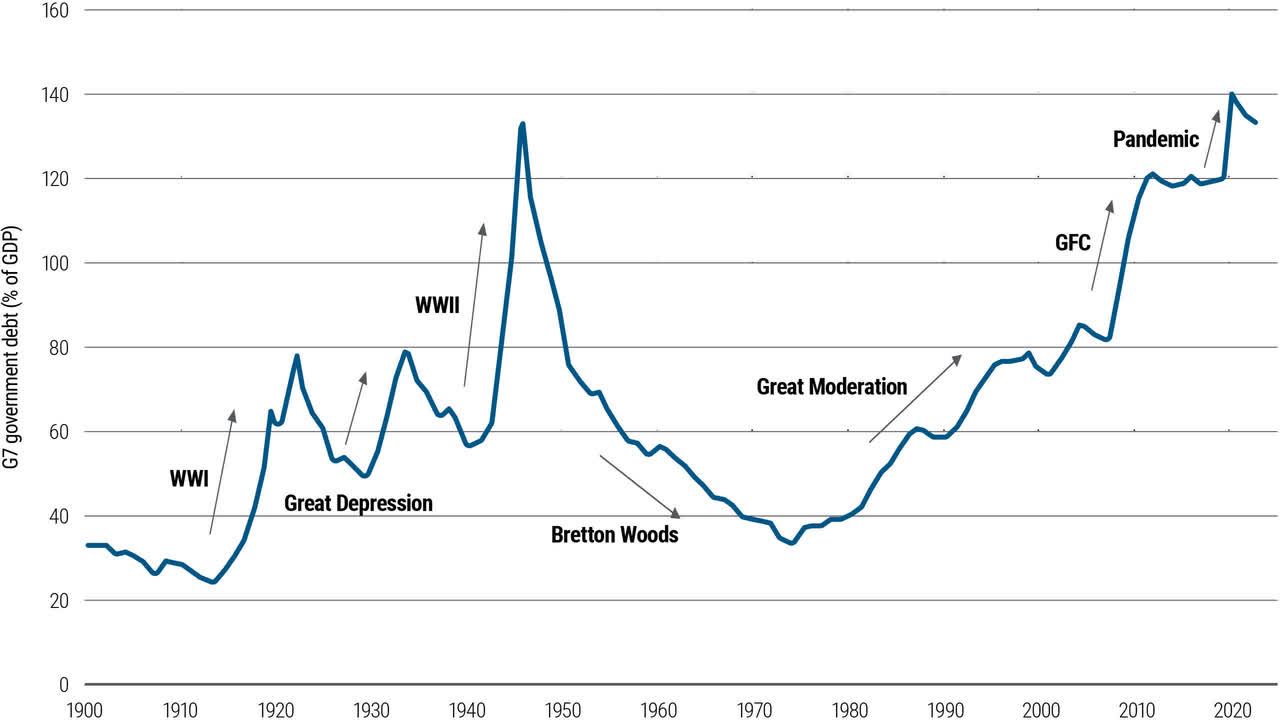 Source: International Monetary Fund (IMF) Public Finances in Modern History, IMF World Economic Outlook, Jordà-Schularick-Taylor (JST) Macrohistory Database, PIMCO calculations as of 16 April 2024. Chart plots annual data through 2023 for debt-to-GDP ratio for the G7 countries, GDP weighted. G7 countries are Canada, France, Germany, Italy, Japan, the U.K., and the U.S. GFC is the global financial crisis of 2008–2009.
Second, the flow of public borrowing remains high. Although deficits have fallen since the height of the pandemic – unsurprisingly, as the pandemic-related measures were not repeated – primary deficits (adjusted for interest costs) in advanced countries remain higher than pre-pandemic levels.
And third, interest rates have surged, compounding the cost of servicing deficits. Unlike in most of history, interest rates may soon exceed GDP growth in many countries, a threshold above which debt dynamics tend to become less stable. Central bank quantitative easing (QE) – a purchasing program that swaps fixed-rate government bonds for floating-rate interest-paying reserves – has accelerated this process, as higher interest rates have quickly translated into increased borrowing costs. Many developed market central banks are now incurring losses as a result.
Developed market debt dynamics by country
In many developed countries, government debt sustainability is not a concern. Debt levels in many euro area countries as well as the Nordics, Australia, New Zealand, and Switzerland are too low to pose any immediate threat to fiscal credibility. The outlook is more precarious in countries with higher debt, such as France, Spain, Italy, the U.K., and Japan. These countries will likely have limited fiscal capacity to address future downturns, and a high starting level of debt increases vulnerability to new shocks (as evidenced by recent volatility in French borrowing costs amid election uncertainty). And if these countries continue to struggle with low growth over the longer term, then their fiscal outlooks could worsen. However, fiscal dynamics in these countries still appear broadly sustainable. While debt levels may not fall in coming years, they are unlikely to rise dramatically, either. The specifics vary by country. Italy, for instance, borrows at high interest rates relative to its growth and has substantial debt, but it also has a long history of running primary surpluses. Japan, in contrast, tends to run larger deficits and has a much higher debt load, but it borrows at low interest rates, making its debt dynamics more manageable. Importantly, these countries generally intend to tighten their fiscal belts. For some, this reflects political willingness; for others it reflects binding fiscal constraints. Many euro area countries were recently placed into Excessive Deficit Procedure – a corrective fiscal rule by the European Union that pressures them to adopt tighter policies. The U.K., meanwhile, looks set to run contractionary fiscal policies ahead, likely influenced by the negative market reaction to the Liz Truss budget in 2022 (which included significant tax cuts and increased spending, but lacked a clear funding plan). Markets are also likely to continue to discipline these governments going forward, helping keep a lid on high levels of fiscal stress and volatility.The U.S. stands out, but remains the “cleanest dirty shirt”
The outlier among developed economies is the U.S., where debt is on a sharply increasing trend. At face value, the dynamics look worrisome. The stock of debt relative to GDP is comparable to many other advanced countries, even lower than some. But the budget deficit – currently around 6-7% of GDP (see Figure 2) – is much wider than that of other countries, especially compared with underlying activity. For example, today’s low U.S. unemployment rate of 4% would typically correspond to a deficit half that size. Figure 2: U.S. government deficit outweighs its G7 peers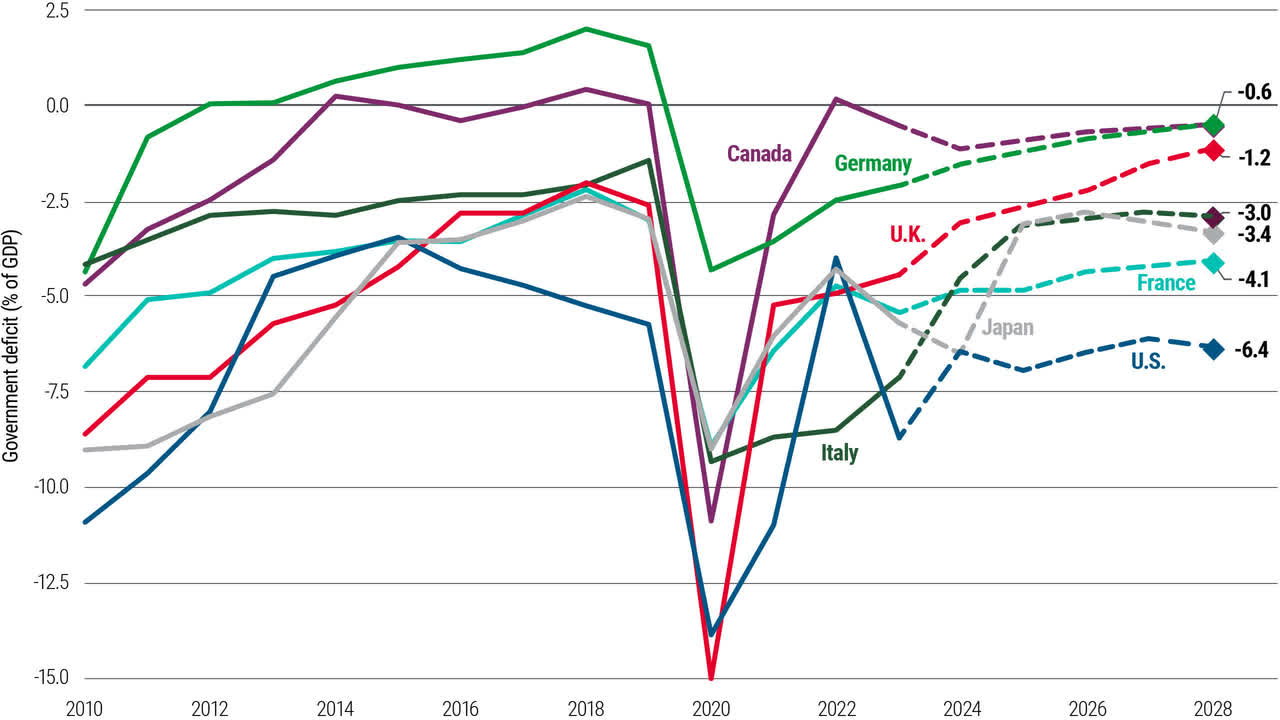 Source: International Monetary Fund (IMF) World Economic Outlook data as of 16 April 2024, U.K. Office for Budget Responsibility (OBR) data as of 6 March 2024, PIMCO calculations. Chart plots annual government deficit-to-GDP ratio for G7 countries, plus projections (dashed line) from the IMF (and OBR for the U.K.).
While issuance of net debt is high (required to fund budget deficits), gross issuance of new debt to roll over existing debt has also surged. The U.S. Treasury Department has shifted much of the increase in gross issuance into the (short-term) Treasury bill market. But with an inverted yield curve, shifting issuance into the T-bill market has pushed interest payments on the debt even higher.
Worse, unlike other developed markets, there appears to be little appetite to tighten the fiscal stance. Many U.S. policies on immigration, trade, and regulation will hinge on the November election. But regardless of the party composition of Congress or the White House, the deficit will likely remain broadly unchanged in coming years – and even increase a bit if the Trump tax cuts are extended at the end of 2025. (For details, watch this recent video with Libby Cantrill, PIMCO’s head of public policy: “Structural Issues May Keep U.S. Deficit Elevated.”)
Consequently, the U.S. government debt-to-GDP ratio is poised to increase sharply, much more so than in other countries (see Figure 3).
Figure 3: Debt is falling in several developed market countries, stable but vulnerable in some, and potentially explosive in the U.S.
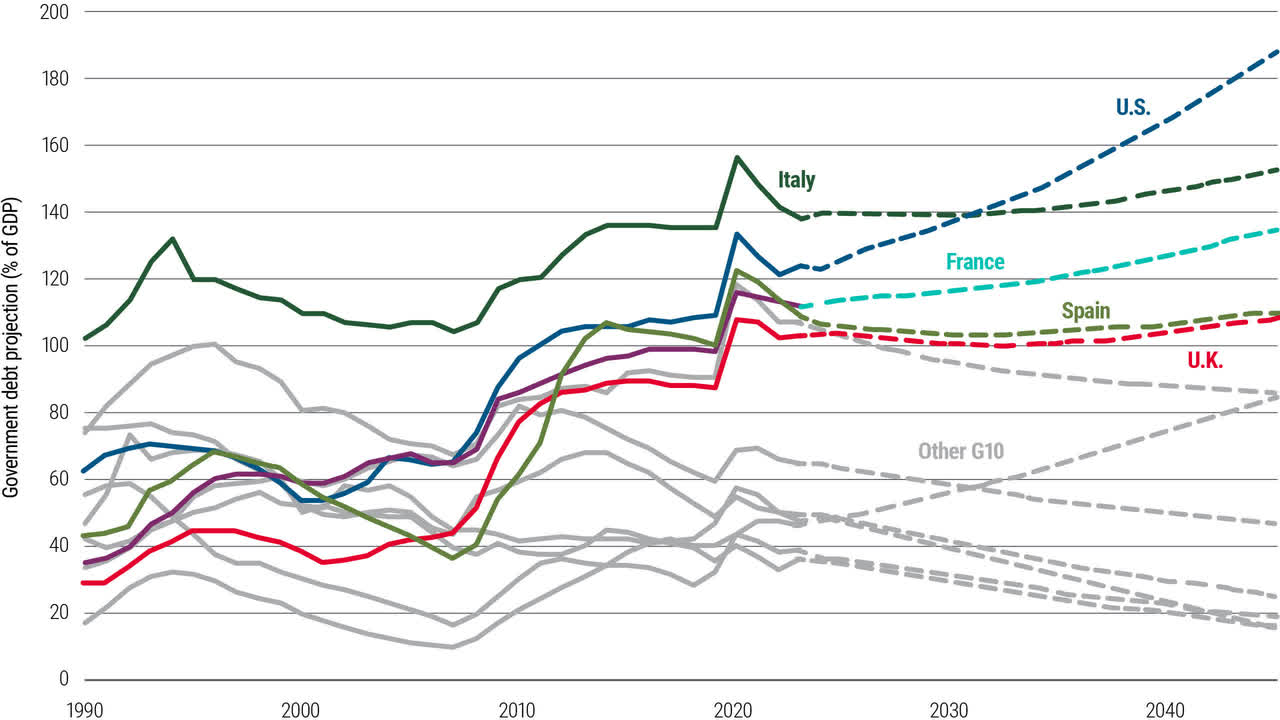 Source: International Monetary Fund (IMF) World Economic Outlook, Bloomberg, PIMCO calculations as of 5 July 2024. The chart plots actual debt-to-GDP ratios through 2023, then projections based on these assumptions: The primary balance evolves as in IMF projections up until 2028, after which it stays static; inflation is at the central bank target; real GDP growth is at trend; and interest rates evolve along the forwards priced into financial markets on 5 July 2024, assuming a weighted average maturity of 7 years across countries. “Other” countries shown are Australia, Canada, Germany, the Netherlands, New Zealand, Sweden, and Switzerland.
However, a deeper look at the U.S. fiscal situation reveals a less gloomy picture. True, debt (a stock variable) relative to GDP (a flow variable) has surged in the past decade. But relative to net national wealth (a stock variable) – a more apples-to-apples comparison – public debt has actually fallen. Growth in the economy’s capital stock has outpaced public borrowing since 2011.
The U.S. also faces less binding fiscal constraints than other countries. While the supply of debt is crucial, so is the demand for it. As the supplier of the global reserve currency and perceived safe assets, the U.S. enjoys higher demand for its liabilities than other countries.
Moreover, the U.S. tax burden – around 30% of GDP – is low compared with other countries and its own history (see Figure 4). This means the U.S. is unlikely to hit upper-bound constraints on taxation (in economic jargon: “Laffer Curve constraints”). Contrast this with many European countries, where the tax burden is much higher and, in some cases, at multi-decade highs, leaving less room to adjust taxes in response to fiscal needs.
Figure 4: Relative to other G7 countries, the U.S. tax burden is far from facing upper-bound constraints
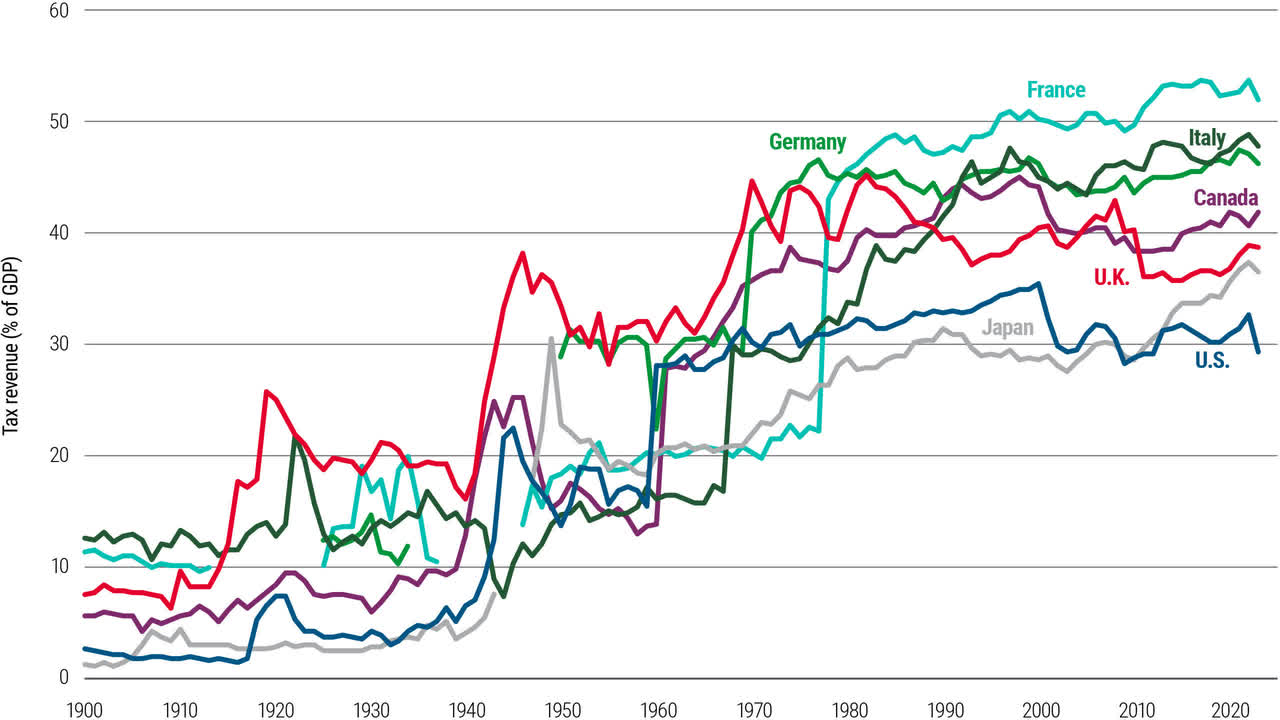 Source: International Monetary Fund (IMF) Public Finances in Modern History, IMF World Economic Outlook, PIMCO calculations as of 16 April 2024. Chart plots annual data through 2023 of tax revenue for the general government as a percentage of GDP.
Investors are therefore likely to grant more fiscal credibility to the U.S. than other countries. To some extent, this is nothing new: the Congressional Budget Office (CBO) has projected an ever-increasing U.S. debt path for over a decade, yet financial markets have been largely unmoved.
Future of U.S. debt
What does that mean for U.S. debt in coming years? For the reasons outlined above, the overall baseline outlook is likely one of status quo: the deficit remains high, debt continues to climb, and demand for U.S. Treasuries stays robust, in part because of the U.S. dollar’s status as global reserve currency. The term premium – a measure of the compensation investors demand for the risk of holding longer-term bonds – could rise modestly amid potentially greater macro uncertainty as well as rising U.S. debt (learn more about the term premium in PIMCO’s recent article, “Will the True Treasury Term Premium Please Stand Up?”). But the macro cycle matters too: We anticipate the Federal Reserve will begin to lower interest rates – probably as early as this year – once policymakers are confident inflation is returning more sustainably toward target. If neutral interest rates remain low, this could potentially improve the U.S. fiscal outlook to some degree, even amid modestly higher term premia (learn more about PIMCO’s outlook for neutral policy rates in our Secular Outlook, “Yield Advantage”). Debt cannot rise infinitely, however. At some point, policy or prices will likely need to adjust to make the U.S. fiscal path more sustainable. The most likely long-term solution – perhaps over the supersecular horizon (beyond, say, ten years) – is some form of debt consolidation through entitlement spending reforms or higher taxes. While that seems unlikely now, attitudes may change over time, especially if inflation and interest rates remain at – or return to – uncomfortably high levels. History is not always a strong predictor, but it can offer a guide, and over the last century the U.S. has often tightened fiscal policy when high rates appeared to constrain fiscal policy or growth. Interest payments as a share of federal expenditures have foreshadowed previous periods of fiscal consolidation (see Figure 5). Currently, interest payments account for close to 14% of total U.S. expenditures and are rising sharply. Previous episodes when interest payments reached similar levels were followed by fiscal consolidation: after WWII (with financial repression as well), under Reagan in the late 1980s, and under Clinton in the 1990s. Figure 5: Rising interest payments have preceded previous episodes of significant fiscal tightening in the U.S.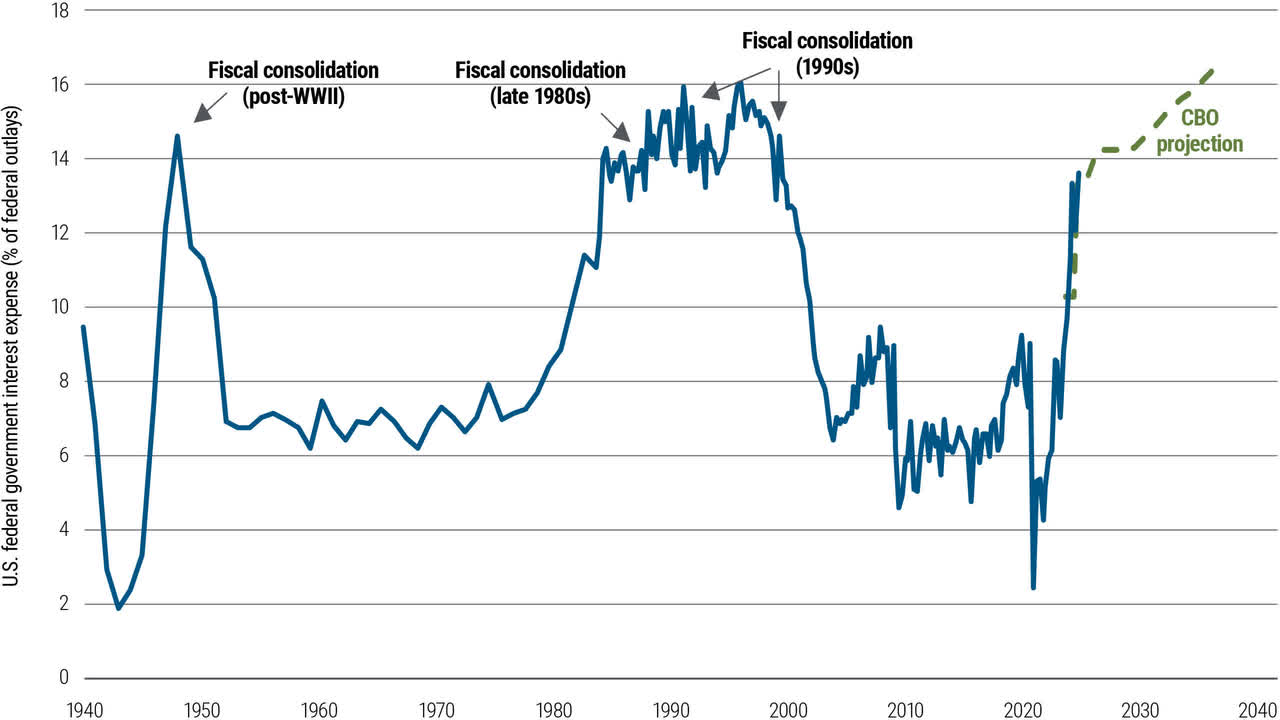 Source: U.S. Treasury, U.S. Office of Management and Budget, U.S. Congressional Budget Office (CBO) projections, PIMCO calculations as of March 2024
In summary, while the timeline for fiscal reform may be supersecular – the Social Security Trust Fund, for example, is projected to run out of its reserves in 2035 – Congress has a long history of adjusting fiscal policy accordingly when conditions change, with varying degrees of impact. Just how dramatic any future tightening could be would depend on an array of macro trends – growth, productivity, inflation, demographics, trade, geopolitics – along with the political will and appetite of leaders in Washington.
Assessing the risks of unlikely U.S. debt paths
A status quo path of rising debt that leads eventually (over the very long run) to a pivot toward some degree of fiscal constraint is our base case for the U.S. economy. That said, it’s worth considering a few unlikely risk scenarios. First, the most disruptive case: a sudden and disorderly loss in fiscal credibility, with demand for U.S. Treasuries drying up and the term premium rising sharply. This scenario is highly unlikely. The U.S. issues liabilities in its own currency, and since the Federal Reserve effectively can print dollars, we see no risk of a nominal default on U.S. Treasuries. The dollar’s role as global reserve currency, the general dynamism of the U.S. economy, and less binding fiscal constraints also make a disorderly fiscal crisis very unlikely. Second, a fiscal dominance scenario: Policymakers resort to high inflation to erode the nominal value of the debt stock. This is also unlikely. Inflation is an unpopular policy choice, and inflation alone is unlikely to sustainably erode debt because borrowing costs tend to increase too. Long-term fixed liabilities help, as they take time to roll over at a higher interest rate, but post-pandemic QE has shortened the overall maturity of U.S. government liabilities. As a result, for inflation to sustainably erode debt, it must be accompanied by low interest rates – so that the real inflation-adjusted interest rate is negative – likely through financial repression or yield curve control. These measures were common after WWII, and even then, most countries that successfully reduced debt also cut spending. However, today’s institutional credibility around Fed independence appears stronger, as evidenced by long-term inflation expectations anchored around the Fed’s target, even amid well-above-target inflation in the past couple of years. While central banks may tolerate slightly above-target inflation (“2-point-something”) for a while, they are unlikely to let inflation expectations drift meaningfully higher. Third, a more benign prospect: The U.S. debt path improves thanks to notably higher growth in real activity. This is unlikely as well. While there may be reasons to expect GDP growth to pick up over time – such as AI boosting productivity – trend GDP growth would have to more than double from current levels to flatten the debt trajectory. Higher growth would increase tax receipts but would likely raise borrowing costs too.Investment implications
Our long-term outlook for debt across developed countries informs several takeaways for portfolios:- Amid elevated debt and deficits, we expect more market volatility ahead, as financial markets become more sensitive to fiscal and political shocks. The recent volatility in French sovereign spreads is a case in point.
- More limited fiscal space will tend to constrain fiscal policies in future downturns. Coupled with QE fatigue, we expect less volatility-suppressing policies in coming years, which adds to a more volatile macro outlook. We may see a gradual increase in the term premium, but this would not be a sign of waning confidence in the creditworthiness of the U.S. government, in our view.
- We expect developed market interest rates to fall over the secular horizon. That’s partly because fiscal policy will likely remain tight. But with higher fiscal deficits, the yield curve is likely to steepen, with short-maturity interest rates rallying more than long-maturity ones.
- Varying fiscal dynamics across countries also create relative value opportunities in global duration. We believe fixed income markets are poised to generate competitive returns and lower risk compared with other asset classes. At current levels and given the base case outlook, we see value in diversifying a bond portfolio beyond U.S. duration.
Enjoyed this article? Sign up for our newsletter to receive regular insights and stay connected.