
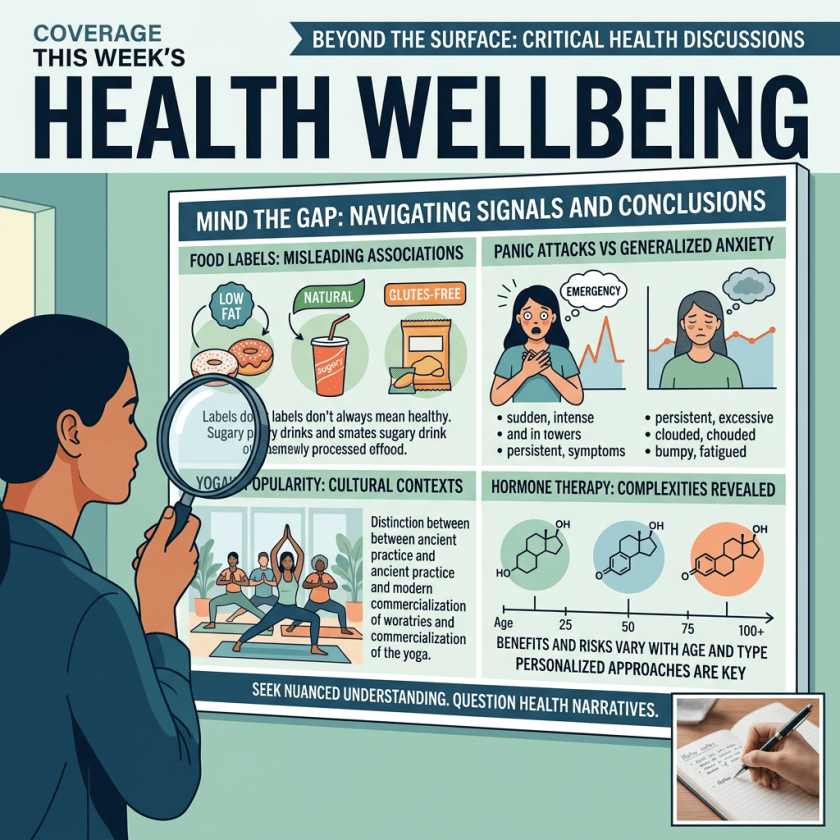
An editorial overview of the week’s key themes in Health Wellbeing
There is a particular kind of health headline that arrives fully formed, carrying its own conclusion. A sweetener causes heart attacks. A label means a food is good for you. A form of exercise is dying. This week’s Health Wellbeing coverage was, almost by accident, an extended argument against reading that way — eight pieces that each stop at the point where the evidence stops, and say so.
The clearest example came from the food aisle. A major study found that higher blood xylitol levels track with greater cardiovascular risk, a finding serious enough to warrant attention and thin enough that it cannot establish causation. The honest reading is not that xylitol is dangerous but that the reflexive equation of “sugar-free” with “healthy” has never had much behind it. Something similar applies to California’s newly passed non-ultraprocessed food seal, which may well become a blueprint for other states. A seal that certifies what a food is not is a real improvement on nothing, but it is not a statement about nutritional quality, and its usefulness will depend entirely on how tightly the standards are drawn and how shoppers learn to interpret it.
Mental health carried the bulk of the week, and the same discipline showed up in a different guise — as specificity. The most practically useful piece drew the line between panic attacks and generalized anxiety, two conditions that share a name and diverge in treatment. Chronic worry and acute panic episodes respond to different therapeutic approaches, which makes careful assessment the actual intervention and a generic anxiety plan a false economy. The same instinct runs through the reporting on peer support for postpartum depression, where the evidence is genuinely encouraging but the framing matters enormously. Peer connection reduces isolation and improves engagement with care; it does not replace clinical treatment, and scaling it without supervision or clear referral pathways would convert a promising model into a liability.
Anxiety also appeared this week in places it is not usually named. A study of organizational failure argued that unspoken leadership anxiety quietly converts change initiatives into blame, burnout and performative busyness — a claim worth taking seriously as a lens on workplace stress rather than as a complete theory of why transformations fail. At the individual scale, the examination of people pleasing and self-silencing made a distinction the wellness genre usually flattens: adapting to other people is ordinary social competence, and only becomes corrosive when it is chronic enough to erode boundaries and self-trust. The signal to watch for is not accommodation itself but the point at which it starts displacing your own values.
Two pieces rounded out the week by pushing back on tidy narratives from the physical side. The apparent decline of yoga, examined in What Happened to Yoga?, turns out to be a story about consumer demand and studio economics rather than about efficacy — closing studios say nothing about whether the practice works, and the more interesting question is how yoga sits alongside strength training and recovery in a routine somebody will actually sustain for decades. And the survey of hormone therapy’s effects beyond reproductive health does the careful work of sorting established outcomes from early signals, a distinction that matters more here than almost anywhere, given how wide individual variation runs and how consequential the trade-offs can be.
What connects a sweetener, a grocery label, a therapy protocol and a yoga studio is the gap between a signal and a conclusion. This week’s coverage lived in that gap deliberately — not out of caution for its own sake, but because most of the practical decisions readers face are made there. Knowing that xylitol is associated with cardiovascular risk and knowing that it causes it lead to different behaviour; knowing that your anxiety is panic rather than chronic worry leads to a different treatment. The useful skill is not certainty but knowing which one you are holding.
Full post index for this week:
- We actually know how to help mothers with postpartum depression · September 4, 2026
- How Leadership Anxiety Derails Transformation · September 4, 2026
- What Happened to Yoga? · September 4, 2026
- You’re a people pleaser? Here’s how to not lose yourself. · September 4, 2026
- The surprising ways hormones can change your body · September 4, 2026
- Xylitol linked to heart attacks and strokes in major study · September 3, 2026
- California passes non-UPF food seal, setting potential blueprint for other states · September 3, 2026
- Panic Attacks vs. Generalized Anxiety: Why Treatment Isn’t One-Size-Fits-All · September 3, 2026
Browse the full Health Wellbeing archive at genesis-aka.net/health-wellbeing/
Enjoyed this article? Sign up for our newsletter to receive regular insights and stay connected.