
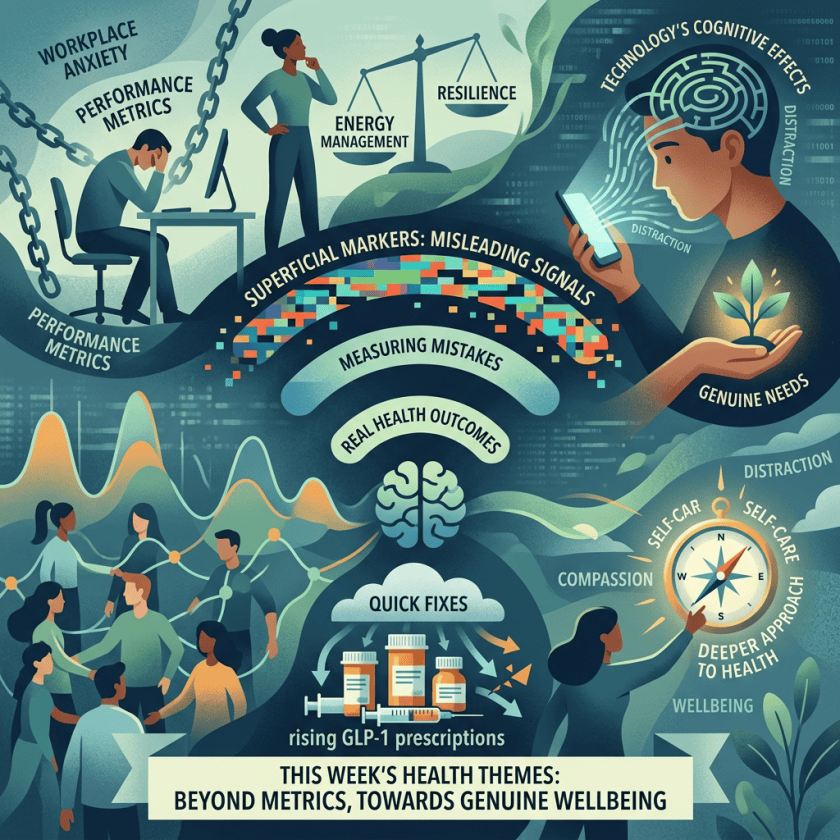
An editorial overview of the week’s key themes in Health Wellbeing
Health coverage spends a great deal of energy on signals — the visible marker that stands in for the thing we actually want to know. This week’s eleven posts, read together, form an unusually coherent argument about how often those signals mislead, and what it costs us when we mistake the proxy for the substance.
The clearest example arrives from the workplace, where anxiety can masquerade as commitment long enough to be rewarded. Visible effort reads as dedication; nobody audits what is driving it. The distinction matters because stress-fuelled output degrades on a delay — focus narrows, trust thins, and retention suffers well after the performance reviews have already been filed. The same confusion between engagement and evidence runs through the week’s technology stories. Immersive brain-training systems built on virtual reality are considerably more compelling than the neurofeedback that preceded them, but being absorbing is not the same as working. The harder questions — real-world outcomes, who experiences side effects, and how much neurological data users hand over once brain sensors reach consumer price points — remain conspicuously open.
Technology’s effect on the mind surfaced in a second, subtler form. The finding that conceding AI danger tends to raise rather than reduce public anxiety is worth sitting with, because it reframes risk communication as a wellbeing issue rather than a purely informational one. Repeated high-threat narratives register emotionally whether or not the underlying evidence supports them, and sustained exposure to unresolved fear has measurable effects on stress and attention. The practical response is not to look away but to distinguish verified risk signals from speculative worst cases — a media-diet discipline that looks a lot like the one this week’s other stories require.
Nowhere is that discipline more needed than in the 310-fold rise in GLP-1 prescriptions for young children. The multiplier is arresting and, on its own, almost meaningless. What decides whether this is a public health advance or a problem is everything the number omits: which children are receiving these drugs, how robust the long-term evidence actually is, and whether access, follow-up care and family circumstances are keeping pace with the prescribing. A comparable modesty governs the week’s nutrition coverage, where gut-friendly snack options are presented as a sensible upgrade rather than a microbiome overhaul. The benefit, if it comes, comes from repeatable combinations of fiber, protein and sometimes fermented foods — mediated throughout by individual tolerance, portion size and the surrounding diet.
Consumer culture has begun to notice the exhaustion all this measurement produces. The wellness brands riding the anti-optimization wave are selling relief from self-quantification, which is a genuine need and also, awkwardly, another product category. Commercial momentum is not evidence, and the open question is whether these offerings reduce stress or merely restate wellness pressure in gentler language.
Against that backdrop, the week’s personal essays carry the corrective. The three flows of compassion — giving, receiving, and turning it inward — offer a diagnostic with no dashboard attached: notice which direction feels hardest, especially where shame or habitual over-caretaking make support difficult to accept. Alanis Morissette’s account of postpartum depression that deepened with each birth makes the case that feeling frightened or persistently unwell after birth should be named rather than absorbed into normal adjustment. A couple approaching 60 on different terms demonstrate that shared routines and mutual support matter more than matching goals. And a writer living with a stress-sensitive disease draws the week’s most necessary line: stress may coincide with a flare without being its single cause, and the useful response is energy management and clear boundaries rather than self-blame.
Alan Watts, in the week’s quietest piece, describes stepping outside constant inner chatter — a prompt for attention, not a clinical protocol.
The through-line is scepticism about proxies. Effort is not health, immersion is not efficacy, a prescribing multiplier is not a verdict, and a brand’s growth is not proof. What survives the scrutiny is slower and less legible: compassion practised in the direction that resists it, symptoms named early, energy budgeted honestly, and attention returned to the present without a metric attached. That is harder to measure, which is rather the point.
Full post index for this week:
- How employee anxiety masquerades as performance, then backfires · Sep 17
- How virtual reality is changing brain-training technology · Sep 17
- The Three Flows of Compassion: Giving, Receiving and Self-Compassion · Sep 16
- GLP-1 prescriptions for young children up 310-fold · Sep 16
- Conceding AI Danger Raises, Not Reduces, Public Anxiety · Sep 16
- Alanis Morissette’s postpartum depression got worse with every baby · Sep 16
- My partner and I have different approaches to aging as we get closer to 60 · Sep 16
- The 9 Best Snack Options to Support Your Gut Health · Sep 16
- Meet the Wellness Brands Riding the Anti-Optimization Wave · Sep 15
- I live with a disease that worsens with stress. I ‘lean out’ when I can, but I can’t avoid it all. · Sep 15
- The Unspeakable World: Alan Watts on How to Touch the Pulse of Life · Sep 15
Browse the full Health Wellbeing archive at genesis-aka.net/health-wellbeing/
Enjoyed this article? Sign up for our newsletter to receive regular insights and stay connected.