
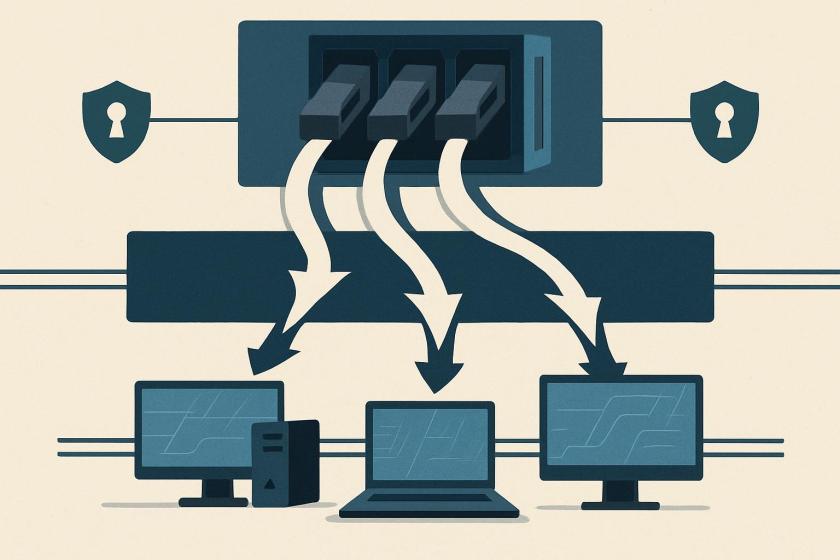
Enterprise AI rarely fails because of the model alone. The harder problem is stitching together compute, networking, storage, endpoint devices, and management controls so training, inference, and day-to-day user workflows can all operate against the same operational assumptions. For technical teams, that means AI strategy should be treated as an architecture program, not a point purchase.
The main design trade-off is concentration versus distribution. Pushing more work into a centralized data center can simplify control and utilization, but it can also amplify power, network, and capacity constraints. Moving some inference to endpoints or nearer to the workload can reduce latency and data movement, yet it raises new requirements for fleet management, patching, policy enforcement, and consistency across heterogeneous hardware.
Networking is not a secondary layer in AI systems. Once accelerators become the performance centerpiece, the surrounding fabric determines whether the platform scales cleanly or becomes bottlenecked by transfer overhead and CPU contention. Architects should evaluate how data flows between storage, accelerators, and applications, and whether the operational model can absorb growth without creating fragile, overcustomized islands of infrastructure.
Software openness and security controls matter as much as raw compute. Teams building on a broad hardware stack need a clear answer for portability, driver and runtime support, identity and device governance, and long-term maintainability. The practical test is whether the platform reduces technical debt while still leaving room for future model changes, workload shifts, and cross-team integration without re-architecting the entire environment.
Overcoming tech debt to build AI momentum
In AI, time-to-insight is critical for extracting meaningful value, but expanding it rapidly comes at an enormous cost for enterprises whose resources are tied up in existing IT infrastructure. And there’s no let-up: AI’s unquenchable need for computing power is projected to skyrocket, a McKinsey report found. In the next few years alone, data centers will need more than three times in capital expenditures as traditional IT applications. AMD Data Center Solutions help enterprises overcome tech debt and repurpose their budget for a seamless transition to an AI-ready foundation. AMD EPYC processors enable up to a 7-to-1 server consolidation and consume up to 68% less power with up to 78% lower TCO, approximations from AMD internal research found. This reduction in power consumption and operational cost opens up floor space and financial budgets for additional tasks. Other solutions in the AMD data center portfolio include AMD Instinct accelerators, the Pensando platform for networking, and ROCm, an open software stack that enables a wide range of GPU programming.How a heterogeneous hardware pipeline unlocks returns across the enterprise
AI’s ability to deliver real intelligence across an enterprise hinges on the flexibility of a company’s underlying infrastructure. Successful AI deployments must adapt to corporate goals and workloads across a full range of environments and devices. If performance falters anywhere along that chain, the entire return on investment can quickly erode. An enterprise’s AI hardware backbone needs the horsepower to handle large-scale workloads, while remaining flexible enough to grow alongside evolving technologies and business demands in a reliable and cost-effective way. The AMD portfolio is designed to underpin high-performance AI, no matter the workload demands. By adopting enterprise-grade systems backed by AMD Ryzen AI 7 PRO 350 processors, for example, organizations can save up to $53 million in employee time and upfront acquisition costs in the first year, compared to competitors.* Its GPUs, similarly, are tailored for a variety of performance levels and form factors, and its latest MI325X GPU accelerator sets new inference benchmarks, outperforming the competition by up to 40%.† Weak networking, however, can limit even the most powerful AI architectures. AMD addresses this with scale-out DPU and NIC solutions that accelerate AI applications through high-speed data transfer and by offloading networking tasks from the CPU, boosting performance for critical workloads. Beyond the data center, AI-enabled PCs are poised to transform how people work and interact with intelligent services. To support increasingly AI-driven applications, laptops built with either AMD Ryzen AI or Ryzen AI PRO processors have a dedicated neural processing engine that offloads tasks from the CPU and GPU. With performance exceeding 50 TOPS, these systems can run AI models locally, enabling on-device intelligence for sensitive data without compromising other professional workloads.Flexible AI innovation, minus the barriers
As an enterprise’s AI advances, teams need the freedom to secure, manage, and program systems with tools that best align with internal best practices. AMD GPUs allow developers to leverage its ROCm open software platform, where developers can build without vendor lock-in. Since AMD contributes to interoperable standards like the Open Compute Project and Ultra Ethernet Consortium, organizations can be assured of future agility and access to the latest innovation. These hardware and software options are enhanced with Original Postro-technologies.html" target="_blank" rel="noopener nofollow" shape="rect">AMD PRO Technologies, a set of security features and manageability tools that ensure you realize the full value of your investment. AMD PRO Technologies ensure teams can implement AI and other technology innovations at their own pace, without IT departments having to fret about critical data exposure. AMD PRO Technologies equip business AI operations with multi-layered security and simplified management as they move into a new era of work.AMD advances enterprise AI from experimentation to execution
To turn AI into a measurable and lasting advantage, enterprises will need a robust computing foundation. The AMD end-to-end portfolio lets them do just that: unify sprawling infrastructures from silicon to software, accelerate workloads, and future-proof operations to thrive in an intelligent economy. Don’t let legacy servers and applications hold your organization back from inventing the future. Learn more about AMD end-to-end AI solutions today and give your leadership the hardware solutions they need to maximize potential in the face of a once-in-a-generation technological revolution. Endnotes: *Legal claim: KRKP-51 †Legal claim: MI350-049Enjoyed this article? Sign up for our newsletter to receive regular insights and stay connected.