
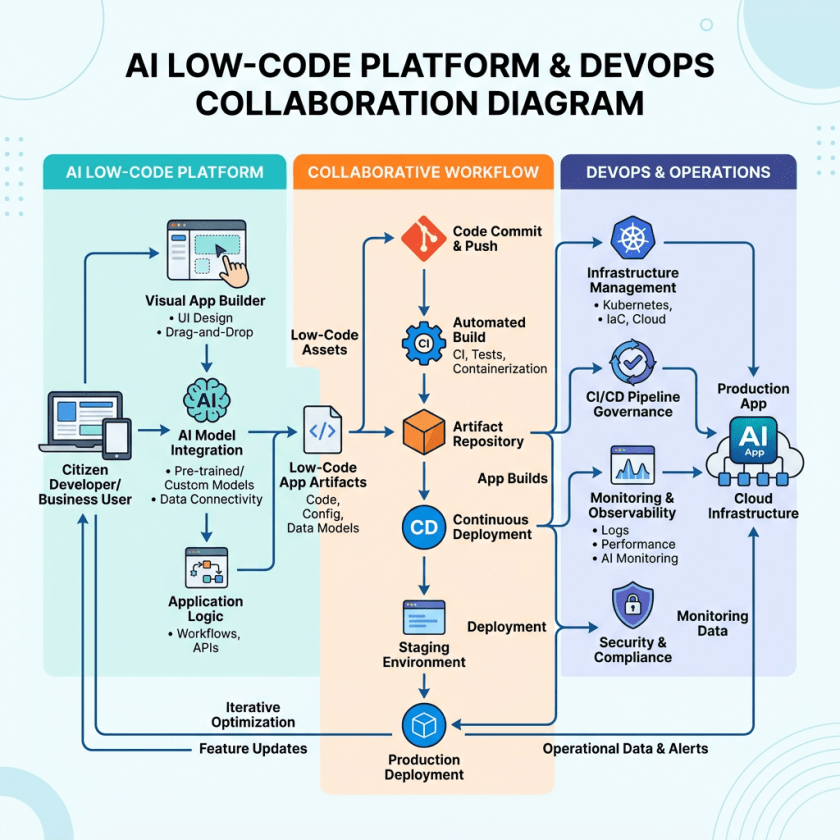
AI-assisted low-code platforms like VibeCode are generating a lot of excitement. They let users describe applications in natural language and produce working code quickly. This speed is impressive, but it raises questions for DevOps teams responsible for stability, security, and reliability.
DevOps has always focused on delivering software faster while keeping systems stable. Low-code and AI-assisted tools change how teams reach those goals. When non-developers create applications or workflows, DevOps practices must adapt to maintain quality and governance.
Understanding the Landscape
Low-code platforms provide visual interfaces and pre-built components, allowing technical and non-technical teams to build applications quickly. They often include ways to add custom logic and integrate with version control systems.
VibeCode-style tools take this further by generating full source code from text prompts. They blur the line between code and no-code by producing deployable code automatically. Unlike traditional low-code platforms, they do not always include structured lifecycle management, which places more responsibility on DevOps teams.
DevOps Challenges with AI-Assisted Development
Quality and Reliability
AI-generated code can work immediately but may have hidden issues. DevOps teams should treat it like any other source code, applying testing, code review, and quality gates before deployment.
CI/CD Integration
Some low-code platforms include visual tools for automating CI/CD workflows. VibeCode-generated applications may require manual setup to connect to standard CI/CD pipelines. Teams can use tools like GitHub Actions or GitLab CI to ensure builds, tests, and deployments are automated and consistent.
Security and Governance
Allowing broad groups to generate applications can lead to fragmented development outside central oversight. DevOps should enforce standard practices, including secrets management, static analysis, dependency scanning, and vulnerability testing.
Collaboration Between Developers and Citizen Builders
Low-code and AI-assisted tools enable collaboration between business users and developers. DevOps can support this by providing shared staging environments and documented deployment processes. Non-developers can safely contribute without bypassing governance, while developers can extend or improve the applications efficiently.
DevOps Best Practices
- Treat AI output as code from the start: Store generated applications in repositories to apply version control, code reviews, and change logs.
- Automate quality checks: Include unit tests, integration tests, linting, and dependency scans in CI pipelines.
- Centralize deployment: Align AI-generated applications with the organization’s standard CI/CD pipelines for consistency.
- Define guardrails without blocking innovation: Implement role-based access, approval processes for production, and security templates to keep citizen developers productive while maintaining control.
Conclusion
VibeCode and similar AI-assisted tools offer faster ways to build applications. They lower barriers for innovation and accelerate prototyping. DevOps remains critical to ensure quality, security, and maintainability. By applying standard DevOps practices to AI-generated code, teams can safely adopt these tools without risking production stability.
The future will likely bring deeper integration between AI-generated platforms and standard DevOps pipelines. Until then, automated testing, CI/CD workflows, and governance frameworks are the key to balancing innovation with reliability.
Enjoyed this article? Sign up for our newsletter to receive regular insights and stay connected.