

For architects and OT/IT teams, the important shift is not just “moving AI to the edge,” but redefining the control boundary. When inference leaves the cloud, the design must account for where decisions are made, which path they travel, and which subsystem remains authoritative for certified safety. In practice, that means separating hard safety from fast adaptation: the PLC can continue to own e-stops and SIL/PL functions, while a local edge layer handles time-sensitive kinematic updates that would otherwise be lost in scan-cycle overhead.
This creates an integration problem as much as an AI problem. Direct robot-controller links may be feasible through industrial Ethernet, vendor APIs, or fieldbus extensions, but each option changes latency, tooling, and supportability. Teams need to validate deterministic behavior end to end, including sensor ingest, model execution, command serialization, and controller response. The architectural trade-off is clear: tighter coupling improves responsiveness, but it also raises the bar for version control, testing, and failure isolation across heterogeneous robot brands.
Operationally, the biggest win is reducing micro-stops without weakening the safety case. That requires tuning motion limits, torque envelopes, and approach behavior in a way that is observable and auditable on the line. Brownfield environments add friction because limited cabinet space, power budgets, and legacy scan logic constrain where the edge device can sit and how it is maintained. For deployment teams, the question becomes less “Can the model detect risk?” and more “Can the entire decision loop remain deterministic, supportable, and compliant at production speed?”
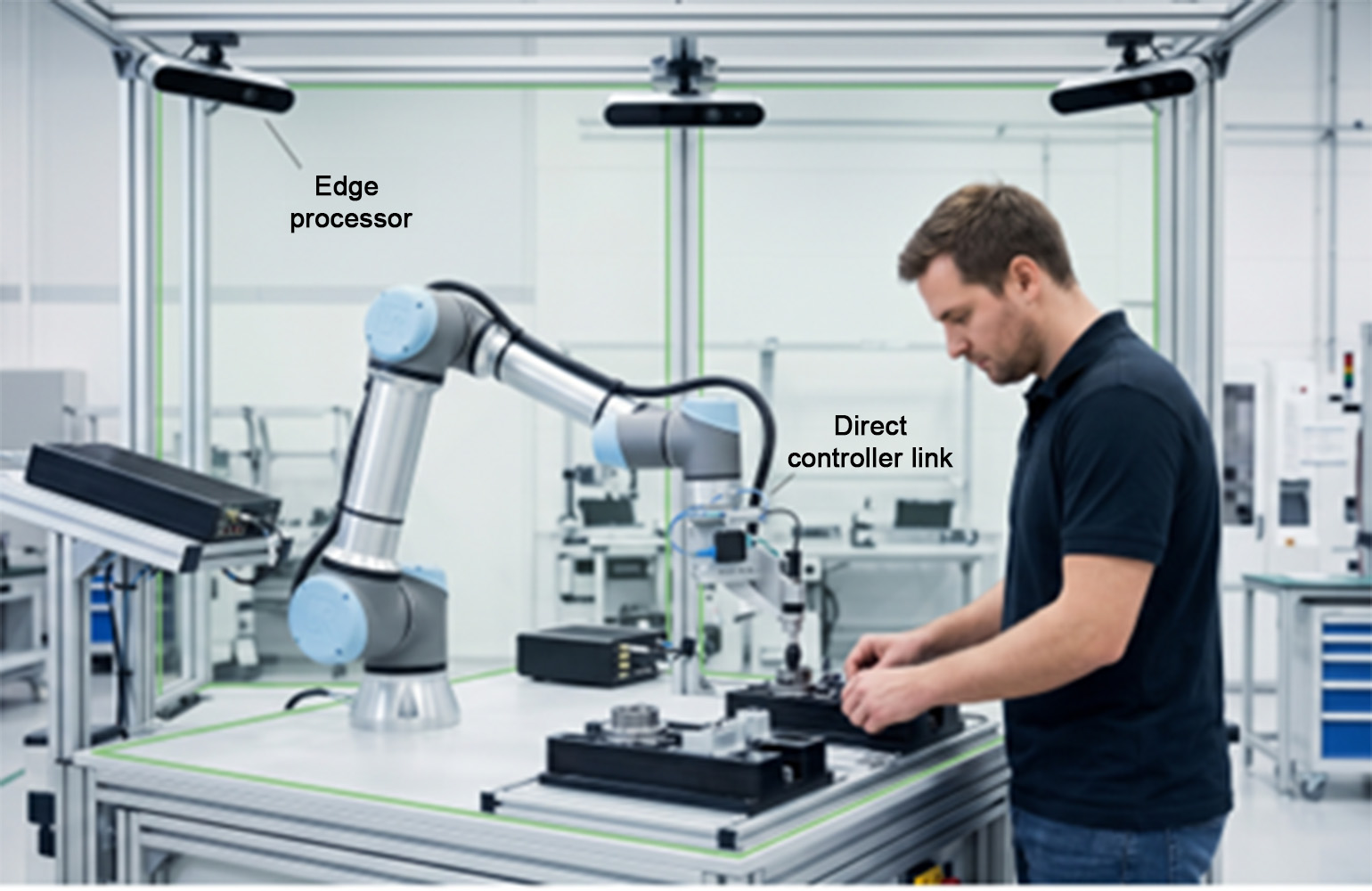 Latency can pose safety risks in collaborative assembly cells. Source: Cogniedge.ai
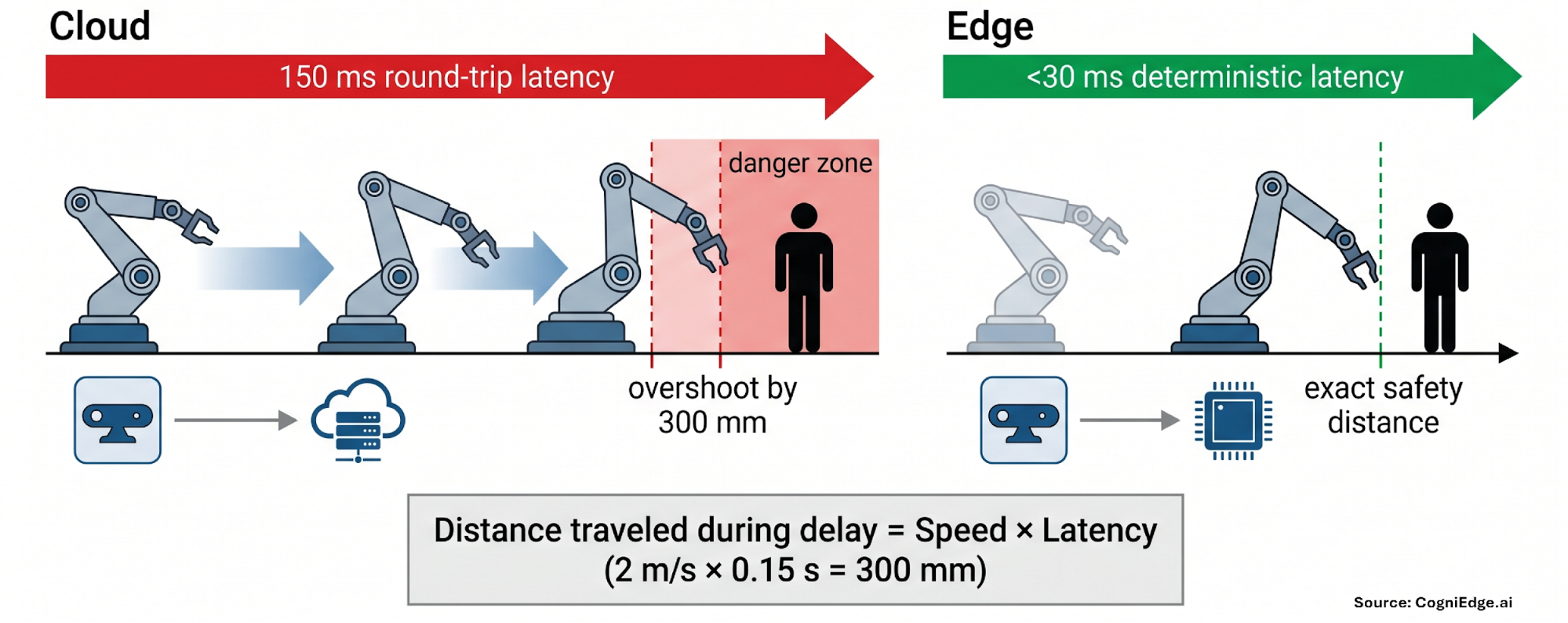
The physics of latency in speed and separation monitoring
 Source: Cogniedge.ai
Why legacy PLCs create an unacceptable bottleneck
Most brownfield cells still rely on traditional PLCs for safety logic. These devices were engineered for deterministic, discrete IO and scan cycles typically ranging from 10 to 50 ms. They excel at reading a light curtain or an e-stop but struggle with the high-bandwidth, multidimensional data streams coming from modern vision systems such as skeletal tracking, micro movement analysis, and operator state estimation. Routing edge AI inferences through the PLC adds another full scan cycle plus fieldbus overhead. The cumulative delay destroys the determinism needed for proactive SSM. In practice, many integrators find themselves forced to run the robot at reduced speeds or accept frequent interruptions even when the AI knows the situation is safe.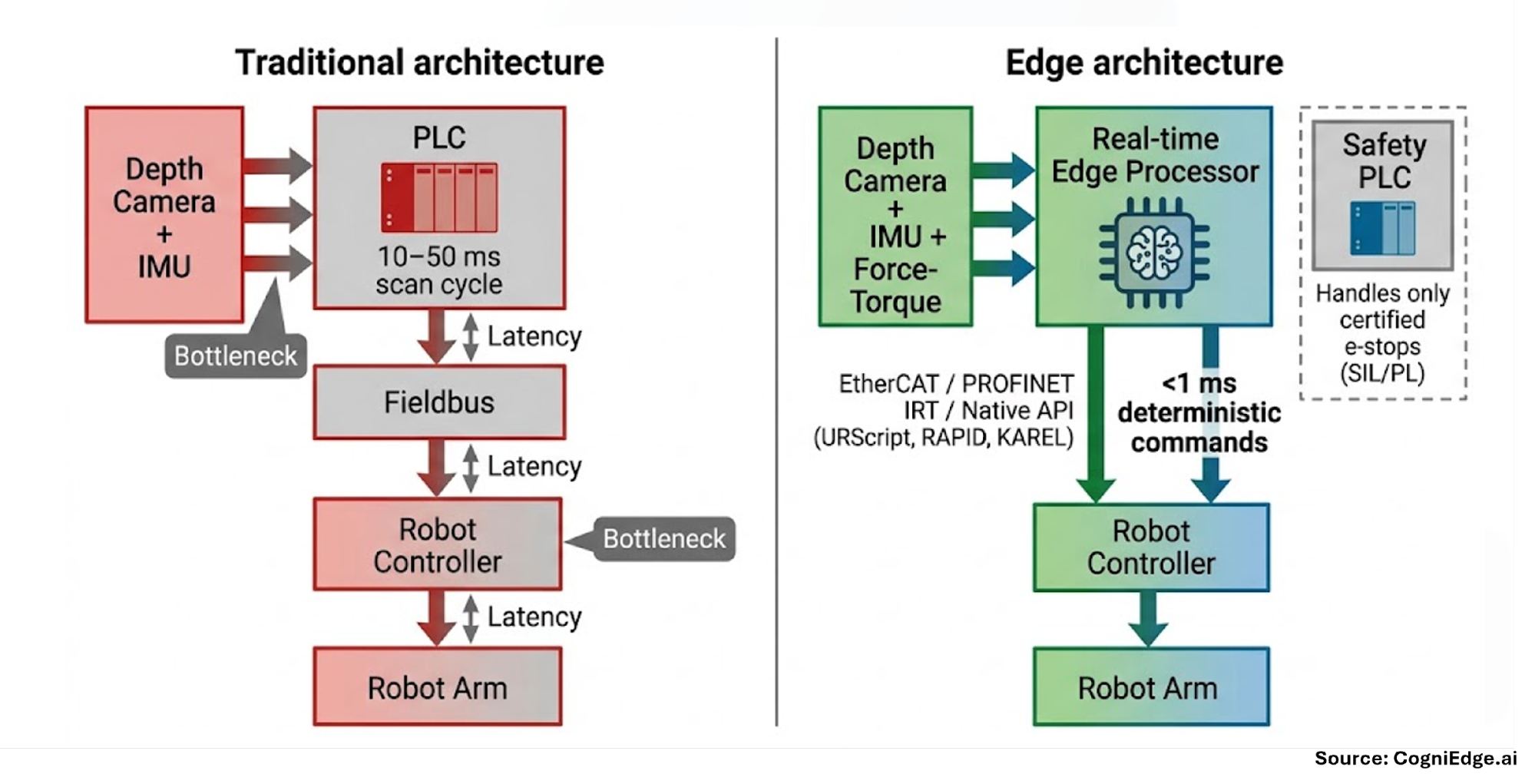 Source: Cogniedge.ai
Building the direct edge-to-controller bridge
The solution is a localized real-time safety processor that sits at the workcell and communicates directly with the robot controller, bypassing the PLC for non-safety-critical but time-sensitive adjustments. This layer ingests multi-modal sensor data (depth cameras, IMUs, force-torque sensors) at the edge, runs low-latency AI inference, and injects updated commands into the robot’s motion planner via high-speed industrial protocols. Common implementation paths include:- EtherCAT or PROFINET IRT for sub-millisecond deterministic cycles when the controller supports fieldbus extension.
- Real-time UDP or native robot APIs (URScript for Universal Robots, RAPID for ABB, KAREL for FANUC) for direct socket communication to the motion controller.
Adjusting kinematics on the fly in high-mix cells
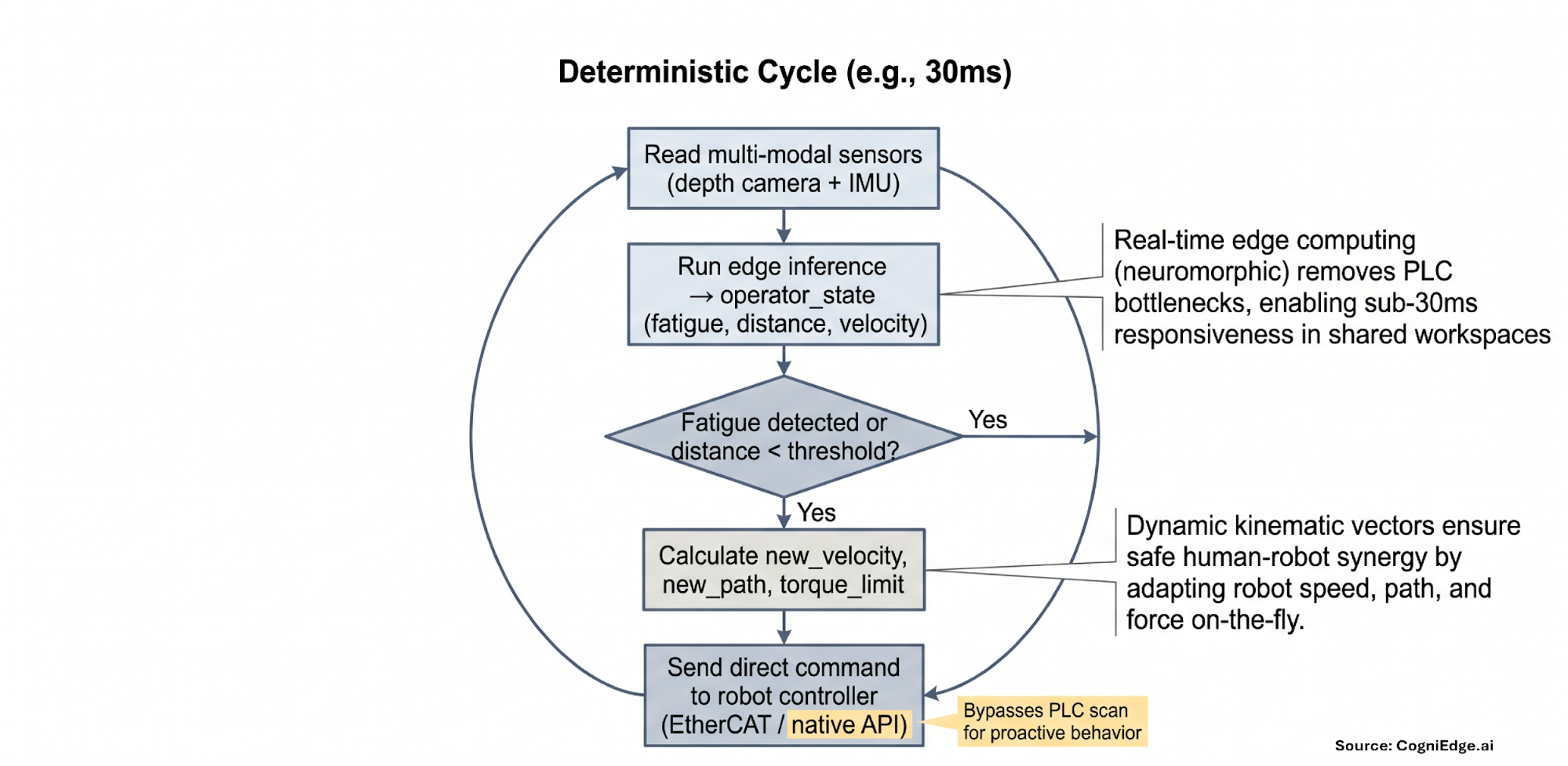
With the latency gap closed and a direct command path established, the cobot can move from reactive stopping to continuous, adaptive collaboration. In a high-mix assembly station, an operator’s movements may become slower or more erratic toward the end of a shift, which can be an early indicator of fatigue. The edge processor detects these micro deviations in real time through skeletal tracking and velocity profiling. Instead of triggering a protective stop, the system issues immediate kinematic adjustments:- Reduce maximum acceleration from 5 m/s² to 2 m/s².
- Widen the approach angle by 15° to give the operator more space.
- Lower torque limits on approach axes to reduce collision energy.
 Source: Cogniedge.ai
The hardware requirements for edge-first safety for collaborative robots
Factory floors have limited space and power. Edge processors for this use case must operate below 1 W while delivering real-time inference on temporal data streams. Neuromorphic chips and Spiking Neural Networks (SNNs) are particularly well suited because they process change detection and time-series data with extreme efficiency and low latency. These compact, fanless modules mount directly in or near the work cell, connect via standard industrial Ethernet, and integrate with existing robot controllers without requiring new cabinets or major rewiring.Practical benefits for systems integrators
By implementing direct edge-to-controller architectures, the industry can finally deliver on the ultimate promise of high-mix collaborative cells: fluid interaction that maintains takt time without sacrificing safety. This shift unlocks immediate value across the entire manufacturing ecosystem. For systems integrators, it offers a scalable approach that works in brownfield environments, leverages standard protocols across robot brands, and preserves existing investments in safety-rated PLCs. For manufacturers, it protects the bottom line by eliminating the frequent micro-stops that traditionally destroy cycle times. Most importantly, for the operators working on the line, it creates a safer, fatigue-aware environment where the robot acts as a true, responsive partner rather than a rigid machine. As collaborative automation grows more complex, closing the latency loop at the controller level will be the defining factor that separates successful, high-throughput deployments from those limited by legacy bottlenecks.About the author
Madhu Gaganam is the founder and CEO of Cogniedge.ai and an engineering technologist with more than 30 years of industrial automation experience at companies including Rockwell Automation, Gartner, NXP, and Dell. A recognized industry authority, he is a Top 10 Robotics Thought Leader on Thinkers360, co-chair of the Digital Twin Consortium, and an active IEEE RAS member.Enjoyed this article? Sign up for our newsletter to receive regular insights and stay connected.