
The technical shift here is not just faster provisioning; it is a different operating model for search and vector backends in agent systems. Scale-to-zero changes the capacity planning assumption that many teams build around for retrieval-heavy applications. For architects, that means the backend can track actual agent traffic patterns instead of being pinned to peak capacity, but it also places more weight on cold-start behavior, workload burstiness and how quickly downstream services tolerate resumption.
The integration story matters as much as the engine itself. Native hooks into Vercel, Kiro, Claude Code and Cursor reduce the friction between application code and retrieval infrastructure, but they also tighten coupling between development workflows and a specific managed data plane. That can speed prototype-to-production handoff, while pushing teams to think carefully about environment parity, IaC coverage, policy inheritance and whether the same collection model fits both experimentation and production governance.
Operationally, the model changes where complexity lives. Instead of tuning clusters for peak indexing and search load, teams need to understand OCU-based consumption, storage separation, and the boundary between search, vector search and GPU acceleration. This makes cost attribution clearer, but it also means observability, quota management and workload profiling become central to avoid surprises when agents increase query frequency or retrieval patterns change under production traffic.
For AI platform teams, the main implication is lifecycle design. A search and vector layer that can be created in seconds is useful for rapid agent iteration, yet the surrounding controls still matter: security policy defaults, collection-group inheritance, region availability and migration paths from classic serverless deployments. The value is highest when the retrieval backend is treated as a governed platform primitive, not a disposable prototype asset.
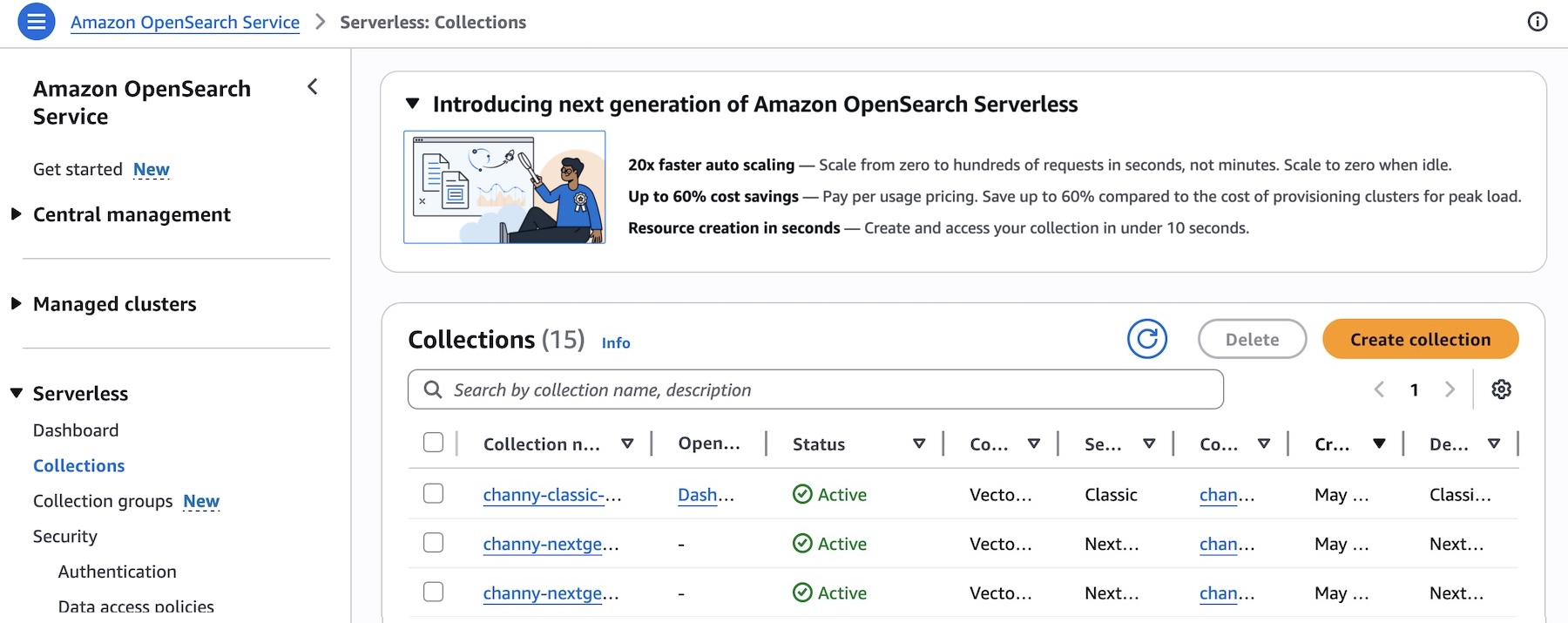
To get started with the next generation of OpenSearch Serverless, choose Create collection in the Serverless menu in the Amazon OpenSearch Service console.
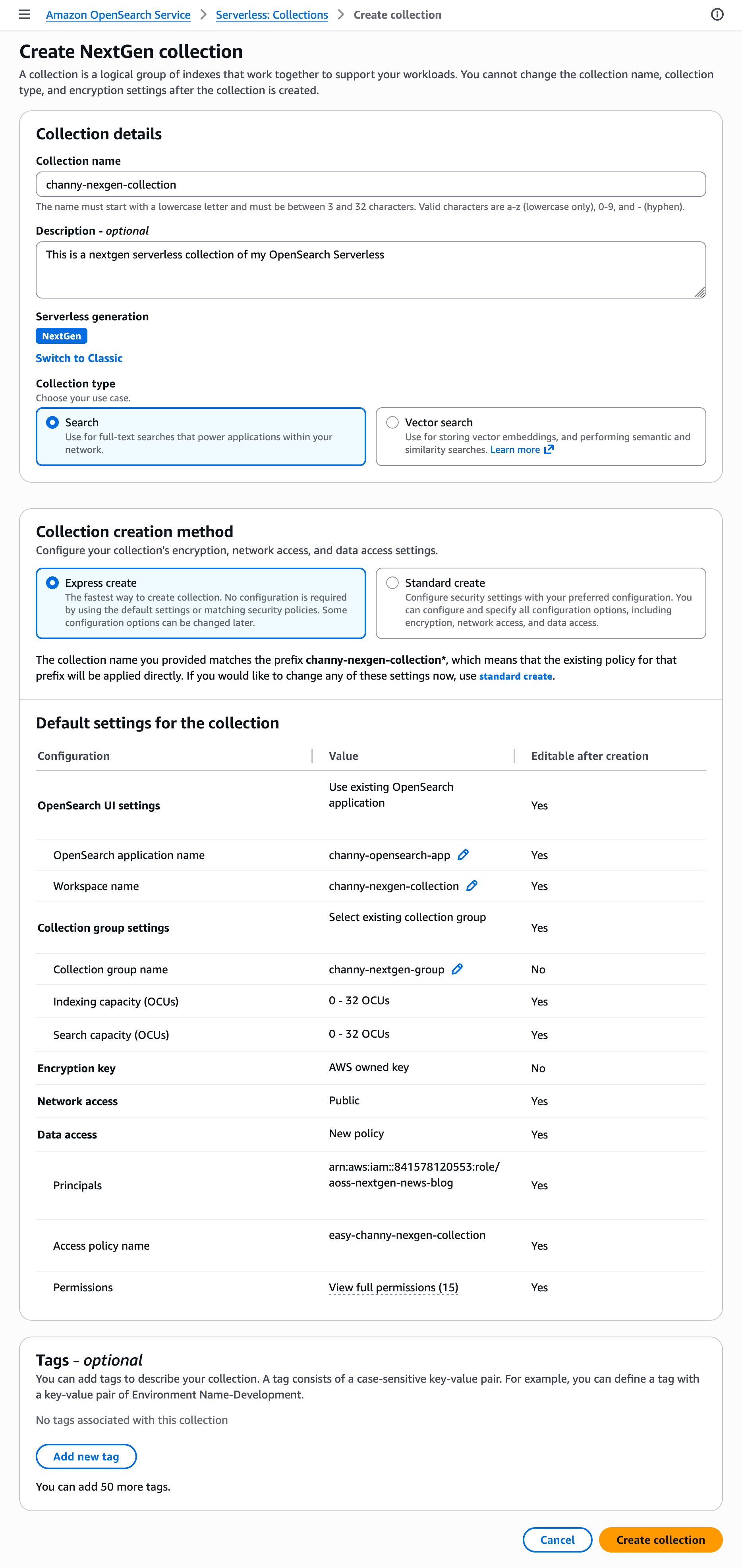
 Create NextGen collection with instant auto scaling and scale-to-zero for cost optimization. At launch, we support full-text search and vector search only for the collection type. If you want to use the existing OpenSearch Serverless infrastructure, choose Switch to Classic.
Choose Express create, the fastest way to create collection. No configuration is required—the default settings and matching security policies are applied automatically. Some configuration options can be changed later.
Create NextGen collection with instant auto scaling and scale-to-zero for cost optimization. At launch, we support full-text search and vector search only for the collection type. If you want to use the existing OpenSearch Serverless infrastructure, choose Switch to Classic.
Choose Express create, the fastest way to create collection. No configuration is required—the default settings and matching security policies are applied automatically. Some configuration options can be changed later.
 When you choose Create collection, OpenSearch Serverless will provision resources in seconds.
You can also create a collection of OpenSearch Serverless with AWS Command Line Interface (AWS CLI) or AWS SDKs. Here is a sample CLI command to create a collection group.
When you choose Create collection, OpenSearch Serverless will provision resources in seconds.
You can also create a collection of OpenSearch Serverless with AWS Command Line Interface (AWS CLI) or AWS SDKs. Here is a sample CLI command to create a collection group.
aws opensearchserverless create-collection-group \
    --name channy-nextgen-group \
    --standby-replicas ENABLED \
    --generation NEXTGEN \
    --description "My NextGen collection group" \
    --capacity-limits '{
        "maxIndexingCapacityInOCU": 96,
        "maxSearchCapacityInOCU": 96,
        "minIndexingCapacityInOCU": 0,
        "minSearchCapacityInOCU": 0
    }' \
--region "us-east-1"SEARCH and VECTORSEARCH.
aws opensearchserverless create-collection \
    --name channy-nextgen-collection \
    --type SEARCH \
    --collection-group-name channy-nextgen-group \
    --standby-replicas ENABLED \
    --description "My collection in NextGen group" \
    --region "us-east-1"
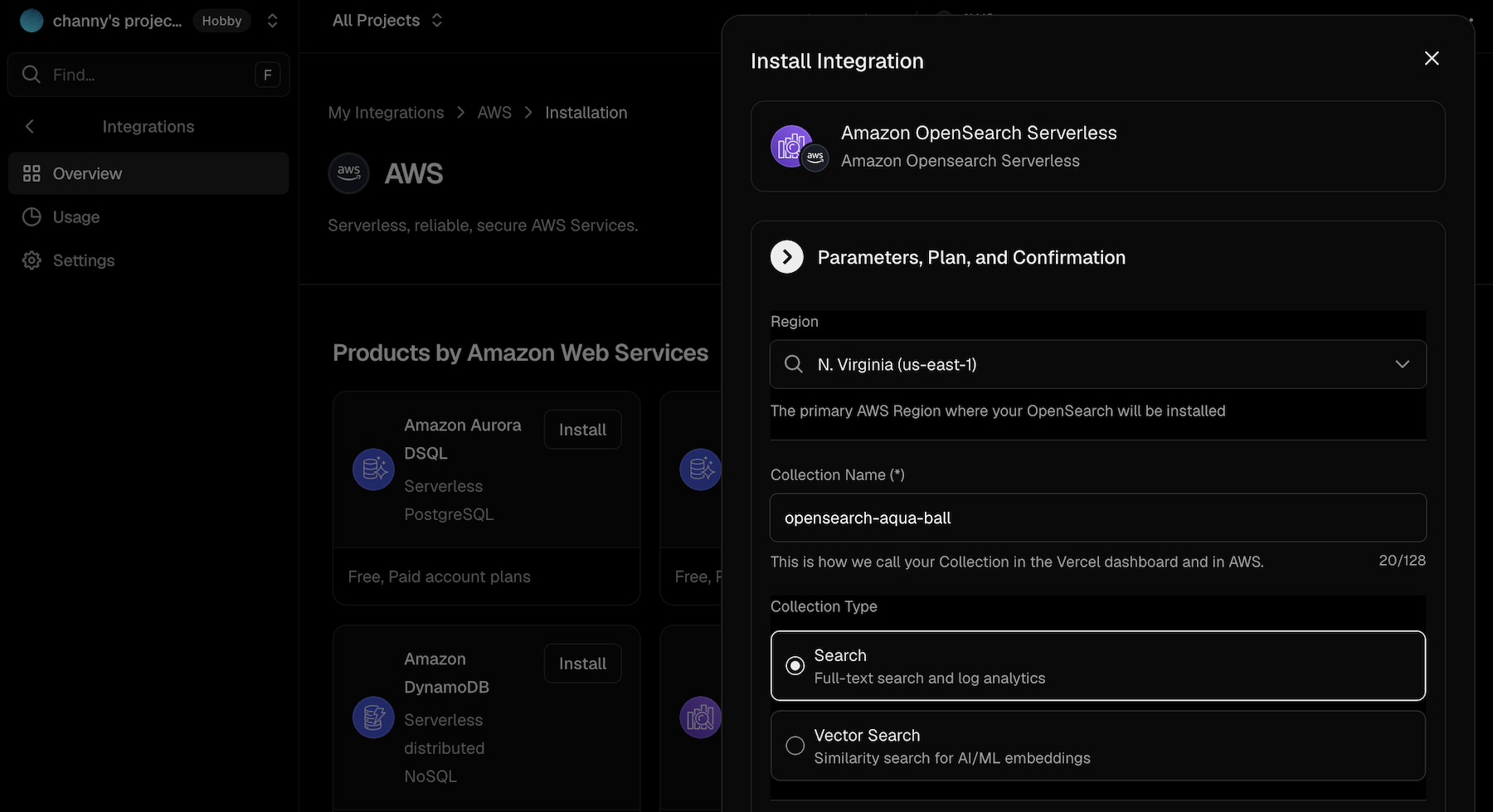
To support building production-ready agent applications in Vercel, you can now create a new OpenSearch collection or connect your existing OpenSearch Serverless collection within the Vercel console. Create a search backend in seconds and add features on-demand as your application grows. To learn more, visit AWS for Vercel.
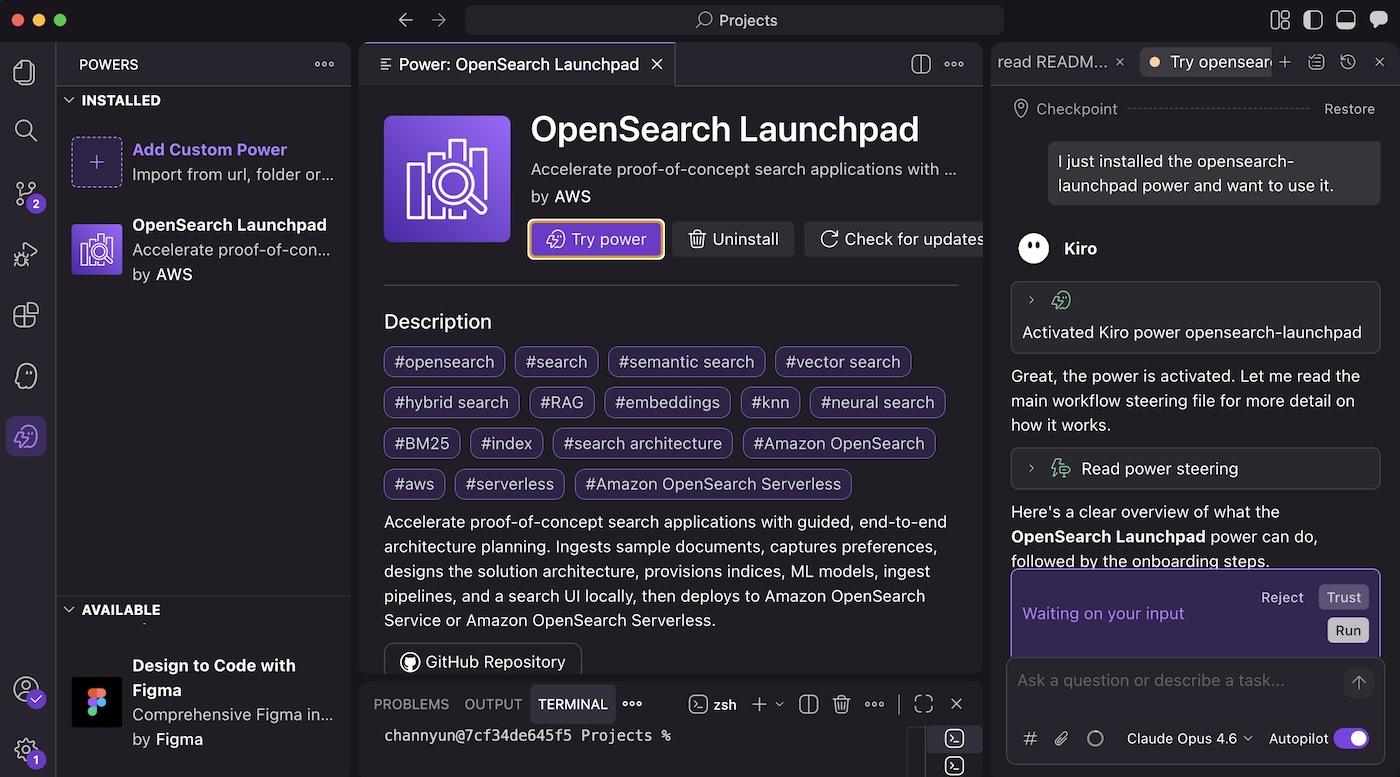
 You can go from idea to working prototype in minutes using Claude Code, Cursor, and Kiro. OpenSearch Agent Skills provide a repository of skills that bring OpenSearch intelligence directly into your agent. Each skill encapsulates domain knowledge, best practices, and multi-step execution logic for a specific workflow–so your agent not only gets results, but understands how they were achieved. You can also use the OpenSearch Launchpad in Kiro Powers to accelerate search applications with guided, end-to-end architecture planning.
 Now available
The next generation of Amazon OpenSearch Serverless is generally available today and is available in all AWS commercial Regions where Amazon OpenSearch Serverless is currently available. The next generation of OpenSearch Serverless charges for the compute you use in OpenSearch Compute Units (OCUs) for indexing, search, and GPU acceleration. You are charged separately for storage in GB-month. For more information, see Original Postricing/?trk=d8ec3b19-0f37-4f8c-8c12-189f913e205c&sc_channel=el" shape="rect">Amazon OpenSearch Service Pricing. Give it a try and send feedback to the AWS re:Post for Amazon OpenSearch Service or through your usual AWS Support contacts. — Channy Updated on May, 29, 2026 — Fixed the default value (96) of maximum indexing/search capacity in the CLI command. You should use the number of binary sequence to set these values.
Enjoyed this article? Sign up for our newsletter to receive regular insights and stay connected.