

The architectural shift here is not simply “AI for ops,” but a new control loop between observability, inference and execution. In practice, LLM output should be treated as an intermediate decision artifact, not a direct source of truth. That means the remediation path needs explicit validation layers: schema checks on model responses, policy gates on allowed actions, and deterministic fallback logic when confidence is low or telemetry is incomplete.
For enterprise teams, the integration boundary matters as much as the model itself. The useful pattern is to keep the LLM outside the privileged execution plane and let Ansible remain the system of record for change. This preserves existing CMDB, approval, inventory and secret-management workflows while adding intelligence at the decision point. It also reduces technical debt by avoiding one-off scripts that bypass standard middleware operations.
Operationally, the biggest trade-off is speed versus blast radius. Automated JVM tuning can shorten incident response, but it also introduces risk if recommendations are based on partial context or stale metrics. Teams should therefore define which failures are safe for closed-loop remediation, which require human approval, and which should only trigger advisory alerts. That separation is especially important in clustered middleware where a well-intended change can propagate instability across nodes.
Security and auditability are central to making this viable in production. Model prompts may include sensitive log data, and remediation actions can become an attack surface if the inference service is compromised. A resilient design logs every recommendation, records the input signals that produced it, and constrains execution to pre-approved playbooks. In other words, self-healing infrastructure works best when intelligence is bounded by policy, not when it replaces operational discipline.
Infrastructure reliability has always been central to enterprise success, yet traditional automation methods often fall short in handling complex, dynamic environments. With the rise of large language models (LLMs), a new paradigm of cognitive automation is emerging — where intelligent agents help infrastructure not only detect failures but also recommend or implement remediations in real-time. This article explores how integrating LLMs with Ansible creates a practical foundation for self-healing infrastructure, especially in mission-critical middleware environments such as Apache, WebLogic and Tomcat.
The Case for Cognitive Automation
Traditional automation relies on rigid scripts that require constant human maintenance. While effective for routine tasks, it struggles with unanticipated scenarios. Cognitive automation goes a step further, combining data inputs, AI models and contextual understanding to make decisions dynamically. This is particularly valuable in middleware environments, where service interruptions can lead to widespread system failures. Embedding LLMs within Ansible workflows enables infrastructure to reason about failure modes, learn from previous incidents and trigger appropriate corrective actions.
Real-World Use Case: Auto-Remediation in Enterprise Middleware
A global enterprise running critical workloads on middleware platforms such as Apache Tomcat, WebLogic and JBoss faced recurring performance degradations and outages due to JVM memory misconfigurations — especially heap exhaustion, metaspace overflows and excessive garbage collection (GC) activity. These out-of-memory (OOM) incidents were triggered by dynamic transaction spikes, leading to severe service disruption during business hours. The organization implemented a cognitive automation solution where logs were continuously scanned for OOM patterns, and metrics such as heap utilization and GC frequency were monitored in Prometheus. When JVM pressure indicators crossed thresholds, an LLM (via LangChain) analyzed the context and recommended runtime changes — such as adjusting heap size (-Xmx), setting maximum metaspace limits or switching to G1GC. These recommendations were automatically validated and applied through Ansible playbooks, significantly reducing downtime and manual intervention.
For example, the tuning string -Xms2048m -Xmx2048m -XX:+UseG1GC – XX:MaxMetaspaceSize=512m was deployed across affected clusters within minutes. Over 90 days, the team observed a 45% reduction in JVM-related incidents and improved SLA adherence. The system also generated visual dashboards showing memory pressure trends and GC behavior over time, helping SREs preempt future failures. This cognitive DevOps loop transformed middleware from a reactive maintenance zone to a self-healing, intelligent component of their infrastructure.
Implementation Blueprint
Cognitive automation begins with observability. Logs and metrics from Prometheus, Grafana and middleware are piped into a preprocessing layer, normalized and sent to a hosted LLM (e.g., via OpenAI API). Ansible modules then consume these outputs as variables to drive remediation playbooks. Key stages include:
- Data collection from the observability stack
- LLM inference call with error context
- Response validation
- Conditional remediation using Ansible tasks
- Notification to SRE teams
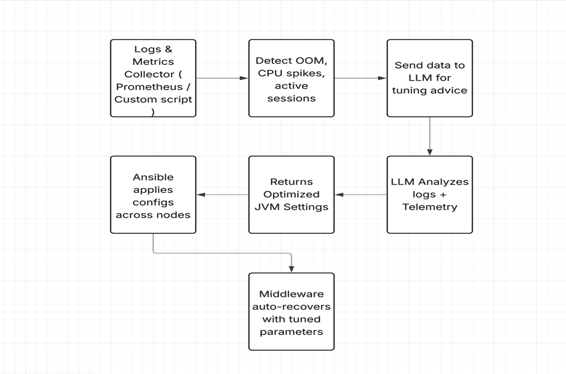
Cognitive Middleware Recovery Flowchart
The diagram below outlines the automated recovery flow, from collecting JVM and system metrics, detecting anomalies, invoking the LLM for tuning recommendations to enforcing the fixes using Ansible. This sequence enables real-time self-healing for memory-related middleware failures.
Code Example: Ansible Playbook — Load-Aware Middleware Recovery
The playbook below demonstrates how dynamic metrics such as user session count and CPU load can trigger automated middleware tuning via LLM recommendations. It shows a YAML-based Ansible workflow designed to scan logs, assess server pressure and apply JVM configuration changes in real-time.
Here’s a simplified playbook integrating LLM outputs for dynamic remediation:
name: Middleware Auto-Remediation Based on Load and OOM Logs hosts: middleware_cluster
gather_facts: yes vars:
user_threshold: 10000 # Example: max active users before auto-scaling or tuning cpu_threshold: 85 # Trigger if CPU usage > 85%
heap_util_threshold: 90 # JVM heap usage percentage tasks:
name: Fetch active user sessions from app metrics
shell: curl -s http://localhost:8080/metrics | grep active_sessions register: user_sessions
name: Parse active session count set_fact:
active_users: “”
name: Check CPU usage
shell: top -bn1 | grep “Cpu(s)” | awk ‘{print $2 + $4}’ register: cpu_usage
name: Set CPU usage fact set_fact:
current_cpu: “”
name: Check for OOM errors in logs
shell: grep -i “OutOfMemoryError” /var/log/app.log register: oom_logs
ignore_errors: yes
name: Call LLM for heap tuning advice if OOM errors found when: oom_logs.stdout != “”
uri:
url: “http://llm-api.local/remediate” method: POST
headers:
Content-Type: “application/json” body_format: json
body:
logs: “” active_users: “” cpu: “”
register: tuning_advice
name: Apply tuning recommendation via shell when: tuning_advice.status == 200
shell: “”
name: Restart middleware service after tuning when: tuning_advice.status == 200
service:
name: app-middleware state: restarted
Operational Considerations of Self-Healing Infrastructure
Security is a key concern when introducing LLMs into infrastructure workflows. To mitigate risks, enterprises should sandbox model recommendations, restrict execution to validated actions and log all model decisions for auditability. Teams should also monitor hallucinations — cases where the LLM generates incorrect but plausible instructions — and create validation gates in their CI/CD pipeline to prevent erroneous execution in production. LLM needs to be trained on logs from production under various load/users sessions scenarios.
Cognitive automation is not a replacement for human operators but a powerful augmentation. As infrastructure scales and complexity grows, traditional runbooks and manual interventions will no longer suffice. LLMs offer a scalable way to encode institutional knowledge and apply it in real-time. With ongoing advancements in prompt engineering and edge AI, we’re likely to see fully autonomous remediation loops embedded into core SRE toolchains soon.
Conclusion
Enterprises seeking to improve uptime, reduce incident response time and enhance operational resilience should explore cognitive automation with LLMs and Ansible. This combination bridges the gap between observability and action, turning middleware from a black box into a self-healing system. The shift toward intelligent infrastructure isn’t just a trend — it’s becoming a necessity.
Self-Healing Infrastructure With Cognitive Automation: How LLMs and Ansible Transform Middleware Reliability
Enjoyed this article? Sign up for our newsletter to receive regular insights and stay connected.