
For IT and pipeline teams, the real significance is not the branding of a new desktop edition but the operational packaging of a studio platform. A creative workstation image that bundles application delivery, desktop tuning, and versioned packaging can reduce onboarding friction for artists and freelancers, but it also shifts responsibility onto the distro maintainers to keep the base OS, GPU stack, and application repository aligned. That is helpful only if the studio can mirror, validate, and rollback those components with the same discipline it applies to render infrastructure.
The larger architectural trade-off is the move to a Wayland-only desktop stack. For general Linux users, the migration is mostly a UI change; for VFX and post-production environments, it touches remote access, input devices, window behavior, and color-managed review paths. Compatibility layers may keep individual apps running, but they do not automatically preserve the remote-desktop assumptions that many production pipelines were built around. Any AlmaLinux 10 rollout therefore needs a dependency audit across artist workstations, review nodes, and GPU-backed remote sessions.
The packaging model also matters for maintainability. A curated installer that can update creative applications independently of the base operating system is useful in fast-moving toolchains, yet it can create a split-brain support model if studios do not define what is controlled by the distro, what comes from a COPR-style repository, and what is pinned internally. In practice, the success of this edition will depend less on the installer itself than on whether it can be turned into a repeatable reference image, with clear rules for drivers, display protocol support, and change management.
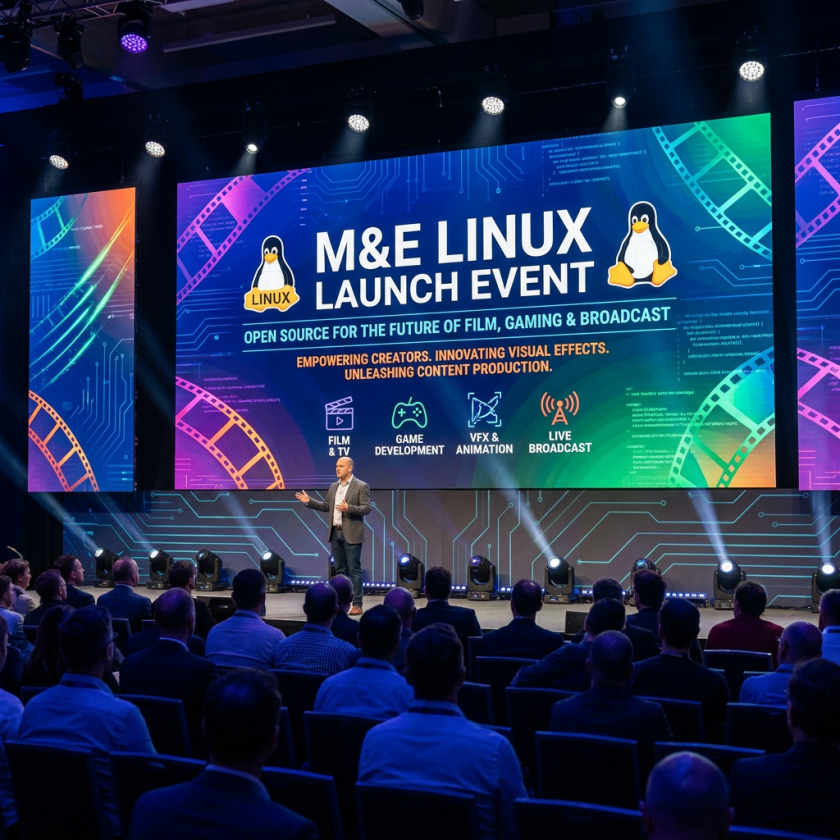
The AlmaLinux OS Foundation publicly unveiled its Media & Entertainment Edition today at AlmaLinux Day: Los Angeles — a purpose-built Linux distribution targeting animation studios, VFX pipelines, and render farms that have been searching for a stable, free infrastructure foundation since Red Hat ended the CentOS stable release in December 2020. The edition ships atop AlmaLinux 10 with KDE Plasma as its default desktop, a curated toolchain tested against real studio workflows, and a one-click installer that drops more than 30 professional creative applications without requiring a terminal command.
The event, held today at the E-Central Downtown Los Angeles Hotel through 5:00 PM PT, is the first AlmaLinux Day dedicated to the media and entertainment industry, and its timing is deliberate: one day before SIGGRAPH 2026 opens at the Los Angeles Convention Center. The AlmaLinux OS Foundation will also exhibit at SIGGRAPH, at booth 735, through July 23.
Why Studios Left on CentOS Were Waiting for This
When Red Hat announced it was redirecting CentOS from a stable downstream release to a rolling upstream (CentOS Stream), the fallout landed hardest on production environments that had planned for years of stability. VFX facilities, render farms, and animation studios had standardized on CentOS specifically because of its RHEL compatibility and long maintenance windows — tools like Houdini, Nuke, and DaVinci Resolve are certified against specific OS versions, and an unplanned platform change mid-production is not a software problem, it is a scheduling and liability problem, as the AlmaLinux M&E SIG’s founding mandate makes explicit.
AlmaLinux emerged as the leading community-supported answer. By early 2026, more than two million systems were checking in for AlmaLinux updates every week, according to the foundation’s keynote session description — roughly double the count from a year earlier. The foundation is a US-based 501(c)(6) nonprofit, funded by $1 million annually from CloudLinux Inc. and backed by more than 25 additional sponsors including AWS, Meta, Microsoft Azure, AMD, and CERN, as the foundation’s about page details.
The Media & Entertainment Special Interest Group, or M&E SIG, was formed in December 2025 out of community conversations that began at SIGGRAPH 2024 and 2025, and today’s unveiling represents its first major deliverable: a production-facing edition of AlmaLinux built specifically for studio infrastructure. The SIG’s wiki documents the founding rationale and ongoing work.
AlmaLinux Creative Installer: Blender, DaVinci Resolve, No IT Team Required
The centerpiece of the new edition is the AlmaLinux Creative Installer, a community-built open source tool developed under the handle KernelChief and supported by the M&E SIG. A single click installs more than 30 professional creative applications with no terminal interaction: GIMP, Krita, Inkscape, Blender, FreeCAD, DaVinci Resolve, Kdenlive, OBS Studio, Ardour, and Audacity — the full professional bench — along with desktop configuration tuned for creative workflows, as showcased on the event’s Creative Installer section.
The target audience is explicit: freelancers, indie studios, and students who need a working creative pipeline today, not after an IT procurement cycle. No IT team required is the stated design goal.
The M&E SIG is actively migrating the installer from its initial implementation to a Qt-based GUI application, which will broaden the range of supported operating system and desktop environment combinations and make it easier to contribute new packages or desktop tweaks. The installer’s COPR repository structure means that updates to individual creative apps do not require rebuilding the full edition — a practical advantage for studios that need to keep Blender and Resolve current without touching base OS packages, as Tristan Théroux’s session introducing the Creative Installer covers in detail.
What the X11-to-Wayland Shift Means Before You Upgrade
This is the part of the story that does not appear in the product announcement — and the part that most directly affects a studio evaluating whether to upgrade render nodes and workstations from AlmaLinux 9 to AlmaLinux 10.
AlmaLinux 10, like Red Hat Enterprise Linux 10 before it, ships without the Xorg server. X11 is a display server protocol dating to 1984, and the Xorg server is its primary Linux implementation. Wayland is its modern replacement — a protocol where the compositor itself serves as the display server, eliminating a rendering layer, reducing latency, and closing a well-documented shared-memory security hole that X11’s architecture required. Wayland has been the default on major desktop Linux distributions since 2021, and X11 officially entered maintenance-only mode in 2024.
The transition is not transparent. Studios using X11-based remote desktop tools — which describes most VFX facilities, where remote access to high-performance Linux workstations is a daily production requirement — cannot simply upgrade to AlmaLinux 10 and expect existing workflows to continue. Xwayland, the compatibility layer that allows X11 applications to run inside a Wayland session, handles most legacy app compatibility, but it does not replace the full Xorg server’s role in remote display architectures.
Nick Cannon, SVP of Production and Technology at Walt Disney Animation Studios and chair of the Visual Effects Society’s Technology Committee, put the industry’s situation plainly when the Academy Software Foundation launched its Wayland for Artists Working Group on June 24, 2026: “Right now our industry doesn’t yet understand the full impact of this transition on high-end content creation applications — whether open source, commercial, or proprietary — as well as the high performance remote access solutions so critical to modern workflows.”
Color management adds a further complication. VFX review workflows routinely require wide-gamut, HDR-accurate display rendering — a capability that Wayland color management support only began reaching through Mesa 25.1’s implementation of the Wayland color management protocol in 2025. Studios running compositors or color grading workflows that rely on ICC profile management should verify their compositor’s color management implementation before upgrading to a Wayland-only environment.
Wayland for Artists: An Industry Working Group, Not a Solved Problem
Today’s event includes a session co-presented by Cannon and Jean-Francois Panisset of the ASWF CI Working Group and the VES Technology Committee formally introducing the Wayland for Artists Working Group to the VFX and Linux communities gathered in Los Angeles.
The Working Group was established to provide a neutral industry-level forum to explore what the X11-to-Wayland shift actually means for professional content creation — mapping which commercial, open source, and in-house applications work natively under Wayland, which require Xwayland, and which have hard dependencies that need to be resolved before migration can proceed. Specific areas include graphics tablet support, window management, input focus, key bindings, desktop customization, remote access solutions, GPU acceleration, color management, HDR displays, and compatibility with proprietary applications that studios cannot simply patch themselves, as detailed in the Working Group’s announcement.
The formation of a working group to study these questions signals that, as of mid-2026, the answers are not yet settled — and that the AlmaLinux M&E Edition’s Wayland positioning is partly forward-looking. The SIG has been testing against AlmaLinux 10 with KDE Plasma specifically to understand what works and what does not before studios make the jump.
Amazon DCV and the Remote Desktop Gap
The session most directly addressing the practical Wayland remote desktop problem will run at 3:30 PM PT today: Tristan Théroux and Karsten Gaier, CEO of NI SP GmbH, will present a live beta preview of Amazon DCV running on the next generation of the Linux desktop stack.
Amazon DCV is a high-performance remote display protocol designed specifically for VFX studio environments. It supports YUV 4:4:4 chroma subsampling for color-accurate remote access, shared GPU usage across multiple simultaneous users, and the low-latency protocol performance that production pipelines require over high-latency WAN connections, as documented on the NI SP GmbH DCV product page. Netflix’s engineering team has publicly described DCV as central to their cloud rendering infrastructure.
Wayland support for Amazon DCV is planned for the second half of 2026 — the session today is a beta preview of work in progress, not a general availability announcement. Studios currently evaluating when to migrate to AlmaLinux 10 should treat the DCV Wayland GA timeline as a dependency: until Wayland-native remote desktop is production-ready, the upgrade path for studios that rely on DCV for remote artist access runs through Xwayland compatibility, not native Wayland.
Full-Day Agenda: From EDR Gaps to Open Source Trust
Beyond the M&E Edition unveil and Wayland sessions, today’s program addresses security, operations, and community. Chris Taylor, CISO of Taksati Consulting, is presenting a session examining EDR capabilities on Linux — what endpoint detection and response tools can and cannot actually do on Linux workstations versus their Windows equivalents — a practical gap that studios managing mixed-platform environments frequently discover after procurement.
Stephen Winters, Director of IT, North America, at Cinesite, closes the afternoon with a security keynote on open source trust in the post-xz era. The xz utils backdoor, discovered in March 2024 in versions 5.6.0 and 5.6.1 of the xz/liblzma package, was a deliberately planted exploit that would have compromised SSH authentication across affected Linux systems had it shipped in production distributions. Winters’ session on open source trust addresses what the attack surface looks like now that AI tools can assist — or mislead — developers in ways that amplify the supply chain risk: tools that generate or recommend dependency downloads create new pathways for malicious packages to enter production builds.
Syed Usman Ahmad of Grafana Labs is presenting a practical log analysis session aimed at studio and render farm sysadmins who need more than grep and tail for production-scale log investigation.
A hands-on workshop led by Neal Gompa of Velocity Limitless, Théroux, and David Duncan covers how studios can derive their own tailored versions of the official M&E Edition deliverable for mass deployment — adapting hardware configurations and software requirements to specific production environments without starting from scratch.
What Comes Next: SIGGRAPH, Reference Architectures, and the H2 2026 Roadmap
Today’s event feeds directly into the rest of the week. The ASWF hosts Open Source Days on July 19 and 20 at the same venue complex, and SIGGRAPH 2026 opens at the Los Angeles Convention Center on July 19 and runs through July 23. The AlmaLinux OS Foundation will exhibit at booth 735 throughout the SIGGRAPH show floor, with benny Vasquez and AlmaLinux Engineering Steering Committee members available for direct conversations, as detailed in the foundation’s SIGGRAPH exhibit announcement.
The M&E SIG’s roadmap for the second half of 2026 includes publishing reference architectures and compatibility guidelines for media and entertainment studios — the documentation layer that moves AlmaLinux M&E Edition from a working proof of concept to a deployable standard that a studio’s infrastructure team can hand to procurement and auditors.
Session recordings will be posted to the AlmaLinux YouTube channel following today’s event. The AlmaLinux newsletter carries announcements when recordings go live.
Frequently Asked Questions
What is the AlmaLinux Media & Entertainment Edition, and how is it different from regular AlmaLinux?
AlmaLinux M&E Edition is a purpose-built configuration of AlmaLinux OS 10 with KDE Plasma as its default desktop, curated by the AlmaLinux Media & Entertainment Special Interest Group specifically for VFX, animation, and post-production workflows. The key addition is the AlmaLinux Creative Installer, a one-click tool that deploys more than 30 professional creative applications — Blender, DaVinci Resolve, Krita, OBS, Ardour, and others — without terminal interaction. Base AlmaLinux 10 provides a generic enterprise Linux environment; the M&E Edition adds studio-tested configuration, curated app packaging, and desktop tuning aimed at artists and pipeline engineers rather than general server administrators.
What happened to CentOS for VFX and animation studios?
Red Hat announced in December 2020 that CentOS Linux would transition from a stable downstream release to CentOS Stream, a rolling upstream that precedes RHEL rather than following it. CentOS 7 reached end of life in June 2024 with no successor in the same stability tier. Studios that had standardized on CentOS for render farms and artist workstations — because of its RHEL compatibility and multi-year maintenance windows — were left to find a replacement. AlmaLinux, Rocky Linux, and commercial RHEL subscriptions have been the main alternatives; AlmaLinux has emerged as the most widely adopted free community option, with more than two million systems checking for updates weekly as of mid-2026.
Can my studio upgrade to AlmaLinux 10 from AlmaLinux 9 without breaking remote desktop workflows?
Not necessarily without assessment. AlmaLinux 10, like RHEL 10, ships without the Xorg server — only Xwayland (a compatibility layer) remains. Studios that rely on X11-based remote desktop protocols, including legacy NX, SSH X-forwarding, or VNC-over-X setups, will find that those workflows no longer function the same way on AlmaLinux 10. Amazon DCV, the high-performance remote display protocol most commonly used in professional VFX environments, is adding Wayland support in the second half of 2026 but has not yet reached general availability for Wayland sessions. The ASWF Wayland for Artists Working Group, formed June 24, 2026, exists precisely because the full impact of this transition on commercial and proprietary applications is not yet fully mapped. Studios should audit remote access and color management dependencies before planning an AlmaLinux 10 upgrade, and consider remaining on AlmaLinux 9 through its full support window while the Wayland ecosystem matures.
What is the Wayland for Artists Working Group, and who runs it?
The Wayland for Artists Working Group is a neutral industry forum established by the Academy Software Foundation in conjunction with the Visual Effects Society’s Technology Committee, announced June 24, 2026. It is chaired by Nick Cannon, SVP of Production and Technology at Walt Disney Animation Studios. The Working Group’s mandate is to understand and document the impact of the X11-to-Wayland transition on professional content creation applications — both commercial software like compositing and color grading tools, and open source tools — and to provide a community-level roadmap for managing the migration. Contributors can join the #wg-wayland channel on the ASWF Slack. The group held its first VFX-community-facing presentation at AlmaLinux Day: LA today.
Enjoyed this article? Sign up for our newsletter to receive regular insights and stay connected.