
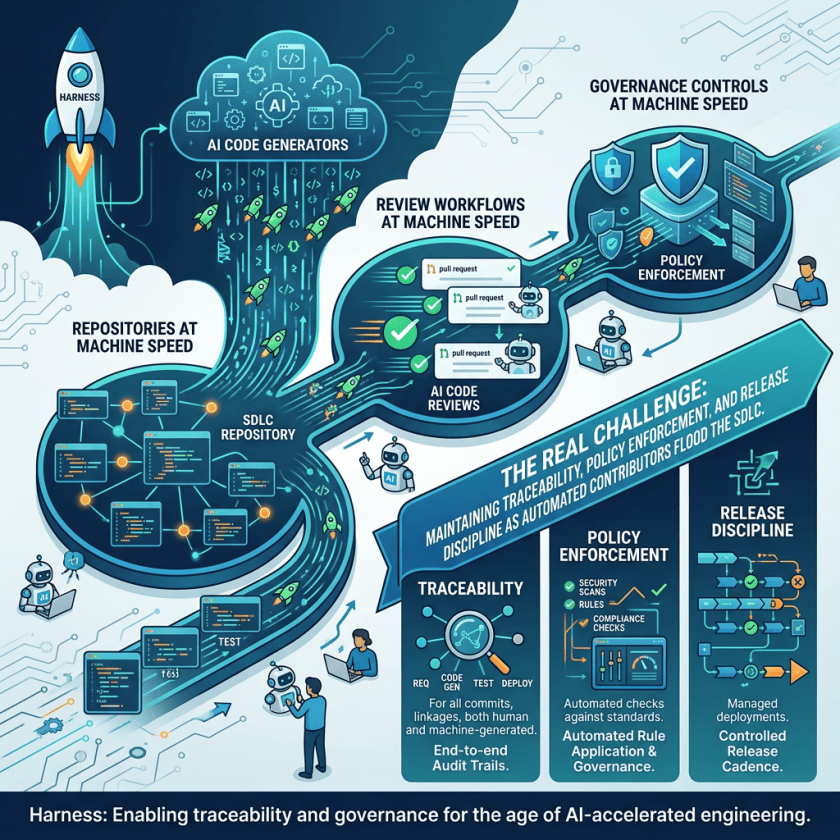
In practice, an “agent-ready” repository raises governance questions that go beyond scaling pull requests. If agents inherit a human user’s permissions, teams will need clear boundaries around delegated authority, branch protection, approval policies and audit trails. Otherwise, faster code generation can simply amplify existing weaknesses in change control. The operational value will depend on whether organizations can reliably answer who initiated a change, which agent produced it, what checks ran, and why it was ultimately approved.
There is also a workflow design issue: once review becomes partially automated, policy quality matters more than reviewer capacity. Teams will need to decide which checks are globally mandatory, which are project-specific, and which risks still require human judgment. Poorly tuned rules could either flood pipelines with false positives or create a false sense of safety around agent-written changes.
For platform engineering and DevOps teams, the broader implication is that AI coding adoption may force consolidation across repository, CI/CD, policy and audit layers. Enterprises evaluating this model should look less at raw generation speed and more at integration depth: identity, traceability, review automation, exception handling and rollback discipline will determine whether autonomous development improves throughput or just accelerates technical debt.
Software delivery platform provider Harness Inc. today announced the launch of Agent-Ready Harness Code Repository and AI Code Review, aimed at developer teams adopting artificial intelligence coding agents at an ever-increasing pace.
Now that AI agents produce code faster than a team can write, review, test and deploy it, that work is shifting to where it needs to happen next: storing, reviewing, approving and shipping without the system breaking down.
According to co-founder and Chief Executive Jyoti Bansal, today’s code management expects humans to write code and open pull requests, while colleagues adjust, fine-tune, test and approve over hours or days.
This old model is being slowly crushed underfoot by the adoption of AI agents that can produce volumes of code in minutes or hours that would have taken days or weeks for a team of developers. The permission and code-keeping systems designed to handle hours and days of work can no longer keep up with this lifecycle. Harness said it’s rebuilding that layer.
“Software delivery is going through its biggest shift since the move to the cloud, and the systems we all built our workflows around were designed for a different scale and a different kind of user,” said Bansal.
Too many enterprise teams are attempting to latch onto the oncoming autonomous era by slapping an AI agent onto their code repository and calling it a day. Bansal said this will not work because most repositories were written over 15 years ago, without organization or a conception of future-proofing for machine readability and requests that need to be resolved almost as soon as they appear in the pipe.
“The entire SDLC has to become autonomous,” added Bansal. That means the repository, the review, the pipeline and the governance from start to finish need to operate as a unified system.
What does it mean to be ‘agent-ready’?
The Harness Code Repository provides source control that’s scale-tested to handle thousands of pull requests and commits opened at once, meaning a team of hundreds or thousands of agents working all day can do so without blocking. Search, history and comparisons can all run at volume.
Each agent also receives its own permissions by inheriting from the human that triggers it, down to the specific repository, branch, project or environment. That means the human writer maintains responsibility for the audit afterward.
The company said it tailored the entire system to use Model Context Protocol and command-line interfaces. This lets the full software delivery lifecycle run programmatically: Find a review by the author’s email instead of an internal ID, pull every pull request across every repository into one place and create, reply to, or resolve comment threads without opening a browser. Using the CLI, agents can use the system directly with lower AI token costs.
Code review works similarly, operating at large scale, and allows agents to read code requests the way a tech would. It checks code at merge, allowing teams to decide which AI Checks are mandatory, set them once for an account, or tune them by project. Any change that fails a check is rejected and goes back to the team for an update.
Feedback from a rejected change reflects what’s at stake rather than noting what line moved. It includes suggested reviewers and labels to make one-click remediation simple, allowing modifications to merge without much fuss.
Harness stressed that although agents can write reams of code, a human still has to decide what ships. AI Code Review sits at the gate, designed to make that decision easier by informing the team of what is production-ready for staging and what needs further action.
Harness has used both new capabilities internally for months. From early testing, teams saved an estimated 10,000 hours over the last month.
Image: SiliconANGLE/Microsoft Designer
Harness tackles influx of agent-delivered code with Code Repository and AI Code Review
Enjoyed this article? Sign up for our newsletter to receive regular insights and stay connected.