
Google announces Gemini 3.5 Transcribe for AI-powered speech-to-text

For IT teams, the important shift here is not just improved speech recognition accuracy, but the move from transcription to interpretation. A system that removes filler words, rewrites self-corrections, and normalises spoken input is no longer producing a verbatim record; it is generating an edited version of intent. That distinction matters for any workflow where spoken text becomes a system of record, drives automation, or is reused downstream in search, summarisation, ticketing, documentation, or compliance archives.
The architectural question is where “cleaned” transcription is acceptable and where raw capture must be preserved. In note-taking, messaging, and lightweight mobile input, aggressive editing may be an advantage. In regulated environments, legal review, incident response, healthcare, or customer-service dispute resolution, organisations may need dual outputs: a faithful transcript for auditability and a polished version for productivity. Without that separation, teams risk losing context about hesitations, corrections, or ambiguous phrasing that may matter later.
Custom vocabulary support and multilingual operation also raise practical integration questions. Domain-specific accuracy depends on how organisations manage terminology, product names, acronyms, and language variants over time. That turns speech input into a vocabulary-governance problem, not just a model-quality problem.
Before broad rollout, practitioners should test three things in real workflows: whether edits alter business meaning, how the model behaves with specialised jargon and mixed-language speech, and whether latency gains justify moving more mobile input away from manual typing. The productivity upside is clear, but the operational boundary between “transcribed” and “AI-authored” text needs to be explicit.
While we wait (possibly in vain) for Gemini 3.5 Pro to launch, Google is releasing a different model in the 3.5 branch. The company has announced Gemini 3.5 Transcribe, an AI model designed to streamline voice input by editing out “ums” and corrections, outputting polished AI text. This model already powers the Gboard “Rambler” feature on the Pixel 11, but it’s about to appear throughout the Google ecosystem.
According to Google, Gemini 3.5 Transcribe is much faster and more accurate than its previous voice-to-text engine, known as Chirp 3. The new AI model should be about 70 percent faster from voice to final transcribed text, and the live-speech error rate has dropped to 5.5 percent. That’s only a little better than Chirp 3, which Google measures at 7.32 percent. Still, it’s a pain to fix typos when you’re using voice input, so any improvement here is beneficial.
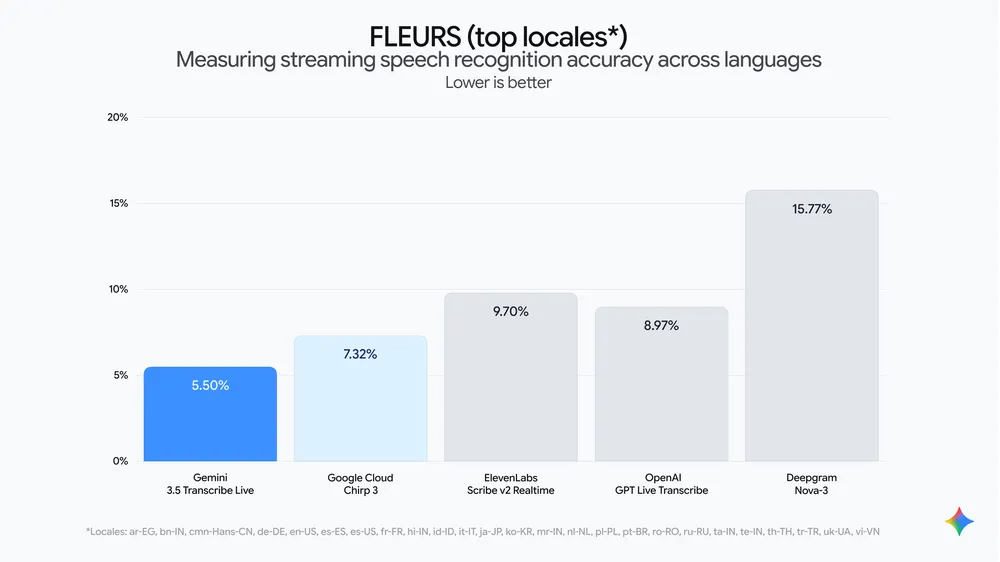
The new model isn’t just better at hearing the words you say; it’s also allegedly better able to get at the heart of what you meant to say. As you speak, Gemini 3.5 Transcribe can remove the awkward “ums” and “uhs” that clutter your stream of consciousness. It can also edit text on the fly if you need to correct yourself and refer to your provided custom vocabulary to handle “specialized jargon.” All this works in 85 languages and with up to three speakers in pre-recorded audio.
The drawback, of course, is that you’re relying on the AI to accurately get the gist of your speech. For short blocks of text, the model seems good at cleaning up inconsistencies and verbal stumbles (based on my testing with Rambler), but the AI does technically change the wording of what you said, and that may not be appropriate for all situations.
Enjoyed this article? Sign up for our newsletter to receive regular insights and stay connected.