
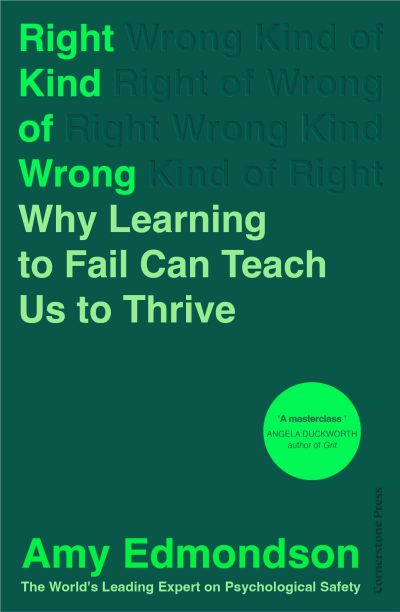
[Edmondson] is on a mission to eliminate “glib talk about failure”, and clear up confusion about what constitutes “the right kind of wrong”. Her message is relevant not only to Silicon Valley bros, but also to anyone who has worked in any organisation
We used to think of failure as a problem, to be avoided at all costs. Now, we’re often told that failure is desirable – that we must ‘fail fast, fail often’. The trouble is, neither approach distinguishes the good failures from the bad. As a result, we miss the opportunity to fail well.
Here, Amy Edmondson – the world’s most influential organisational psychologist – reveals how we get failure wrong, and how to get it right. She draws on a lifetime’s research into the science of ‘psychological safety’ to show that the most successful cultures are those in which you can fail openly, without your mistakes being held against you. She introduces the three archetypes of failure – simple, complex and intelligent – and explains how to harness the revolutionary potential of the good ones (and eliminate the bad). And she tells vivid stories ranging from the history of open heart surgery to the Columbia Space Shuttle disaster, all to ask a simple, provocative question: What if it is only by learning to fail that we can hope to truly succeed?
Right Kind of Wrong provides a useful template and taxonomy for failing well, but Edmondson proves as merciless as you might expect a Harvard professor to be about those who take the old move-fast-and-break-things mantras on failure as an excuse to skimp on their homework.
She makes clear that it is right to try to eliminate basic failures, from accidentally putting the milk into the cupboard rather than the fridge, to ruining an experiment with poor pipette-technique. Where things go wrong also matters, though.
Edmondson distinguishes, for instance, between consistent, variable and novel contexts. When an Air Florida crew absent-mindedly approved the disabling of anti-ice instruments in wintry conditions in 1982, they committed a basic failure in a variable context: it led to the flight’s fatal crash into the frozen Potomac river. Similarly, we would rightly expect a high level of success from modern heart surgeons while understanding that they stand on the shoulders of pioneering predecessors’ policy of thoughtful experimentation.
The real targets of Edmondson’s criticism are organisations that suppress and demonise intelligent failures that can advance understanding. The subtitle of the US edition of Edmondson’s book is The Science of Failing Well, because “a 70 per cent failure rate . . . is not atypical for scientists at the top of their field”. In novel contexts, it is possible to experiment, as the first heart surgeons did, and learn from intelligent failures.
Purchase this book in Amazon store Note: The link is an Amazon Associate affiliate link. If you make a purchase through this link, I may earn a small commission at no additional cost to you. This helps support the content I create for you. Thank you for your support!
Enjoyed this article? Sign up for our newsletter to receive regular insights and stay connected.