
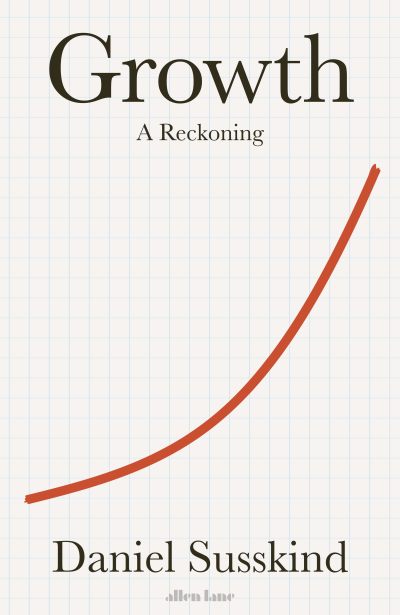
Most politicians want more of it. Some eco-warriors think there’s too much of it. And, according to the economist Daniel Susskind, too few people understand it. In Growth: A Reckoning, he claims to help with all three
Over the past two centuries, economic growth has freed billions from poverty and made our lives far healthier and longer. As a result, the unfettered pursuit of growth defines economic life around the world. Yet this prosperity has come at an enormous price: deepening inequalities, destabilizing technologies, environmental destruction and climate change.
Resolving this growth dilemma, best-selling economist Daniel Susskind argues, is the urgent task of our age. For many, in our era of sluggish productivity, the worry is slowing growth—in the UK, Europe, China and elsewhere—and reversing this stagnation is the goal of every politician. Others understandably claim, given its social and environmental costs, that the only way forward is through ‘degrowth’, deliberating shrinking our economies.
At this time of uncertainty about growth and its value, Susskind has written an essential reckoning. In a sweeping analysis full of historical insight, he explores what really drives growth, offering original ideas for combatting our economic slowdown. He argues that we cannot abandon growth but shows instead how we can redirect it, making it better reflect what we truly value.
Lucid, thought-provoking and brilliantly researched, Growth: A Reckoning is a vital guide to one of our greatest challenges.
In a sweeping analysis full of historical insight, Susskind shows how policymaking came to revolve around a single-minded quest for greater GDP. This is a surprisingly recent development: economic growth was barely discussed until the second half of the twentieth century. And our understanding of what drives it is more recent still. Only lately have we come to see how humankind emerged from its millennia of stagnation: through the sustained discovery of powerful and productive new ideas.
This insight undermines the mantra that “we cannot have infinite growth on a finite planet,” for the world of ideas is infinitely vast. Yet growth’s critics are right to insist that we can no longer focus on its upsides alone. We must confront the tradeoffs, Susskind contends: sometimes, societies will have to deliberately pursue less growth for the sake of other goals. These will be moral decisions, not simply economic ones, demanding the engagement not just of politicians and experts but of all citizens
Purchase this book in Amazon store Note: The link is an Amazon Associate affiliate link. If you make a purchase through this link, I may earn a small commission at no additional cost to you. This helps support the content I create for you. Thank you for your support!
Enjoyed this article? Sign up for our newsletter to receive regular insights and stay connected.