
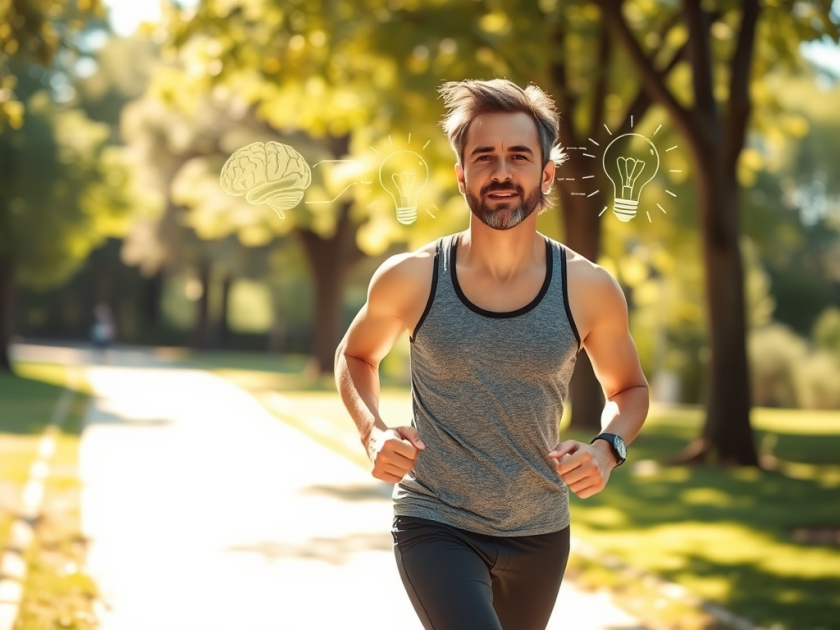
You probably know that exercise helps you perform better under stress. You probably know that exercising at moderate intensity for 20 minutes elevates your mood for up to 12 hours. You might know exercise is one of the five daily habits a 30-year Harvard study shows can not only increase your lifespan by 12 to 14 years, but also cut your risk of Alzheimer’s in half.
You might even know that exercise increases the production of a protein that supports the function, growth, and survival of brain cells.
But what you probably don’t know is that a study published in Nature found a definite link between physical fitness and improved cognitive function, one that results in improved memory, reasoning, sharpness, and judgment.
Want to find out where you stand? All you have to do is take a quick walk.
How CoreWeave Bought and Borrowed Its Way to AI Domination
How CoreWeave Bought and Borrowed Its Way to AI Domination
0 seconds of 3 minutes, 25 secondsVolume 0%
During the study, the researchers asked participants to walk as quickly as they could and measured how far they got in two minutes. The mean distances achieved were 660 feet for men and 640 feet for women. (That extrapolates to a 16-minute mile, or a pace of slightly under four miles an hour.)
Then they asked them to take a variety of cognitive tests, and compared the results:
It surprised us to see that even in a young population, cognitive performance decreases as fitness levels drop. We knew how this might be important in an elderly population, which does not necessarily have good health, but to see this happening in 30 year-olds is surprising.
This leads us to believe that a basic level of fitness seems to be a preventable risk factor for brain health.
Just as importantly, when the researchers took MRIs of participants, they found that “higher (levels of personal fitness) is associated with preserved white matter microstructure and better performance in a wide range of cognitive domains.”
Somewhat simply put, fitter people have greater white matter integrity. White matter is made up of bundles of myelinated axons that affect learning and brain functions and coordinate communication between different brain regions.
More simply put, fit people’s brains are built a little better, which helps them remember, reason, and decide better. White matter integrity improves episodic memory, or personal experiences. White matter integrity improves cognitive flexibility, processing speed, and fluid intelligence.
White matter integrity helps you better draw on what you’ve learned in the past to make quicker, smarter decisions in the present.
All from being able to walk a little farther in two minutes.
So let’s work on that. Walk as fast as you can for two minutes and see how far you get. Where you fall on the scale — under or over 660 or 640 feet — doesn’t really matter. The goal is to work to improve on that result, because doing so should improve your white matter integrity.
If you’re don’t exercise, start walking for 15 minutes every day. (As an added bonus, other research shows a 15-minute walk can significantly increase your lifespan.)
But don’t do a circuit; walk away from your home for 7.5 minutes, then walk back. Over time, try to walk farther on the “out” 7.5 minutes and still make it back in 7.5 minutes.
That will increase your speed and with it, your level of fitness. (And force you to do the whole 15 minutes; when I go for long bike rides, I always ride away from my house for half the intended distance because then I have no choice but to complete the second half if I want to make it home.)
Then consider exercising more. Exercising regularly also checks off an item on the Harvard list of five daily healthy habits.)
If you’re under the study’s mean distance, shoot for 660 and 640 feet for men and women, respectively. And consider adding other forms of cardio, and maybe even a little strength training.
Do that, and your results on the two-minute walking test will improve a lot faster, and with less effort, than you think.
As a result you’ll feel better — both physically and mentally — and you could improve your memory, reasoning, decision-making, and ability to make connections and draw on past experiences.
Can’t beat that.
The opinions expressed here by Inc.com columnists are their own, not those of Inc.com.
Enjoyed this article? Sign up for our newsletter to receive regular insights and stay connected.