
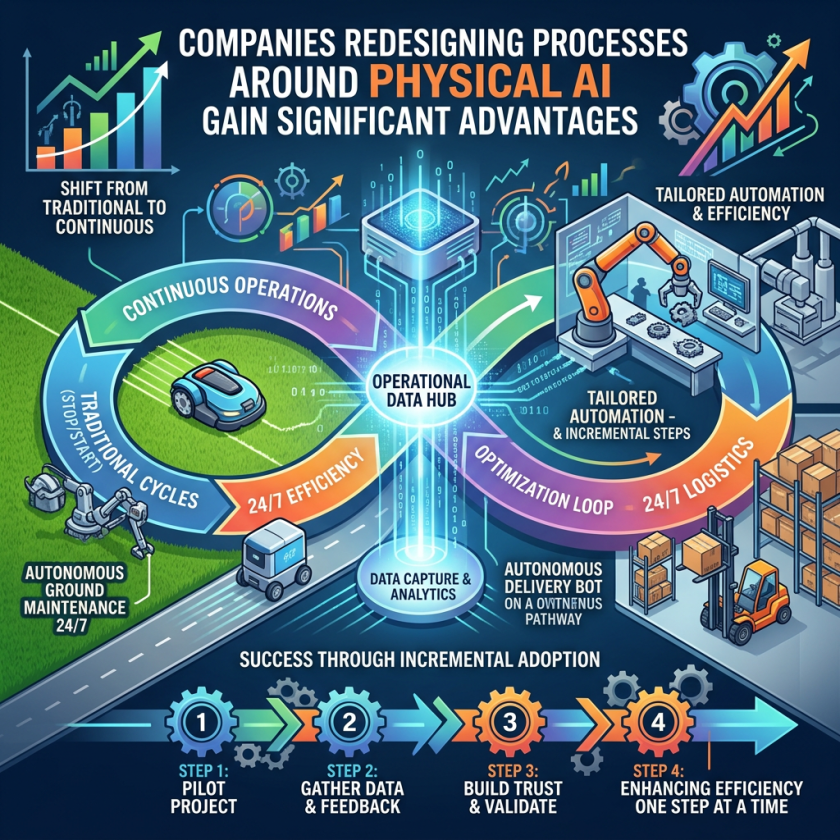
Management takeaway: physical AI is not mainly a technology procurement cycle; it is an operating-model redesign. The first question is not whether a robot or autonomous system works in isolation, but which steps in the end-to-end process should disappear, move earlier, or shift from batch to continuous control. That means the business case should be built on throughput, exception reduction, service levels and safety outcomes, not just labour substitution.
For leaders, the governance issue is decision rights. If a machine acts and a human owns the outcome, then accountability must be explicit, auditable and reversible. That applies to who approves autonomy thresholds, who signs off exceptions, who can override, and who owns incident response when a machine’s action creates a downstream defect. Treat machine identity, event logging and rollback as operational controls, not technical features.
The portfolio implication is that scaling should be funded one process at a time, with benefits tied to a measurable customer or asset outcome. Avoid broad “AI transformation” programmes that spread risk across too many sites before the process is stable. The sharper question for portfolio boards is: which workflow has enough volume, repeatability and data quality to justify continuous learning, and which must stay human-led because variance is too high?
The workforce impact is equally material. Automation usually shifts demand rather than removes it: more reliability, maintenance, process engineering and model supervision, fewer manual checks. That requires a change plan for skills, job design and union or employee relations. Next questions for the leadership team: where is the process broken today, what exception rate can you tolerate, and what controls will let you scale without losing trust?
The machines are ready for real work, and the companies that redesign their processes around them will capture the value first.
Watch a robot lawn mower for a week and you learn something most enterprise automation programs miss. A weekly gardener cuts seven days of growth in one pass, bags the clippings and hauls the green waste away. The robot mows every day and trims a few millimeters at a time. The clippings are fine enough to fall back into the lawn and feed the soil, which is exactly what lawn care guidance recommends. Nobody automated the disposal step. It simply disappeared, and the lawn is healthier for it. That small example captures what I see as the real prize in physical AI. It is also why my conversations across boards, CIOs, founders and venture capitalists on this topic have moved from curiosity to planning.
The Proof Is No Longer in the Lab. It Is Driving Past You.
The clearest evidence is on public roads. Waymo now gives roughly half a million paid rides a week, and it is aiming for a million a week by year end. Tesla launched robotaxi service in Austin last year, and this month began rolling out the Cybercab, a car with no steering wheel at all. Aurora runs driverless trucks on five freight routes across Texas and the Southwest. Amazon passed one million warehouse robots last year and coordinates them with its own AI model, which cut robot travel time by 10 percent.
Jensen Huang put it plainly at CES earlier this year: “The ChatGPT moment for physical AI is here.” The venture capital movement shows this well. Yann LeCun raised just over $1 billion for AMI Labs to build models that learn how the physical world behaves, and Google DeepMind has paired its Gemini Robotics models with Boston Dynamics hardware.
The Biggest Gains Come From Redesigning the Work Around the Machine
The lawn mower lesson carries straight into the enterprise. A machine is cheap to run all day, every day. Work that people batch into weekly or monthly cycles – inspection, inventory counts, maintenance, quality checks – can move to small daily increments. Problems get caught earlier, and whole steps drop out of the process. Buyers are starting to purchase on this basis. They pay for uptime, reliability and throughput instead of owning machines, and the vendor that can deliver those better than a human crew wins the contract. The shift also opens new businesses around the robot: chips that run AI on site for years in heat and dust, private wireless networks that put decisions next to the equipment, and data services that keep deployed models current.
In July I argued that a company’s operational record, meaning what its experts accept, correct and reject, is the most valuable training data it will produce this decade. Physical AI makes that point even more literal. Every shift a robot works in your plant generates data about your layouts, your parts and your exceptions that no competitor can buy. The companies that capture that record and learn from it will pull ahead with every month of operation.
Physical AI Will Not Have One ChatGPT Moment. It Will Have Many, One Industry at a Time.
Language models took off quickly because the internet supplied one enormous body of text to learn from. The physical world has nothing like it. Every factory, warehouse and road behaves differently, and the field’s leading thinkers are candid about the work ahead. Fei-Fei Li describes today’s language models as “wordsmiths in the dark” that have never touched the world they describe. Rodney Brooks points out that we have almost no recorded data on touch, which dexterity depends on. Demis Hassabis says DeepMind is already using simulated worlds to train its robots.
This is good news for enterprises with deep operating knowledge. Progress will come industry by industry, led by companies that combine the hardware, the model, the data and the customer relationship in one field. Waymo in ride-hailing, Aurora in freight and Amazon in fulfillment each fit that description. An enterprise with years of process data and domain expertise holds the scarcest input in this market. It should also plan for models that keep learning after go-live, because lighting, layouts and parts change every week.
Trust Is Earned One Process at a Time. The Leaders Build It Deliberately.
Software can fail, log the error and retry. A truck or a robot arm has far less room for error, so the companies moving fastest are the ones that built trust step by step. Aurora ran its freight pilot with McLane using safety drivers from 2023 before it took the driver out on the Dallas to Houston route. Tesla moved from hands on the wheel, to eyes on the road, to no driver at all over several years. That sequence is the playbook, and three moves put it to work.
The first move is an operating model that states where a machine has authority and which named person answers for the result. The machine acts, and a person owns the outcome. The second move is identity for machines and agents on the same footing as employees. The company must be able to see whom an agent acts for and what it may do, and it must be able to trace and reverse any action. Plant networks and security tools built for human logins will need upgrades once agents start talking to other agents. Legal, HR, security and operations leaders each own part of that work. The third move is about people. Amazon’s most automated fulfillment center, in Shreveport, Louisiana, targets a 25 percent lower cost to serve at peak. The same site needs 30 percent more people in reliability, maintenance and engineering roles. The savings come from redesigning the operation, and the jobs that remain call for more skill. Underneath all three sits one discipline: prove one process against a customer outcome before you scale it, because autonomy on a broken process spreads the flaw faster than any team could.
The robot mower did not win by automating the mowing – it won because someone redesigned lawn care around what a machine does well. Every operations leader now faces the same choice, one process at a time.
The machines are ready. The work now is getting your processes ready for them
Enjoyed this article? Sign up for our newsletter to receive regular insights and stay connected.