

Have you ever wondered how an ETF is born?
As we cross 3,300 ETFs in the U.S. market this week, it’s impressive to note how many new ETFs continue to come to market every day – 78 new ones in the last 3 weeks alone!
This widening path to ETFs that welcomes with open arms new providers and investors alike has a beautiful history of innovation that still leaves us in wonder. Consider some of the first-of-a-kind products we’ve seen over the years that have changed how folks access markets through an ETF wrapper:

If we consider ETFs to be a story of market access, there’s no question that the product itself is key to delivering and accessing value. We often say that a viable ETF is one that actually solves an investor problem. Get the product right – it’s a simple but effective standard of success.
How that comes about, however, isn’t universal except for that fact that every ETF begins the same way: from an idea.
ETFs Begin as Ideas
An original ETF idea can be spontaneous – the result of “why” or “what if” conversations, stemming from the pursuit for a better mousetrap that delivers access that may already exist through other investment vehicles, but could be more tax efficient, or more transparent, or more liquid, or more tradable. “What if we could do this better?” is a great place to start the germination of a new ETF seed.
In recent months, from illiquid alternatives to hard-to-reach options markets to mutual fund conversions, creating better access has been a powerful source of new ETF ideas.
An original idea can also be very intentional, as in a calculated effort to capture a source or a path of return for a specific reason, or for a season or for a given market environment.
The thematic space, for example, is peppered with right-for-now ideas that capitalize on investors’ imagination when markets are ripe for a theme. Remember work from home ETFs at the height of the pandemic? Non-traditional index products, factor strategies and even values-based approaches are all intentionally pursuing an outcome or an exposure that’s different from other types of exposures.
In truth, ETF product development is an interesting exercise that’s part art, part science. The magic is in the balance between the two. Over the years, we’ve seen different things work well, and others fail miserably, so we are sharing here 5 simple lessons for the ETF-creator-at-heart:
-
New ideas are a dime a dozen, but an a-ha moment is priceless.
Everyone comes into this business thinking they have the next billion-dollar idea. If only it were that easy.
You would think that coming up with a first-of-a-kind strategy would be a golden ticket, and, in truth, that often does increase your chances of success dramatically. But there have been many firsts that never found their footing because they were either ahead of their time, past their time, or the market just didn’t care.
There’s no roadmap to a lightbulb moment, but you know it when you see it. A lot of the most interesting product innovation and disruption we’ve seen has come from a problem-solving mindset.
Look at the massive use of options in ETF strategies today – you could say it’s one of the new frontiers for product development. Options have often been the realm of professional traders, but creative thinking – brilliant ideation, really – has resulted in smart implementation of options contracts (and more broadly derivatives) in all sorts of new ETF solutions that generate equity income, buffer outcomes and even finds yield in non-yielding assets like gold. Options today, thanks to smart ETF ideas, are the playground of every investor.
Perhaps one lesson here is that an a-ha moment should not go to waste. If you think you’ve come up with something special, explore it, and explore it quickly before someone else thinks of it, too. One of the beauties of this industry is that the ETF ecosystem is collaborative, with partners open to conversation and education. You don’t have to think through an ETF idea alone.
-
Direct access almost always beats indirect access.
The ongoing push for spot bitcoin ETFs is a classic example of the importance of direct access. Futures-based bitcoin ETFs have been around – and successfully so – for more than a year. But investors are asking for spot exposure because direct is best.
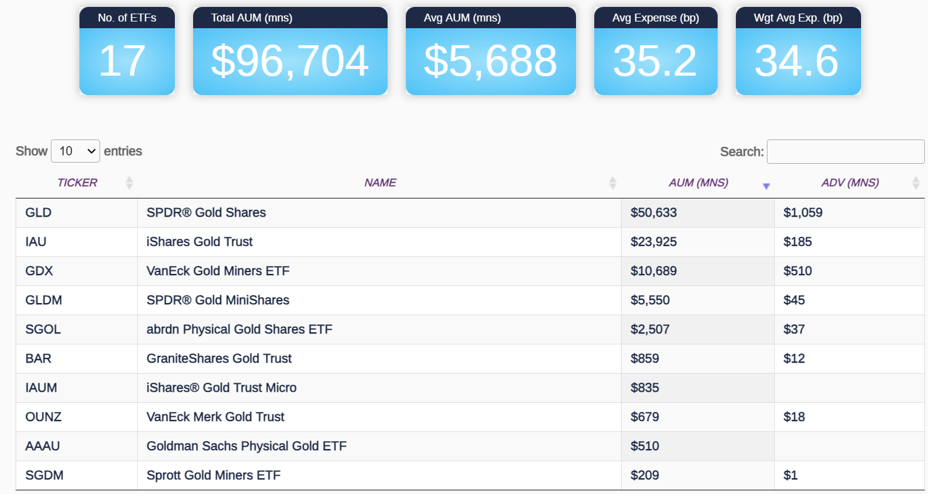
We’ve seen a similar dynamic in gold ETFs. In that space, physical gold ETFs command roughly 90% of all ETFs assets linked to gold (vs. equities-linked access in good miners or even options-laced strategies.)
If you are brainstorming a new ETF idea, are you plotting a direct path to a market segment or an asset, or are you lost in a detour?
Gold ETFs
-
First movers are rarely displaced, but if you can’t be first, be the loudest.
First-of-a-kind ETFs typically have an upper hand relative to their late-coming competitors. Rarely does a first mover gets displaced or demoted from category leader by a clone ETF. We often see that assets that flock to a first mover ETF tend to be sticky, unless, of course, there’s real disruptive innovation within a category.
However, the ETF universe is increasingly crowded, so finding white space to be truly original is getting harder and harder.
If originality – or true disruption through innovation – is not in the cards for you, the next best thing is to be a great storyteller. Every ETF is a story to be told, and those who do it well (with simplicity), do it often (repetition is great), and do it loudly (attack all media-channels/formats available to you) tend of find better success than those who do not.
You may not have an original idea, but it may still be a really interesting idea that can stand on its own and be a successful ETF if you are willing to be a face for that product.
-
ETFs are exchange-traded. Is your ETF idea tradable?
One of the beauties of ETFs is the creation/redemption mechanism that powers up the supply of ETF shares – and keeps share prices in line with the value of the strategy’s underlying holdings. All of that trading happens with the help of market makers and authorized participants.
More importantly, every ETF has a lead market maker, and that’s not a structural given – that’s earned business because LMMs step in where there’s real opportunity for them. That means that a new ETF idea must first pass the LMM muster – can a market maker actually support it?
One LMM put it this way: Ask yourself, “can the market maker hedge exposure either perfectly, if not imperfectly, in the ETF via some underlying market?”
This is all about risk management. If a LMM cannot hedge their position because, say, the underlying market is not deep enough or not mature enough, or there aren’t vehicles to hedge their risk – in options/derivatives/futures – chances of enlisting the help of an LMM may be difficult for that ETF.
If an idea does not materialize in a tradable exposure for the ETF, go back to drawing board and think some more.
-
ETFs are a team sport, so is your team solid?
A lot of times ETFs have different players in different teams – advisors, subadvisors, board of directors, capital markets, marketing and distribution, etc, etc. When it comes to making tactical and strategic decisions on the day-to-day management of an ETF – think allocation of resources for operations and distribution – is everyone on the same page?
One of the common pitfalls we’ve seen when it comes to partners in this business is mismatched expectations. ETFs are a tough business that can feel more like a cash incinerator than a builder of wealth at first. Hitting a stride that pushes a new fund above breakeven levels and ultimately into the big asset leagues can take time, patience and commitment. It most certainly takes a team playing well together.
Making sure everyone involved in your ETF shares the same conviction in the product that you do is a secret to longevity, and quite honestly, for making sure work can be fun, too.
Enjoyed this article? Sign up for our newsletter to receive regular insights and stay connected.