

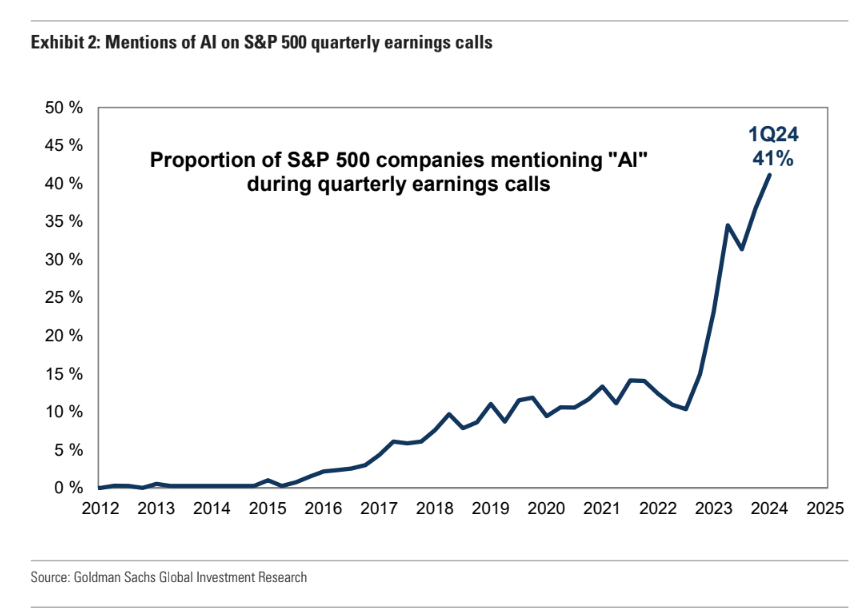
Artificial intelligence (AI) is front and center in discussions across business and economic spheres, with experts, executives, and the general public debating its potential and challenges. The consensus is clear: AI is a critical technology that cannot be ignored. This is evident in the ubiquity of AI mentions in earnings calls, highlighting its significance in today’s business landscape. In light of this, I’d like to share three insightful thoughts from recent earnings calls on AI and its impact.
Goldman Sachs
Is AI Overhyped and Not Worth It?
While AI’s potential for revolutionary change is undeniable, it’s crucial to balance the optimism with a critical eye toward overinflated expectations and significant costs. Despite heavy investments, many companies haven’t yet seen substantial revenue increases from AI. Gains are often limited to small areas like improving coding efficiency or streamlining repetitive tasks. This raises valid concerns about the return on investment [ROI] for AI. Can companies truly recoup the vast sums poured into this technology? Will the promised transformative effects materialize into tangible financial gains? I agree with Jim Covello, the Head of Global Equity Research at Goldman Sachs (GS) who has argued that as structured currently, AI’s current capabilities primarily enhance existing processes rather than create groundbreaking innovations. AI’s current capabilities primarily focus on making existing processes more efficient, but even these efficiency improvements are overestimated and costly. Even though, AI can help update historical data in company models more quickly than manual methods, but at six times the cost! Is it worth it, then?
Currently, AI has shown the most promise in making existing processes—like coding—more efficient, although estimates of even these efficiency improvements have declined, and the cost of utilizing the technology to solve tasks is much higher than existing methods. For example, we’ve found that AI can update historical data in our company models more quickly than doing so manually, but at six times the cost
—- Source Jim Covello, the Head of Global Equity Research at Goldman Sachs
In the current hype cycle, such questions may seem daunting, but as time progresses, investors and shareholders will demand tangible results. The true test for AI lies in its ability to deliver meaningful value beyond incremental improvements. Important to note that the substantial costs involved in building and running AI technology necessitate solving extremely complex and important problems to justify the return on investment. Goldman Sachs estimates that the AI infrastructure build out will cost over $1 trillion in the coming years, covering expenditures on data centers, utilities, and applications. Covello questions what problem worth $1 trillion AI will solve, drawing a parallel with the early days of the internet, which provided low-cost technology solutions that replaced more expensive incumbent solutions. He notes that AI, in its current form, does not align with this historical trend, as it is exceptionally costly and not designed to solve the complex problems that would justify such expenses.
My main concern is that the substantial cost to develop and run AI technology means that AI applications must solve extremely complex and important problems for enterprises to earn an appropriate return on investment [ROI]. We estimate that the AI infrastructure buildout will cost over $1tn in the next several years alone, which includes spending on data centers, utilities, and applications. So, the crucial question is: What $1tn problem will AI solve? Replacing low-wage jobs with tremendously costly technology is basically the polar opposite of the prior technology transitions I’ve witnessed in my thirty years of closely following the tech industry
—- Source Jim Covello, the Head of Global Equity Research at Goldman Sachs
Temper the Expectations
Listening to Demis Hassabis, CEO of Google (GOOG) (GOOGL) DeepMind discussing with the Ex-UK Prime Minister Tony Blair on the opportunities AI presents, one cannot but go away acknowledging that AI is still far from achieving human-level intelligence that everyone fears. Hassabis points out that while AI can outperform humans in specific tasks like game playing, it still lacks the general intelligence equivalent to even a cat. This offers a strong counter-argument to many who are worried about AI reaching and surpassing human intelligence soon. It is clear that significant breakthroughs are required to advance AI to a level where it can generalize its capabilities effectively. It offers a reminder that we are still at an early stage in AI development, and there is a considerable journey ahead before AI can meet the lofty expectations placed upon it. Temper our expectations.
“Well, initially, it will be, you know, that’s an interesting scientific debate at the moment. Of course, at the moment, we’re far from human-level intelligence across the board. But in certain areas, like game playing, we’re better than the best people in the world. Now the question is, what will happen overall when we start generalizing this? But at the moment, we’re still not even at cat intelligence yet as a general system. So, we’ve got a long way to go. You know, I think there’s a lot of big breakthroughs that are still needed. I’m of the opinion that we’re going to need both scaling the existing systems and some big, big new breakthroughs.” –
—Google DeepMind CEO Demis Hassabis [Source: Tony Blair Institute for Global Change]
AI Energy Efficiency
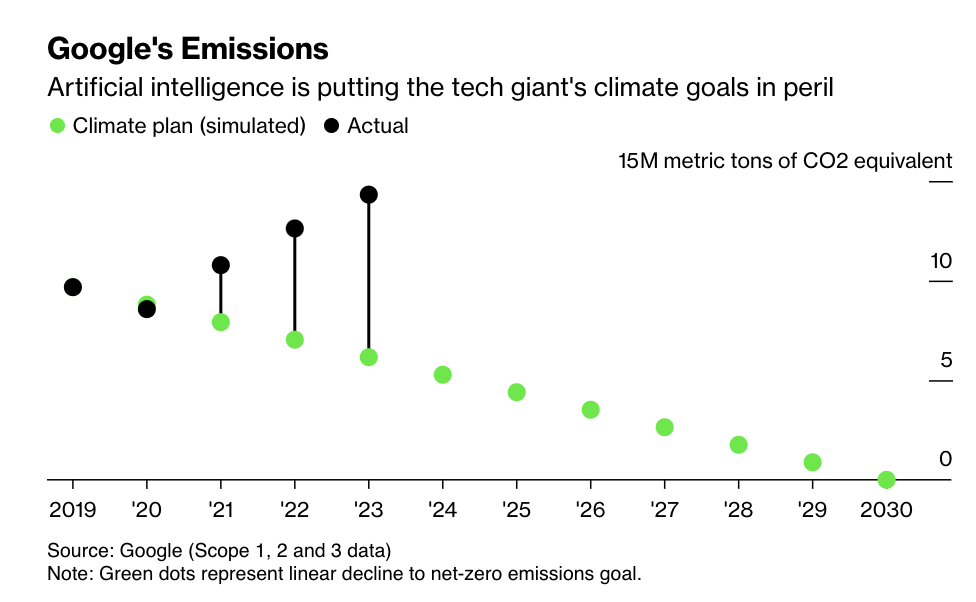
The rise of AI, with its substantial computational needs and intricate algorithms, has dramatically increased energy consumption. Training and operating advanced AI models demand significant processing power, resulting in a considerable energy footprint. This is especially true for the development of large language models, image-generation tools, and other data-heavy AI applications. The widespread adoption of AI across industries such as healthcare, finance, manufacturing, and transportation further escalates its energy use. As AI continues to advance and integrate into everyday life, the energy required to support these technologies is expected to grow exponentially. It is no surprise then that Alphabet has shifted from a focus on “carbon neutrality” to focusing on “carbon removal”. Google has also stopped claiming carbon neutrality, shifting its focus to achieving net-zero emissions by 2030 due to evolving sustainability criteria and a more robust carbon-removal ecosystem. This change coincides with Google’s AI-driven energy consumption surge, resulting in a 48% increase in emissions since 2019. The message is clear: AI is an intensely energy-consuming activity.
Bloomberg
While these concerns are very valid, I was encouraged to see BP (BP) Group’s Chief Economist, Spencer Dale offer a more optimistic perspective on AI’s impact on energy. He believes that AI’s ability to optimize energy efficiency, digitize grids, streamline industrial processes, and accelerate the discovery of new materials for carbon capture, utilization, and storage (CCUS), could offset its energy consumption. This suggests that AI’s net impact on energy demand might be smaller than anticipated, potentially even leading to a reduction in demand over time. This means that AI has the potential to contribute to a more energy-efficient and sustainable future:
I’m a little bit more optimistic than you in terms of the impact of AI is how AI can improve energy efficiency, how it can start to help us digitize grids, how it can help us improve industrial processes, how it can start to find new materials that we can use for and advances that we can use for CCUS and so on. And so that’s likely to reduce that direct impact. How much, so the net impact of AI, I think, is going to be less than the numbers you see at the moment, which only looks at the positive side. And in some sense, there are many commentators out there that actually think that in the medium term, the net impact of AI will be to reduce energy demand, helping the world become more and more efficient and not — and more than offsetting that positive impact. So I think the truthful answer is I don’t know”
—- BP Group’s Chief Economist, Spencer Dale [Source: BP]
Conclusion
In summary, while AI is often heralded as a revolutionary technology, it faces criticism for its overhyped expectations and high costs, especially the fact that it only enhances existing processes rather than driving true innovation. Moreover, despite its impressive performance in specific tasks, AI remains far from achieving human-level intelligence, indicating that we are still in the early stages of its development and that much patience is needed here. However, AI holds significant potential to improve energy efficiency, digitize grids, and optimize industrial processes, which could reduce energy demand and support sustainability efforts in the long term.
Enjoyed this article? Sign up for our newsletter to receive regular insights and stay connected.