

Some Takeaways for Mid-September – Mid-October:
- Our recent check of Bitcoin’s technicals and fundamentals has strengthened our conviction that bitcoin is poised for a high-volatility catch-up rally. Despite its recently subdued volatility compared to other asset classes, mounting signs—including political momentum, increasing institutional adoption, and bullish on-chain and market data—indicate the likelihood of an impending breakout.
- We noticed this month that publicly traded bitcoin miners, who now control a record ~30% of the global hashrate, have significantly increased their bitcoin (BTC) holdings. The U.S.-listed miners in our coverage added 2% to their BTC treasuries MoM in September, continuing their 11% MoM holding/buying spree from August despite increased prices. These additions coincide with an increasing number of BTC that has been untouched for 6+ months (currently in the 95% percentile vs. all-time history).
- A growing list of public companies around the world are duplicating the corporate treasury strategy pioneered by MicroStrategy (+194% YTD). Corporate holdings of BTC rose 8% last month, led by MicroStrategy and German and Japanese firms.
- We did some quantitative analysis on the predictive power between ETP flows and bitcoin price. Our findings support the conclusion that institutional flows are leading price, not following it.
- Bitcoin’s Price Action
- Bitcoin ETPs and Price Correlation
- Bitcoin ChainCheck Monthly Dashboard
- Bitcoin’s Network Activity, Adoption, and Fees
- Bitcoin Miners
Bitcoin’s Price Action
Bitcoin’s price rose by 11% month-over-month (MoM), continuing to form higher highs and higher lows since the market bottomed in August. Still, volatility remains subdued relative to other FX pairs and investable asset classes. Recent positive poll numbers for Trump appear to be leading Bitcoin’s latest rally, the impact of which can be seen in a decline in the % of coins that have moved in the last 6 months: now just 17%, in the third percentile of activity. We believe this “buy and hold” activity highlights BTC’s growing appeal as a macro-hedge, particularly among institutional investors. Indeed, BitcoinTreasuries.net data shows that public companies have increased their bitcoin holdings by ~8% since September 11th. Notable examples include Samara Asset Group’s (SRAG GY) recently announced plans to offer up to €30m in senior bonds to purchase bitcoin. Japanese real estate manager Metaplanet, Inc. rallied over 15% on October 15th after the firm announced adding another 1 billion yen worth of bitcoin, bringing their total BTC treasury to ~855 BTC (~$56 million .D). Metaplanet shares are up 675% in the last 12 months.
Moreover, exchange-traded products (ETPs) and other funds hit a record-high aggregate ownership at nearly 1.1 million bitcoins in late September, approaching the same ownership level as Satoshi Nakamoto. Lastly, in a sign the U.S .market may be opening up to banks, BNY, the largest custodian bank in the world, received an SAB 121 exemption from the SEC to custody crypto assets for digital asset ETPs, sidestepping the onerous requirement to list crypto as balance sheet liabilities. While the exception is limited, it potentially paves the way for the future of bank-custodied digital assets, pending discussions of “additional use cases” with the SEC.
- Market Sentiment: The percentage of Bitcoin addresses in profit grew by 6% over the past 30 days, with nearly nine out of ten addresses sitting on gains today. The unrealized profit/loss ratio also improved by 6%, signaling a more positive outlook compared to the summer months, despite currently sitting at a neutral 0.48 on the 7-day average. Both metrics, at the 71st and 67th percentiles of their all-time history, suggest significant room for upside potential as the next leg of the bull market develops after eight months of choppy price action.
- Bitcoin dominance: Bitcoin’s dominance ticked up one point to 57%, maintaining highs not seen since April 2021 and further solidifying its status as the primary store of value within the crypto market. As detailed in last month’sreport, we think Bitcoin is uniquely positioned among crypto assets to thrive in either a pro-crypto or crypto-hostile administration. We believe ongoing hostility from U.S. regulators like Gary Gensler toward non-Bitcoin digital assets could disrupt the usual pattern of Bitcoin dominance peaking around election time. While sectors like DeFi, L1s, L2s, and GameFi have seen short-term outperformance, Bitcoin has maintained its gains more consistently, as shown in this month’s Chart of the Month. A more crypto-friendly Trump administration could potentially reverse this trend by introducing clearer regulations and de-risking investments in the more participatory proof-of-stake crypto assets.
- Regional trading: The long-term geographical trend of Asia selling bitcoin to the U.S. and Europe remains intact, with traders during U.S. and EU hours driving the strongest price performance, +2% and +4%, respectively, in the last month.
| Regional Trading | MoM Change (%) | YoY Change (%) |
| Asia Hours Price Change MoM ($) | 0 | 1 |
| U.S. Hours Price Change MoM ($) | 2 | 5 |
| EU Hours Price Change MoM ($) | 4 | 4 |
Source: Glassnode, as of 10/14/24. Past performance is no guarantee of future results.
- Funding Rates: Over the past month, the 7-day moving average of annualized bitcoin futures funding rates rose by 8%, reflecting increased risk appetite as prices recovered. At the 49th percentile of its historical range, this indicates relatively neutral sentiment—especially given bitcoin’s historically bullish market bias—suggesting room for increased leverage among aggressive traders.
Bitcoin ETPs and Price Correlation
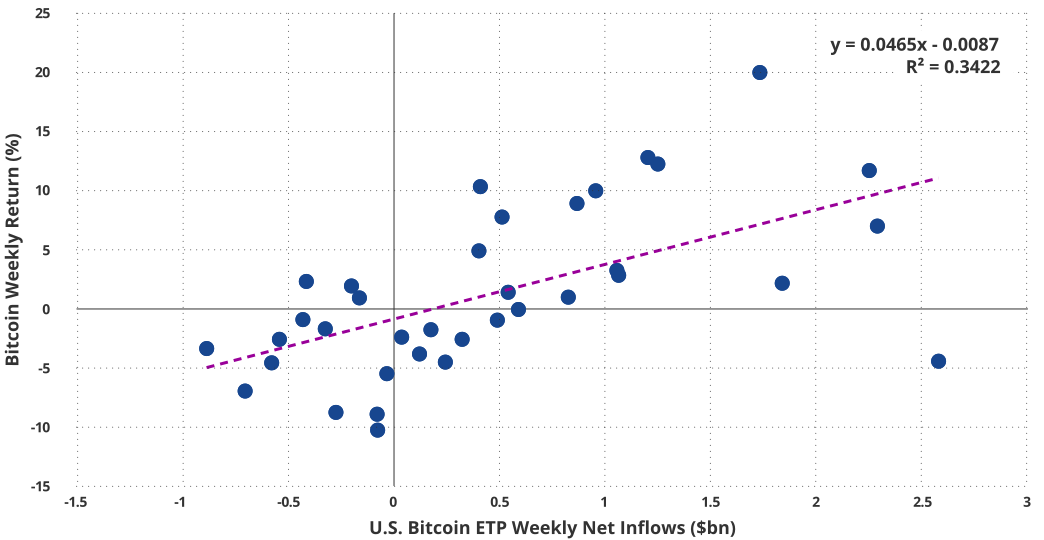
One of the standout findings this month is the growing influence of bitcoin ETPs on the market, marking a pivotal shift in bitcoin’s market structure. U.S. bitcoin ETP net inflows totaled $19.4 billion through October 14th. The correlation between weekly ETP inflows and bitcoin’s returns has shown a strong positive relationship, with an R² value of 0.3422. This trend became even stronger when analyzing weeks from July 1st – September 22nd, which yielded an R² value of 0.5791. Interestingly, we also found that daily ETP flows also showed some modest predictive power for BTC price changes in the following after-hours trading period (R² = .0527), demonstrating a spillover of US “TradFi” market momentum into the 24/7/365 crypto markets.
U.S. Bitcoin ETP Inflows Help Drive Price Discovery
Source: Farside, Glassnode, YTD through September 30th.
These findings suggest that institutional participation via ETPs is playing an increasingly important role in bitcoin’s price discovery process. When examining the reverse relationship, we found a less statistically significant impact. Bitcoin’s after-hours returns (price movements overnight, on weekends, and on holidays) showed some predictive power for U.S. bitcoin ETP inflows on the following trading day (R² = 0.1261), suggestive of institutional momentum-chasing. We found this relationship strengthened on a weekly basis, with one week’s bitcoin returns explaining the variance of the following week’s U.S. bitcoin ETP inflows with an R² value of 0.3422. However, when filtering for July 1st– September 22nd, we found that there was no statistically significant relationship between bitcoin’s returns in each given week and U.S. bitcoin ETP flows in the following week. These findings underscore the idea that institutional flows are leading price, not following it.
| Directionality of Prediction | R2 | Slope | Statistically Significant? (α = 0.05) |
| U.S. Bitcoin ETP Daily Net Flows (BTC) 🡒 After-Hours BTC Return (%) |
0.0527 | y = 3E-05x – 0.0004 | Yes |
| After-Hours BTC Return (%) 🡒 U.S. Bitcoin ETP Daily Net Flows (BTC) |
0.1261 | y = 2989.3x + 94.964 | Yes |
| U.S. Bitcoin ETP Weekly Net Flows ($bn) 🡒 Next Week’s BTC Return (%) |
0.00002 | y = -0.0004x + 0.0151 | No |
| This Week’s BTC Return (%) 🡒 Next Week’s U.S. Bitcoin ETP Net Flows ($bn) |
0.2974 | Y= 6.9016x + 0.3998 | Yes |
| U.S. Bitcoin ETP Weekly Net Flows ($bn) 🡒 Same Week’s BTC Return (%) |
0.3422 | y = 0.0465x – 0.0087 | Yes |
| U.S. Bitcoin ETP Weekly Net Flows ($bn) 🡒 Next Week’s BTC Return (%) (July 1st – September 22nd only) |
0.0858 | y = 2.3691x + 0.3213 | No |
| U.S. Bitcoin ETP Weekly Net Flows ($bn) 🡒 Same Week’s BTC Return (%) (July 1st – September 22nd only) |
0.5791 | y = 0.1028x – 0.0207 | Yes |
Source: Farside, Glassnode, YTD through September 30th. R-squared, the coefficient of determination, is a statistical measure that indicates the proportion of the variation in a dependent variable that is explained by the independent variable(s) in a regression model.
Bitcoin ChainCheck Monthly Dashboard
| As of October 15th, 2024 | 7-day avg | 30 day change1(%) | 365 day change (%) | Last 30 days Percentile vs all-time history (%) |
| Bitcoin Price | $ 62,493 | 8 | 131 | 97 |
| Daily Active Addresses | 690,451 | -3 | -21 | 66 |
| Daily New Addresses | 276,290 | -8 | -29 | 56 |
| Daily Transactions | 661,649 | 13 | 144 | 97 |
| Daily Inscriptions | 9,055 | -63 | -45 | 30 |
| Total Transfer Volume (USD) | $ 40,178,512,677 | -30 | 103 | 85 |
| % Supply Active, last 180 days | 17% | -14 | 1 | 3 |
| % Supply Dormant for 3+ Years | 46 (%) | 0 | 13 | 98 |
| Avg Fees (USD) | $ 2.66 | 257 | 43 | 57 |
| Avg Fees (BTC) | 0.00004 | 228 | -38 | 9 |
| Percent of BTC Addresses in profit | 88 | 6 | 34 | 71 |
| Unrealized profit/loss ratio | 0.48 | 6 | 81 | 67 |
| Global Power Consumption (TWh) | 130 | 2 | 51 | 99 |
| Total Daily BTC Miner Revenues (USD) | $29,868,367 | 19 | 11 | 84 |
| Total Crypto Equities’ Market Cap* (USD) (MM) | $134,115 | 20 | 159 | 73 |
| Transfer volume from Miners to Exchanges (USD) | $3,056,250 | 50 | -59 | 72 |
| Bitcoin Dominance | 57% | 1 | 13 | 82 |
| Bitcoin Futures Annualized Basis | 8% | 11 | 86 | 49 |
| Mining Difficulty (T) | 92 | 0 | 59 | 100 |
* DAPP market cap as a proxy, as of Oct 14th, 2024
1 30 day change & 365 day change are relative to the 7-day avg, not absolute
Source: Glassnode, VanEck research as of 10/15/24. Past performance is no guarantee of future results.
Bitcoin’s Network Activity, Adoption, and Fees
On-chain metrics for Bitcoin have shown mixed results over the past month:
- Daily transactions: Daily transactions grew 13% MoM. Transaction activity is historically high at the 97th percentile.
- Ordinals inscriptions: Daily inscriptions (e.g. Bitcoin NFTs) transactions fell 63% MoM, a significant pullback from the Ordinal ecosystem’s surge in activity in early September.
- Total transfer volume: Total transfer volume declined by 30% MoM. However, this metric is somewhat overstated, as last month’s transfer volumes peaked at highs not seen since April. Transfer volumes remain up 103% YoY and sit at their historical 85th percentile.
- Average transaction fees: USD-denominated transaction fees increased by 257% to an average of $2.26 MoM, driven recently by increased Runes transactions. Runes are a type of fungible token standard on Bitcoin, primarily used for meme trading. While up 43% YoY in USD terms, fees are down 38% YoY in bitcoin (BTC) terms, pointing to the necessity of bitcoin’s continued price appreciation for healthy miner economics. Bitcoin’s so-called security budget, comprised of Bitcoin’s (deflating) mining rewards and network transaction fees, remains a topic of concern for the network’s long-term health. However, having weathered the four-year halving cycle reset this April, it is a relatively distant concern.
September Bitcoin Mined, Bought, and Sold by Pure-Play Miners

Source: Company Filings, VanEck Research as of 10/14/2024.
Bitcoin Miners
- Total daily BTC miner revenues: Driven by higher prices and increased transaction fees from network activity, miner revenues reached ~$29.9 million, a 19% MoM increase.
- Transfer volume from miners to exchanges (USD): After reaching YTD lows in early September, Bitcoin transfers from miners to exchanges increased by 50% MoM. Curiously, however, the U.S.-listed miners that we cover appeared to increase their holdings. This parallels the trend of European and American traders accumulating Bitcoin from Asian sellers. Among the 12 U.S.-listed miners in our coverage, the 9 maintaining Bitcoin treasuries have continued to increase their aggregate BTC holdings, driven primarily by the pure-play miners we noted in our AI/HPC research: MARA, RIOT, and CLSK. While other miners like CORZ and CIFR have divested from their BTC treasuries to fund AI/HPC buildouts, these pure-play miners are emulating MicroStrategy’s leveraged Bitcoin approach by increasing their BTC positions. MARA particularly stood out for continuing its months-long Bitcoin buying spree, financed by ~$244 million in convertible note proceeds announced in August.
- Publicly traded miners’ hashrate dominance: Publicly traded Bitcoin miners now control a record ~30% of the global hashrate. This concentration means that any further pivots by these listed miners toward AI/HPC could have significant implications for global hashrate and difficulty. Divesting from mining reduces the global hash rate and mining difficulty, making the sector more profitable for remaining players, all else being equal.
- Rise of the pivotoors: As of October 14th, CORZ (+278%) leads our covered Bitcoin miners YTD. In fact, only miners that have announced AI/HPC pivots are positive on the year: CORZ, WULF (+97%), IREN (+26%), and CIFR (+5%). As referenced above, in late September, CIFR announced selling over one-third of its bitcoin treasury to finance the acquisition of its new West Texas Barber Lake site. Similarly, in early October, WULF sold its 25% equity interest in the Nautilus Cryptomine joint venture to fuel further the expansion of its AI/HPC and self-mining efforts at its Lake Mariner facility.
- Better late than never: In a fireside chat with Bernstein on October 3rd, RIOT’s CEO Jason Les discussed the potential suitability of its Rockdale and Corsicana sites for AI/HPC. Relative to its peers, RIOT has been late in joining the AI/HPC discussion. Justifiably, Mr. Les explained that Riot does not want to create unnecessary hype nor invest in AI/HPC infrastructure without a customer. With MARA indicating in March its strategic initiative to diversify its operations with its MARA 2PIC700 immersion cooling system, CLSK remains perhaps the only U.S.-listed miner in our coverage unequivocally committed to remaining a “pure-play” bitcoin miner—at least for now. Echoing RIOT’s reluctance to create undue hype, CLSK’s CEO Zach Bradford expressed skepticism about bitcoin miners’ ability to compete for high-quality revenues, stating that despite CLSK owning two buildings that could meet AI/HPC data center criteria, they are choosing to remain focused on efficient bitcoin mining. As of October 14th, RIOT is the best-performing mining stock over the last month, +25%.
Chart of the Month: Bitcoin’s 2-Year Performance vs. Other Crypto Asset Categories

Source: TheTie as of 10/11/2024. Past performance is no guarantee of future results.
Notes:
Net unrealized profit/loss ratio (NUPL) can be calculated by subtracting the realized market cap from the market cap and dividing the result by the market cap. When a high percentage of Bitcoin’s market cap consists of unrealized profits, it can be interpreted that investors are greedy. Background reading here.
Links to third party websites are provided as a convenience and the inclusion of such links does not imply any endorsement, approval, investigation, verification or monitoring by us of any content or information contained within or accessible from the linked sites. By clicking on the link to a non-VanEck webpage, you acknowledge that you are entering a third-party website subject to its own terms and conditions. VanEck disclaims responsibility for content, legality of access or suitability of the third-party websites.
Enjoyed this article? Sign up for our newsletter to receive regular insights and stay connected.