
By Christopher Gannatti, CFA, Global Head of Research; and Samuel Rines, Macro Strategist, Model Portfolios
Key Takeaways
- In 2025, Europe accelerated its defense revival with Rheinmetall opening the continent’s largest shell factory, a critical step toward meeting NATO’s artillery needs amid the ongoing war in Ukraine.
- While HENSOLDT strengthens Europe’s radar and electronic warfare capabilities across air, land and sea, RENK ensures mobility and maintenance readiness for tanks and fleets critical to deterrence.
- For investors seeking exposure to Europe’s military industrial buildout, the WisdomTree Europe Defense Fund (WDEF) offers targeted access to key players like Rheinmetall, HENSOLDT and RENK.
Europe’s rearmament isn’t just about ordering more kit; it’s about fixing the bottlenecks that make a credible deterrent possible: ammunition at scale, sensors that see first and systems that keep fleets moving. Three German champions, Rheinmetall, HENSOLDT and RENK, sit at the core of that effort. Together they’re rebuilding depth (stocks), sharpening edge (effects) and hardening resilience (uptime and supply chains) across NATO’s1 front line.
Resilience Reloaded: Rheinmetall’s Answer to Europe’s Defense Gaps
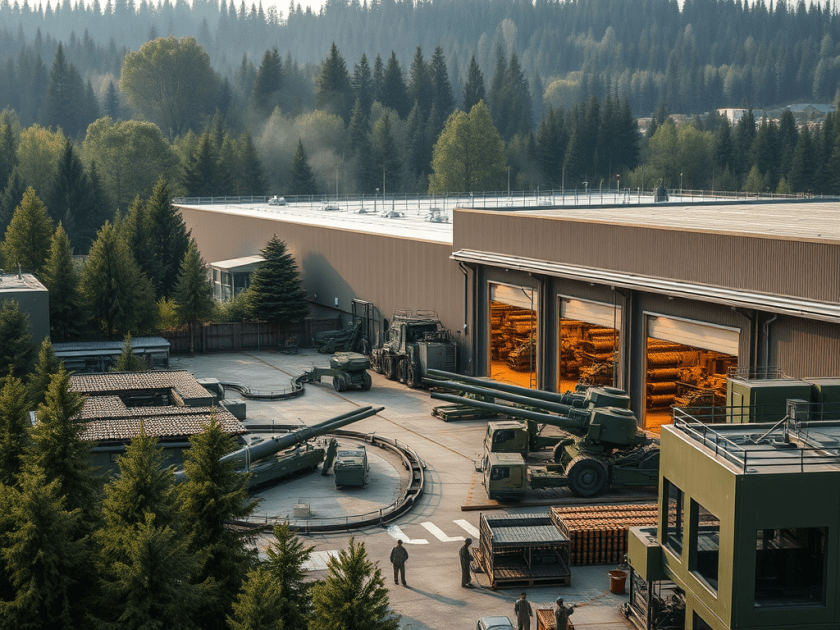
On August 27, 2025, in the pine forests of Lower Saxony, Rheinmetall swung open the gates of Europe’s largest ammunition factory. At first glance, Unterlüß looks like an industrial park of anonymous warehouses. In reality, it is a cornerstone of Europe’s defense revival. The €500 million facility will be capable of turning out about 350,000 155mm artillery shells each year by 2027. That’s enough ammunition to match several months of Ukraine’s current artillery fire tempo, produced every year, on German soil. Across Rheinmetall’s wider network, the company aims for 700,000 shells annually, a cornerstone contribution to the European Union’s target of 2 million rounds per year.2
Europe has learned the hard way that a military without shells is like a car without fuel. That’s why Rheinmetall isn’t just building one factory. To de-risk bottlenecks in explosives and logistics, it is investing more than €1 billion in a joint venture in Bulgaria to localize gunpowder and shell production, with a parallel ammunition project underway in Romania.3 These moves mean Europe’s stockpiles don’t depend on a single link in the chain or on suppliers thousands of kilometers away.
But filling production lines isn’t just about quantity; it’s about versatility. Rheinmetall’s artillery catalog spans everything from high-explosive rounds to smoke shells that conceal troop movements, illumination rounds that light up the battlefield in infrared and extended-range options that push NATO-standard 155mm guns farther. The Bundeswehr’s4 DM121 and DM125 and the SMArt sensor-fuzed round add precision and specialized effects. The point isn’t just firepower, it’s interoperability. A French howitzer and a German one can fire the same family of shells, reducing the logistical headaches that plagued past wars.
Artillery alone, however, doesn’t secure supply lines, depots or cities. Europe has also rediscovered a Cold War lesson: short-range air defense (SHORAD) is essential. Missiles like Patriot are powerful, but at millions of euros per shot, they are too costly to swat down cheap drones or cruise missiles flying in swarms.5 Rheinmetall’s answer is Skynex and Skyranger 30, gun-based systems that restore affordable volume. Skynex fires 35mm programmable AHEAD rounds that burst into a lethal cloud of tungsten pellets, shredding drones at a fraction of missile cost.6 Think thousands of euros per burst instead of hundreds of thousands. That economics is strategy: Europe can’t afford to run out of interceptors after the first week.
The market has responded. In 2024, Rheinmetall booked a six-figure order for AHEAD cartridges, worth low triple-digit millions in euros, showing just how seriously governments are buying in. And in early 2025, Germany took delivery of its first Boxer-mounted Skyranger 30, with full series production to follow.7
Ukraine’s battlefield experience has validated this approach. The venerable Gepard, a 1970’s cannon system, has become a frontline hero against drones. Rheinmetall’s Skynex builds on that heritage with a digital backbone, networked radars and modular launchers. When Kyiv says guns are saving its cities from Shahed8 drones, European capitals listen.
Rheinmetall, in short, has become Europe’s resilience factory. Mass shell production closes the continent’s most acute readiness gap. Localized powder and ammunition projects spread risk across borders. Gun-based SHORAD restores affordable depth to air defense in an era where “everything is a drone.” And a diverse portfolio of artillery effects means NATO can fight without reinventing its supply chain.
Unterlüß is more than a factory; it’s a symbol that Europe is relearning how to deter.
HENSOLDT: The Eyes of Resilience
Deterrence doesn’t just depend on how many shells you can fire; it begins with what you can see. From low-flying drones trying to sneak under radar to cruise missiles approaching in salvos, survival hinges on detection, tracking and classification. That’s where HENSOLDT comes in.
At the center is the TRML-4D radar, the “eyes” of the IRIS-T SLM air-defense battery. Ukraine has fielded it at pace, and European capitals are lining up orders. Its digital backbone means the radar updates faster and paints a cleaner picture of difficult, low-altitude targets, the kind that slip past older systems. The same DNA goes to sea in the TRS-4D family, already mounted on German Navy ships and soon to equip new frigates. By using common architectures across land and sea, Europe gets classic resilience multipliers: easier training, shared spare parts, smoother upgrades.
Air power is getting sharper vision too. In February 2025, HENSOLDT won a €350 million contract to push forward the ECRS Mk1 AESA radar for Germany’s and Spain’s Eurofighters.9 This gives fighters the ability to spot and track multiple threats with greater precision while laying the path for further evolutions later in the decade. On the passive side, the company’s Twinvis radar is edging toward certification with Germany’s air traffic service. Unlike traditional radars, Twinvis listens instead of broadcasting, turning civilian broadcast signals into a detection tool. That dual-use application is a milestone of maturity and positions it for homeland defense roles. Meanwhile, on the ground, the SPEXER 2000 3D MkIII is scaling up production as a counter-drone radar, a direct answer to today’s most urgent threat.
But HENSOLDT doesn’t just watch; it shapes the electromagnetic spectrum. Its Kalaetron Attack family brings software-defined jamming, flexible enough to escort aircraft, protect convoys or strike stand-off targets. With multi-target capacity and code that can be updated as adversaries adapt, it’s the kind of electronic warfare Europe needs against opponents who learn fast.
Taken together, HENSOLDT is Europe’s sensor spine. A radar stack that spans ground, air and sea. Common designs that simplify sustainment. Passive detection and counter-drone radars that match the drone era. And electronic warfare tools that evolve at the speed of software. If Rheinmetall is Europe’s arsenal, HENSOLDT is its situational awareness, the eyes that make resilience possible.
RENK: Powering Europe’s Armor and Fleets
You can’t deter if your fleets can’t move or if they break down when you need them most. RENK is Europe’s quiet giant in mobility: the company that builds the transmissions for tanks, the gearboxes for ships and the test systems that keep both ready for the long haul.
On land, RENK is indispensable. Its HSWL10 354 transmission underpins the Leopard 2 family across 18 countries, making it the unseen but essential backbone of Europe’s de facto main battle tank (MBT). For infantry fighting vehicles (IFVs), RENK’s HSWL 256 powers Germany’s Puma and the UK’s Ajax, turning raw engine horsepower into reliable traction across mud, snow and contested terrain. It’s the difference between an armored column advancing and one stalled in place.
At sea, RENK is equally critical. The company is supplying gearboxes for Damen Naval’s Dutch and Belgian Anti-Submarine Warfare frigates, with the first deliveries scheduled for October 2025. These gearboxes are engineered for quiet propulsion, vital when hunting submarines in the North Sea or across the GIUK gap, where acoustic stealth can decide who hears whom first. The first frigate enters service in 2028, bringing a badly needed anti-sub capability to NATO waters.11
But hardware is only half the story. RENK Test Systems (RTS) allow militaries to run reproducible, original equipment manufacturer (OEM)-standard diagnostics on vehicles and drivetrains without sending them back to proving grounds. Think of it as preventative medicine for fleets: catching faults before they cascade into breakdowns. Add to that RENK’s lifecycle services, spares, field repair and overhauls, and the result is higher readiness across Europe’s armor and infantry fighting vehicle fleets.
Looking ahead, RENK is plugged into Europe’s MARTE initiative, which is shaping the next generation of heavy armor. By leveraging its Leopard and HSWL experience, RENK is positioned to accelerate a common, scalable main battle tank architecture, one transmission standard that could unify tomorrow’s fleets. That kind of standardization bakes resilience into logistics, just as NATO has done with ammunition calibers.
Running on RENK means commonality. Common transmissions and gearboxes simplify spare parts. Test systems and field service keep vehicles available longer. Quiet naval propulsion strengthens Europe’s anti-submarine posture. If Rheinmetall is Europe’s arsenal and HENSOLDT its eyes, RENK is the drivetrain, the power that keeps fleets moving and deterrence credible.
The Strategic Through-Line: Capacity, Commonality, Cost
Capacity. Europe’s most urgent weakness has been simple: not enough shells, radars or service bandwidth to sustain a fight. Rheinmetall’s Unterlüß plant, backed by regional ammunition joint ventures in Bulgaria and Romania, is the most tangible answer yet to the “shell hunger” problem. HENSOLDT’s radar lines add detection power at scale, while RENK’s test systems and lifecycle services ensure that tanks and fleets don’t sit idle when they’re needed most. Capacity is the foundation of deterrence; without it, everything else is theory.
Commonality. Europe has also learned that a patchwork arsenal is a fragile one. By standardizing across families, TRML-4D and TRS-4D radars, Leopard-based transmission, and modular EW/radar architectures, armies and navies simplify training, reduce the spares burden and make upgrades predictable. Commonality turns dozens of national programs into something closer to a collective capability.
Cost. Sustained deterrence isn’t just about volume; it’s about affordability. Rheinmetall’s 35mm programmable rounds for Skynex and Skyranger demonstrate how to intercept drones at thousands of euros per burst, not hundreds of thousands. That cost-per-effect math is what keeps defenses sustainable. Rheinmetall’s leadership has argued that scaling to serial production will reduce platform costs too, making Europe’s long-term buildup more than a budgetary blip.
The procurement horizon reflects this logic. Berlin is preparing large, multi-year orders: Eurofighters, thousands of Boxers, expanded IRIS-T and SkyRanger buys. Deliveries stretch over the next decade, but the effect is immediate: industry sees steady demand and keeps investing in capacity.
Europe’s deterrence surge is no longer a PowerPoint ambition. It is bending steel at Unterlüß, filling depots with shells, wiring new radars into networks and putting test rigs into service bays. Rheinmetall, HENSOLDT and RENK sit at the practical center of that shift: the arsenal, the eyes and the drivetrain of a continent rediscovering resilience.
One of the biggest megatrends we have seen gaining momentum in 2025 has been Europe deciding to take more responsibility for its defense and committing to spend hundreds of billions of euros to do it.12 Those investors looking to capitalize on that theme can look to the WisdomTree Europe Defense Fund (WDEF), which is designed to track, before fees, the total return performance of the WisdomTree Europe Defense Index. As of September 18, 2025, WDEF had exposure to:13
- Rheinmetall: 12.98%
- HENSOLDT: 4.31%
- RENK: 4.17%
1 NATO stands for North Atlantic Treaty Organization.
2 Source: “Rheinmetall opens 155 mm artillery shell plant in Unterlüß. Janes OSINT Insights,” Janes, 9/1/25.
3 Sources: “Rheinmetall to make shells, gunpowder in Bulgaria under €1 bln deals,” Reuters, 8/26/25; “Romania signs €535 million framework for ammunition powder factory with Rheinmetall,” Reuters, 8/27/25.
4 The Bundeswehr is the unified armed forces of Germany, encompassing the Army, Navy, Air Force, Joint Support Service and Joint Medical Service.
5 Source: N. Lindstaedt, “With no ceasefire in sight, Patriot missiles are vital to Ukraine’s survival,” Forbes, 7/14/25.
6 Source: “Major order for air-defence ammunition: Rheinmetall supplies 35 mm AHEAD ammunition worth a low triple-digit million euro amount to European customer country” [press release], Rheinmetall AG, 5/28/24.
7 Sources: “Major order for air defence ammunition: Rheinmetall supplies 35 mm AHEAD ammunition worth a low triple-digit million euro amount to European customer country” [press release], Rheinmetall AG, 5/28/24; “Mobile air defence: Rheinmetall hands over verification model of Skyranger 30 to the Bundeswehr” [press release], Rheinmetall AG, 2/5/25.
8It refers to the Shahed family of Iranian drones, most notably the Shahed-136 loitering munition (sometimes called a “kamikaze drone”), which has been widely used by Russia in Ukraine.
9 Source: “Hensoldt receives 350-million-euro contract extension for the Eurofighter radar” [press release], Hensoldt AG, 2/13/25.
10 HSWL is a family of heavy-duty automatic transmissions produced by RENK for tracked military vehicles like main battle tanks (MBTs) and infantry fighting vehicles (IFVs).
11 Source: “RENK awarded contract for anti-submarine warfare frigates” [press release], RENK Group AG, 4/4/24.
12 Source: European Commission; Economic Governance and EMU Scrutiny Unit, “ReArm Europe Plan / Readiness 2030: White Paper on European Defence / Readiness 2030 – Defence financing and spending under the Economic Governance Framework,” European Parliament, 3/25.
13 Source: WisdomTree, holdings subject to change.
Important Risks Related to this Article
For current holdings of WDEF, please click here. Holdings are subject to risk and change.
There are risks associated with investing, including the potential loss of principal. Foreign investing involves specific risks, such as risk of loss from currency fluctuation or political or economic uncertainty. Funds focusing their investments on certain sectors increase their vulnerability to any single economic or regulatory development. This may result in greater share price volatility. This Fund focuses its investments in Europe, thereby increasing the impact of events and developments in Europe that can adversely affect performance. Europe has and may continue to experience security concerns, war, threats of war, aggression and/or conflict, terrorism, economic uncertainty, sanctions or the threat of sanctions, natural and environmental disasters, the spread of infectious illness, widespread disease or other public health issues and/or systemic market dislocations that lead to increased short-term market volatility and have adverse long-term effects on European and world economies and disrupt the orderly functioning of securities markets generally, which may negatively impact the Fund’s investments. Many countries within Europe are closely connected and their economies and markets are largely interdependent. As such, economic and political events in one European country, including monetary exchange rates between European countries and armed conflicts among two or more European countries, may have adverse effects across Europe. European countries that are members of the European Union (“EU”) and the European Economic and Monetary Union (“EMU”) are subject to certain economic and monetary policies and controls and the risks associated with such coordinated economic and fiscal policies. Because the Fund invests primarily in the securities of companies in Europe, the Fund’s performance is expected to be closely tied to social, political and economic conditions within Europe and to be more volatile than the performance of more geographically diversified funds. Investments in non-U.S. securities involve political, regulatory and economic risks that may not be present in investments in U.S. securities. The securities of small-capitalization companies generally trade in lower volumes and are subject to greater and more unpredictable price changes than larger-capitalization stocks or the stock market as a whole. The Fund invests in the securities included in, or representative of, its Index. The Index may not perform as intended. Please read the Fund’s prospectus for specific details regarding the Fund’s risk profile.
Enjoyed this article? Sign up for our newsletter to receive regular insights and stay connected.