
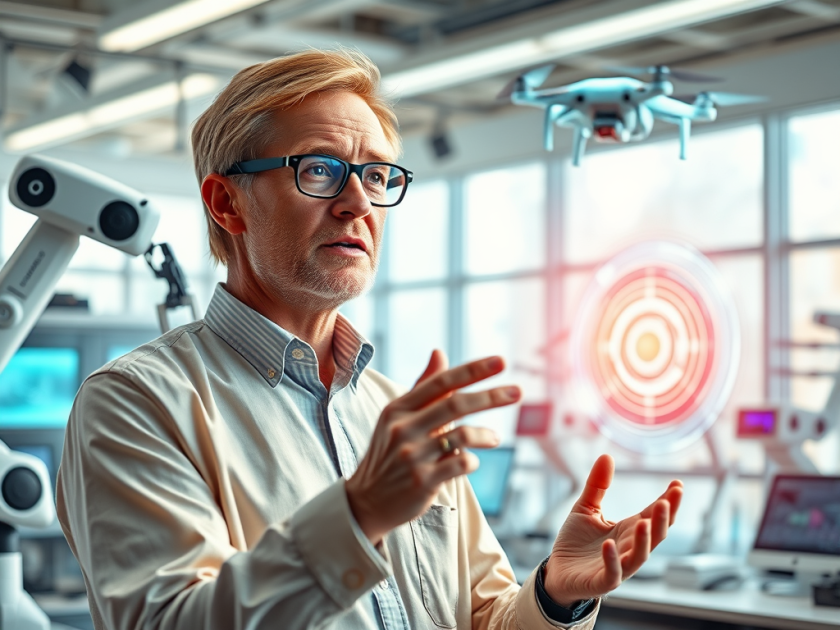
VettaFi recently sat down with Dr. Henrik Christensen, Qualcomm Chancellor’s Chair of Robot Systems and Distinguished Professor of Computer Science at University of California, San Diego, to discuss the “marriage” of AI and physical automation.
Christensen explains why the market’s fixation on sci-fi concepts has created a disconnect, leaving practical robotics companies poised for growth that is not yet priced in. The conversation also covers the engineering challenges and cross-sector advancements fueling the next wave of innovation.
This interview has been edited for length and clarity.
VettaFi: Henrik, you’ve been a pioneer, directing the government’s attention toward robotics since 2008 as the lead author of the U.S. robotics roadmap. How does it feel to see robotics finally come to the mainstream focus? Does it surprise you, and what’s at stake now?
Dr. Henrik Christensen: Good question. We have seen robotics getting big attention, but much of the traditional industrial robotics manufacturing has moved outside of the U.S., primarily to China and Japan. That is a little sad.
However, we are simultaneously seeing companies like Amazon and Symbotic driving massive growth in logistics within the U.S. A lot of that was driven by COVID; people got used to the convenience of e-shopping and delivery, creating a new wave of robotics in logistics.
The most exciting development is the marriage of AI and robotics. For a long time, they were separate. Now, they are coming together to open new opportunities in autonomous driving, drone systems, and beyond. We are going to see a new wave of growth generated by this combination that exceeds what we had anticipated.
VettaFi: What do you feel are the most underappreciated hurdles holding the technology and further adoption back right now? Conversely, what are the most underappreciated opportunities that the market is currently overlooking?
Christensen: In some sense, our biggest enemy is Hollywood because they sold a vision that robots can do anything immediately. That energy has fueled the idea that we will soon have humanoids running around everywhere. Companies are promising humanoids for home services for $30,000, claiming you can come home from work to a clean house. Nobody in robotics believes this is even remotely credible yet.
Getting from the idea to reality is incredibly hard. We are missing key technologies, specifically hands. Building a mechanical hand with the 400–500 sensors found in a human fingertip is still a research topic. Furthermore, robots lack common sense. A robot doesn’t intuitively know that a pie is a cake or where specific items go in a pantry. You cannot just tell a robot to “put away the groceries” because every household organizes differently.
Because of this, we won’t see a full jump to automated homes immediately. We will see a staged approach. Imagine a robot helping clean hotel rooms — an environment that is relatively structured and sterile compared to a home. Once we master hotels, we can move to managed care facilities, and eventually the home. We need to be intelligent about deploying robots in structured environments first to avoid failure.
VettaFi: Looking toward 2026, do you believe the market’s current valuation of robotics companies reflects what is coming, or is there a disconnect?
Christensen: The short answer is yes, but it is complicated. I think we’ve seen massive overvaluation in AI and humanoid companies where promises are easy to make but hard to deliver. They are selling a dream.
However, traditional robotics companies – those not building humanoids – are likely undervalued. We will see leveling where traditional, non-anthropomorphic systems experience significant growth. This is driven by better computer vision and AI that can be engineered for specific, optimized applications.
We are seeing realistic optimism in other areas, such as autonomous driving. Waymo just announced they are launching in six more cities. We are finally getting over the hump where this is really happening. In logistics, we will likely see “swarm” robots for last-mile delivery—imagine a truck releasing a swarm of small robots to deliver to a neighborhood.
Finally, healthcare has been conservative but is poised to take off. The world is realizing that the population is aging rapidly. Fertility rates in the industrialized world are dropping, and we need robots to provide managed care and better surgery to handle this demographic shift.
VettaFi: Is there anything that I didn’t ask about that you feel is important to add?
Christensen: It is important to note that robotics benefits from progress everywhere. I need better materials, CPUs, data centers, and batteries. There is almost no area of engineering that robotics will not benefit from.
For example, we are seeing progress in soft materials that mimic skin. This enables better grasping and manipulation so the robot doesn’t feel cold to the touch. We have an advantage: No matter where people are making progress, I can use it. People focus on the AI or the “mechanical creature,” but they forget about the component technologies. Economic growth in any of these engineering sectors allows us to grow robotics.
VettaFi: Can you share anything about what you’re up to in Singapore as a Temasek Fellow?
Christensen: I work with a number of their portfolio companies on the future of transportation and home technologies, but I also look at global strategy. Europe is focused on privacy (GDPR), while Singapore is focused on safety and density.
Singapore is a unique environment. They have rapid aging and labor shortages, but also significant wealth. Because it is a small country — you can drive across it in 40 minutes — we can conduct rapid experiments across healthcare and housing that would be difficult to do elsewhere. It allows us to test how to deploy robots in small living spaces or integrate them into a society that is used to live-in help. It has been an amazing experience to experiment at that scale.
Henrik Christensen, PHD is one of the strategic advisors for the ROBO Global Index Suite. The ROBO Global Artificial Intelligence Index underlies the ROBO Global Artificial Intelligence ETF (THNQ), the ROBO Global Robotics and Automation Index underlies the ROBO Global Robotics and Automation Index ETF (ROBO), and the ROBO Global Healthcare Technology and Innovation Index underlies the ROBO Global Healthcare Technology and Innovation ETF (HTEC).
Enjoyed this article? Sign up for our newsletter to receive regular insights and stay connected.