
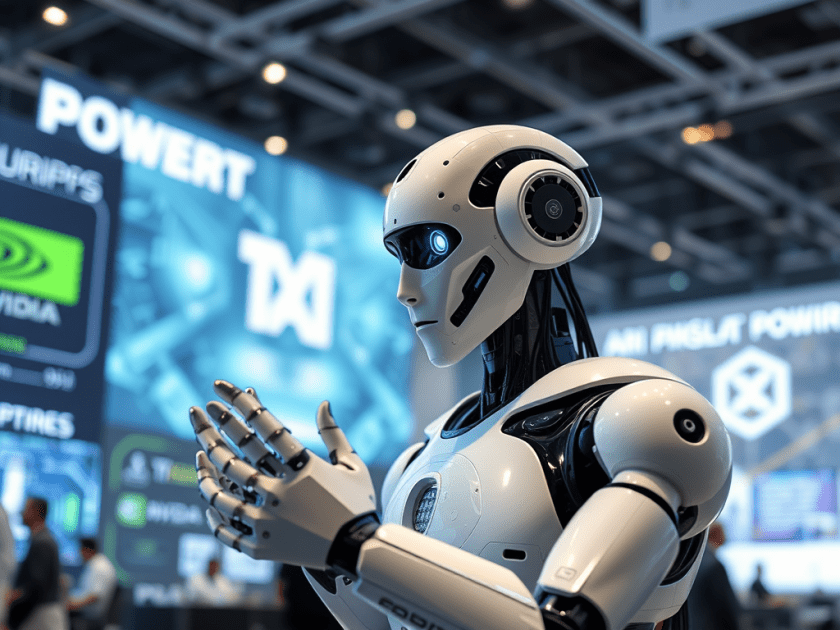
Two major industry events in December offered a window into where robotics and AI are headed in 2026, and what that means for portfolios exposed to the space.
NeurIPS (the Conference on Neural Information Processing Systems, December 2–7 in San Diego) is the premier academic conference for AI research. What gets presented here typically shows up in commercial products not too long after. This year, the big story was Vision-Language-Action (VLA) models. These systems let robots see, understand language, and act in the physical world. Now they are moving from research papers to working demonstrations.
iREX (the International Robot Exhibition, December 3–6 in Tokyo) is the world’s largest robotics trade show. Organized by the Japan Robot Association since 1974, it draws the companies that actually build and sell robots. This year’s edition was the biggest in history with nearly 700 companies presenting.
Together, these events show AI breakthroughs from the lab translating into commercial robotics hardware. For the ROBO Global Robotics and Automation Index (ROBO) and ROBO Global Artificial Intelligence Index (THNQ), several constituents made moves that should accelerate adoption and expand addressable markets.
NeurIPS: THNQ Constituents Enabling the Physical AI Stack
NVIDIA made the biggest splash by open-sourcing its robotics AI stack. GR00T N1 is the first open foundation model for humanoid robots. NVIDIA also released Cosmos (its world model platform now used by Figure AI, 1X, and other humanoid developers) and Alpamayo-R1, a reasoning model for autonomous driving. Open-sourcing these tools lowers the barrier for robotics developers globally, which should expand the ecosystem and deployment timelines for robotics solutions.
Alibaba’s Qwen team won a best paper award for a technique that makes large language models run more efficiently, already live in their latest consumer AI interfaces. Alphabet presented over 175 papers including robotics foundation models and Gemini-powered agents. For example, their Robo2VLM research showed how robot manipulation data can improve foundation models, a feedback loop that could accelerate both AI and robotics development. Meta announced SAM 3, its latest image recognition system, hitting 95% accuracy, improving performance and reducing friction for computer vision applications from personal AI assistants to robotics. These efficiency and accuracy gains matter because they bring down the cost and complexity of deploying AI at the edge, where robots operate.
Lastly, Tesla demonstrated Optimus 2.5 at NeurIPS with running gait (both feet leaving the ground), 22-degree-of-freedom hands, and autonomous charging capability. The company announced Optimus V3 for early 2026, with production scaling to one million units by late 2026. If Tesla hits that timeline, it would represent the most aggressive humanoid manufacturing ramp ever attempted, with significant implications for component suppliers across ROBO’s Actuation and Sensing subsectors. Of course, Tesla isn’t the only player in this space, so many others may collectively cause a global “rising tide.”
Physical AI Accelerates at iREX
The headline announcement from iREX was SoftBank and Yaskawa Electric signing an MOU to jointly develop “Physical AI” robots for offices, hospitals, and schools. Yaskawa, the third-largest industrial robotics company globally and a ROBO constituent, demonstrated MOTOMAN NEXT, an autonomous robot using multi-access edge computing to integrate with building management systems. This partnership signals that industrial robotics leaders see their growth coming from new environments beyond traditional factory automation, a much larger total addressable market.
FANUC, another core ROBO constituent, introduced the CRX-10iA/L Paint, the first international explosion-proof certified collaborative robot for painting. FANUC also deepened its NVIDIA partnership for AI-driven robots that respond to verbal commands. Advantech (ROBO, Computing & AI) and Orbbec unveiled an NVIDIA Jetson Thor platform delivering 2,070 TFLOPS of AI compute for humanoid applications.
Thirdly, Nabtesco, the leading precision gear manufacturer and longtime ROBO holding in Actuation, launched new humanoid-specific gears. As humanoid production scales from hundreds to thousands to potentially millions of units, component suppliers like Nabtesco are positioned to benefit from volume that dwarfs current traditional industrial robotics, which itself would warrant a CapEx cycle to fulfill the “bot making bot” world ahead of us.
Recent Q3 2025 Earnings Season Confirms the Thesis
The fundamental picture supports this momentum. For Q3 2025, ROBO constituents delivered 28.5% EPS growth and 12.9% sales growth, with 74% of reporting companies beating estimates. THNQ performed even stronger: 29.6% EPS growth and 29.7% sales growth, with 82% beating. Profitability remains high across both indices, with over 90% of constituents profitable.
The companies building the physical AI stack are generating real earnings while continuing to benefit from infrastructure investment and adoption. The agenda has moved from “can robots learn?” to “how fast can we deploy them?” in high-value areas across healthcare, agriculture, industrial automation, and even our homes. For investors, that shift from research to deployment is when revenue models scale for both AI and Robotics. This ongoing development offers a longer duration investment cycle than pureplay data center strategies, for example (yet still captures upside there, too, providing critical underlying infrastructure).
Looking for regular updates? Subscribe here for weekly insights on robotics, AI, and healthcare technology.
ROBO is the underlying index for the ROBO Global Robotics & Automation ETF (ROBO), the L&G ROBO Global Robotics and Automation UCITS ETF (ROBO.LN), and the Global X ROBO Global Robotics & Automation ETF (ROBO.AU). THNQ is the underlying index for the ROBO Global Artificial Intelligence ETF (THNQ) and the L&G Artificial Intelligence UCITS ETF (AIAI.LN).
Enjoyed this article? Sign up for our newsletter to receive regular insights and stay connected.