
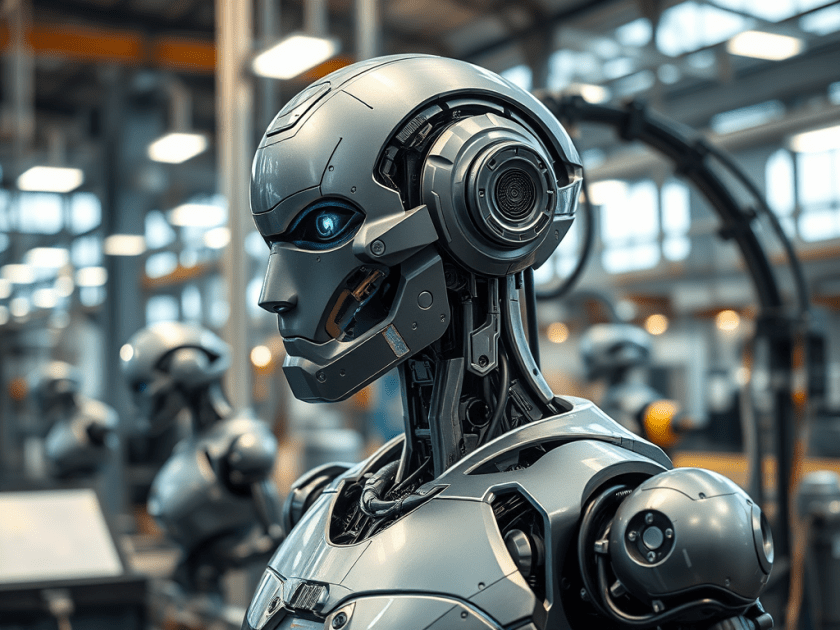
Be it Wall-E, R2-D2, or Rosie from The Jetsons, most readers grew up with sci-fi molding what a robot looks like and is capable of doing. Technology has now come so far that we no longer need to rely on Hollywood to imagine this part of the future for us. News shows and viral videos exposing us to actual hardware being developed today carry that mantle now.
We’ve moved from the imaginary to the technically possible, but most of our knowledge remains founded on what is fun to watch, rather than what is making a true difference to society. After all, Boston Dynamic’s dancing dogs and humanoids get more views than FANUC’s (6954) robots, which are involved in the production of a significant amount of all vehicles globally and have shipped over a million units.
The Invisible Army Behind the Scenes
There’s an army of robots marching behind the scenes to enable today’s lifestyle. We can divide those into industrial and service robots. FANUC is an example of the first. The industrial robot market is the larger and vastly more mature of the two. It contributes to the manufacturing of electronics, automotives, machinery, as well as behind-the-scenes logistics automation happening in warehouses across the globe. This makes it less visible to the average person.
Service robots, on the other hand, are much more likely to coexist with us. We may interact with service robots as a user or as a “colleague” of sorts. We would see these in areas like last-mile logistics, professional cleaning, or healthcare, for example. This proximity to a larger part of the population still doesn’t provide the average person with an insight into the growth or the prevalence of the technology. How many of us are aware that the number of industrial robots in operation has increased 216% in the last 10 years? It’s gone from 1.5 million in 2014 to 4.7 million in 2024.
Service Robots and Labor Realities
The latest available data from the International Federation for Robotics (IFR) estimates that 2024 saw a total of 199,000 professional service robots installed, a 9% increase from the previous year. That number, while robust in itself, does not tell the whole story. Within the service robots category, the installation of medical robots increased by 91% to 16,700 units. Meanwhile, professional cleaning robots saw their installations increase by 34% and search and rescue increased by 19%. These numbers give us an indication of two things. First of all, what tasks the current technology is capable of performing; second, and most importantly, what industries face the biggest labor shortages.
To determine whether a task is automated, ask whether a robot would be more efficient in the long term. Essentially, this automation deployment happens where economics meet both functionality and scalability. Importantly, new drivers for automation are coming into play on the demand side. There, we have an aging population and a lack of skilled workers as primary drivers. The World Health Organization (WHO) is projecting a global shortage of over 10 million healthcare workers by 2030 for example. That is no doubt part of the reason why healthcare is making a strong push for automation today.
Healthcare as a Window Into Automation
Healthcare provides us with a great window into how these forces are interacting. 2024 saw an increase of 610% in the installation of diagnostics & medical laboratory analysis robots (IFR data). These robots allow for precise and efficient execution of time-consuming and error prone tasks, 24/7. Rehabilitation & non-invasive therapy (+106%) as well as surgical (+41%) robots are another example of segments where the machines are quickly providing high returns on investment. They bring either immediate efficiency improvements or enable the available workforce to do a better job in an environment less prone to burn out.
The existing technology continuously improves, fueled by advances in materials and software. Meanwhile, this same progress is opens doors to new types of robot. Last year’s addition to the ROBO Global Robotics and Automation (ROBO) index, Ondas Holdings (ONDS), is deploying mine swiping as well as border patrol robots, among many other solutions for autonomous strategic asset protection. Drones were brought into focus during the ongoing Ukrainian conflict. They very quickly moved from niche consumer market to an important part of defense, agriculture and even transportation.
Humanoids and the Household Challenge
Humanoids also exploded into the scene in 2025. They brought the enormous potential of deployment in a world built for humans and follow a trend of integrating standalone technologies to create synergies. Cleaning robots can also provide an element of security. Hotel robots capable of carrying food or towels are also capable of providing directions or answering questions about hotel amenities. Essentially, we are entering an age of general purpose robots.
Going into 2026, it is important to note that the accelerated growth seen in the robotics industry has been against a backdrop of uncertain political policies and high cost of capital. While neither of these is conducive to high capex investments like robotic installations, there have been billions of capital commitments for reshoring in the U.S. and abroad. Industrial use cases are increasing and diversifying, and adoption among the service industry is growing rapidly. We are seeing fast adoption of models such as robotics-as-a-service (RaaS) as well as increasingly sophisticated financing models. Of note, in the United States we will see continued benefit of 100% bonus depreciation of capex investments in the first year.
One place where growth has been limited is the home. As of today, robotic vacuums remain the only product to successfully make it into our houses. Humanoids may change that. Incredible pent-up and anticipated demand for multipurpose robots capable of doing chores around the house remains. The challenges to that remain the same they have been from the beginning: availability, safety and cost.
The breakthroughs driving humanoid performance don’t exist in isolation. Vision systems, manipulation algorithms, and AI models transfer readily across form factors, suggesting households may adopt multiple specialized robots rather than just a single general-purpose unit. The question shifts from when to how many.
The Geopolitical Race for Leadership
Going forward, we see the robotic industry as one poised for rapid growth. The question of where that growth will come from — and what companies will lead it — is a much more complex one. At this point, China is undoubtedly leading the adoption race, with over half of all industrial installations taking place in the country. They also have about 100 companies actively developing humanoid robots. The U.S., on the other hand, is undergoing the third phase of its National Robotics Initiative (NRI-3.0). It announced its Genesis Mission late in 2025, described by the administration as a “Manhattan project for AI and robotics.” This creates a complex environment where governmental policy is as important as technological development by individual companies.
While growth may be likely, picking the winners requires expertise. That is why the ROBO Global Robotics and Automation Index (ROBO) relies on a strategic advisory board including the actual architects of the robotics revolution. People like Dr. Daniela Rus, the Director of MIT CSAIL and Dr. Henrik Christensen, professor of computer science at UC San Diego, represent part of a team of market and thought leaders which help the strategy identify the invisible robots that are actually building the future.
ROBO is the underlying index for the ROBO Global Robotics & Automation ETF (ROBO), the L&G ROBO Global Robotics and Automation UCITS ETF (ROBO.LN), and the Global X ROBO Global Robotics & Automation ETF (ROBO.AU).
Enjoyed this article? Sign up for our newsletter to receive regular insights and stay connected.