
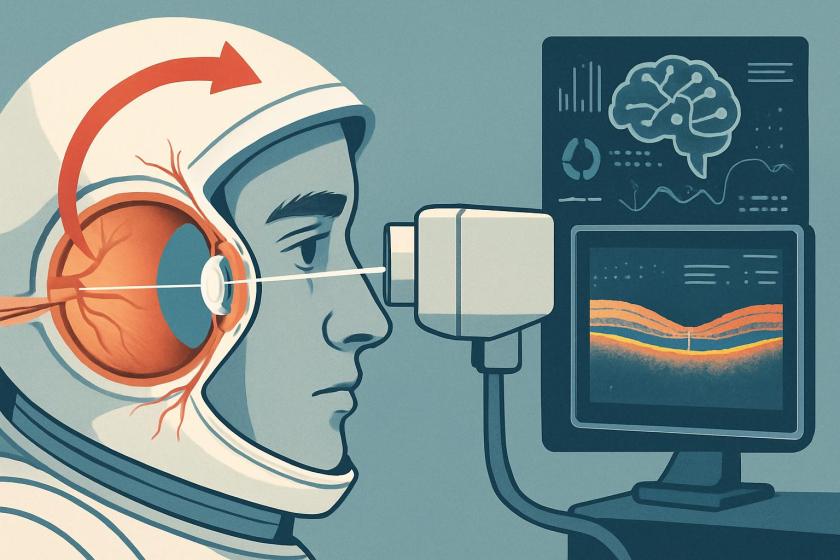
SANS is a useful reminder that space medicine is mostly about managing uncertainty, not eliminating it. The condition is described as a cluster of eye and optic-nerve changes seen in microgravity, but the real challenge is separating temporary shifts from changes that could persist. That distinction matters because a finding in orbit does not automatically tell us how much lasting vision risk any individual astronaut faces.
What stands out here is the evidence gap between monitoring and prevention. Astronauts are tested periodically with questionnaires, imaging and ultrasound, yet those tools are constrained by mass, space and crew time on long missions. Miniaturized OCT and image-based AI may improve detection, but these are still engineering solutions in progress. They may help identify changes earlier, though early detection is not the same as proving an intervention will prevent harm.
The medication angle also needs caution. Drugs already familiar on Earth are being considered because they are available, not because they are established SANS treatments. That makes sense in a setting where options are limited, but it also highlights how much of current practice is extrapolation. For readers, the broader lesson is that space health decisions often balance plausibility, safety and feasibility long before a full evidence base exists.
For future Mars missions, the practical question is less “Can we test everything?” and more “What is good enough to keep vision within acceptable limits?” That framing is realistic, but it also means the standard for action may be operational rather than therapeutic. In other words, the goal is to protect function under extreme constraints, while accepting that some risks will remain only partially understood.
It’s a vision thing
Samantha Harvey’s book Orbital gave a fictional glimpse into the lives of astronauts in space. Among other things, the Booker Prize-winning novel sparked my curiosity about how a gravity-free environment might affect the human body. So when I recently learned about an eye phenomenon commonly referred to as SANS, I wanted to find out more.
Spaceflight Associated Neuro-ocular Syndrome refers to the collective changes in the astronaut’s eye and brain that occur during spaceflight. In these instances, eyes typically swell and vision can become impaired. According to NASA, roughly 70% of astronauts aboard the International Space Station experience some swelling in the back of their eyes, and symptoms can worsen the longer an astronaut is in space. Some of the changes might become permanent.
At the moment, the only drug utilized on board the ISS as a countermeasure to SANS is Diamox, which is a tablet used as a glaucoma treatment on Earth. A NASA medical technical brief published last year shows that other drugs, such as Topamax and a GLP-1 agonist, are being considered as potential SANS medications.
It’s unclear whether the astronauts Butch Wilmore and Suni Williams developed SANS when their eight-day mission left them stuck in space for nearly nine months. When I asked NASA, the automated email response said the agency is currently closed due to the government shutdown.
Astronauts currently get tested for SANS every two to three months while in space, according to the European Space Agency’s lead flight surgeon Adrianos Golemis and Claudia Stern, head of the department of clinical aerospace medicine at the German Aerospace Center. This can include an optical questionnaire, visual tests, an ultrasound of the eye and an optical coherence tomography (OCT) scan, which uses light waves to take pictures of the retina.
But testing for SANS would be a challenge during longer missions — like a trip to Mars, which could take six to nine months. A journey of that length would mean less resources on the spaceship for transporting heavy medical equipment.
Siloton, a Bristol, England-based startup, is working on a solution. It’s developing a miniaturized OCT machine for the European Space Agency, though it’s “still at a relatively early stage,” Alasdair Price, Siloton’s CEO, says by email. The final device — which hasn’t yet been tested in space — is expected to weigh no more than 2 kilograms (4.4 pounds). By contrast, Price says the machine currently used on the ISS weighs 27.6 kg, which is “too large to be used on longer-distance missions.”
A research team at the European Space Agency has also been training an AI model with the goal of being able to automatically detect changes in the optic nerve of astronauts. The device, which is still in development, clips onto the back of an iPad, allowing astronauts to record images with the camera and send them back to Earth using an app.
“Astronaut health is a core priority, so where needed we will always find solutions that are at least good enough to avoid impacts on health beyond ‘safety thresholds’ that we have established,” Golemis and Stern say in a written response to my questions. — Lisa Pham
| |
|
Enjoyed this article? Sign up for our newsletter to receive regular insights and stay connected.