
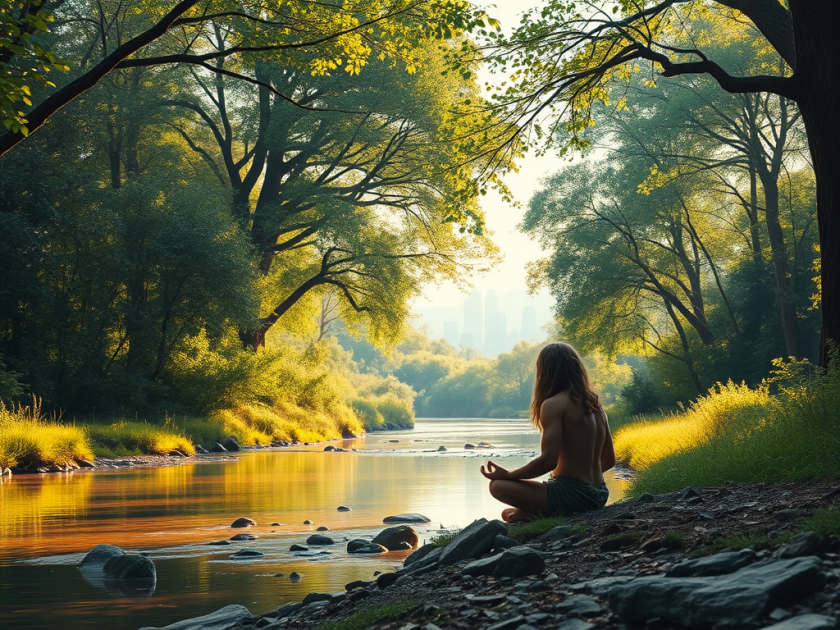
| Relax like a caveman
Over the last six million years or so, humans have evolved the ability to do some pretty cool things: converse in sophisticated languages, say, or design increasingly complex tools. One thing we didn’t develop is a tolerance for chronic stress. That’s a problem, since our modern world serves up a never-ending stream of that — from air, light and noise pollution to money worries to the fast-paced, largely sedentary nature of daily life. This mismatch may be taking a toll on our collective “evolutionary fitness” — that is, our ability to survive and reproduce as a species, says Colin Shaw, an evolutionary anthropologist at the University of Zurich. Human bodies and minds are adapted to natural habitats where our ancestors lived for thousands of generations, not the urban settings where most of the world resides today. In recent years, a growing body of research has raised concerns that this shift is compromising reproductive health, immune function, cognitive performance and physical capacity, according to Shaw. “In the process of building this wonderful life for ourselves, we’ve actually created an environment that’s less healthy,” he says. Shaw explored this conundrum in a recent paper in Biological Reviews with co-author Daniel Longman, a senior lecturer in human evolutionary physiology at Loughborough University. Consider stress. Over millions of years, humans needed to be able handle short bursts of it — say, when a lion was about to attack. That jolt of heightened focus helped trigger a fight-or-flight response, and anyone who failed to muster it would have struggled to pass on their genes. “The lion got you,” Shaw says. In the past, humans typically enjoyed a period of recovery after such a harrowing moment. These days, we often react as if a lion is pouncing all the time — whether we’re stuck in traffic, racing to finish a project at work or fielding an unwanted text message — but without the recuperation. In his research, Shaw often brings people onto the streets of Zurich, which is typically regarded as one of the world’s most “livable” cities. But even there, his subjects’ blood pressure tends to rise when compared to visits to a nearby forest. He recommends this experiment to everyone. It may surprise you how loud your neighborhood actually is. While we typically filter out all that noise, doing so doesn’t come for free. “Energy has to be allocated to buffering those stressors,” he says. “As a result, that energy is not available for cognitive processes, immune function, things like paying attention to your kids and actually not yelling at them.” By collecting more real-world data about how exactly modern environments impact our health, Shaw hopes to influence how we design cities and how healthcare workers approach issues like chronic stress and immune disorders. “The reason why they prescribe drugs is because there are these massive trials that tell you that this particular molecule does this particular thing and you can expect this particular outcome,” he says. “We need that in the environment and in the natural world to really understand how it works.” For now, he suggests being careful about the forces competing for your attention all day. Technologies like social media are designed to suck you in, robbing you of time when you might be recovering from your daily stresses. “You should probably be sleeping, you should probably be reading, you should probably be meditating,” he says. “You should probably be not getting stimulus.” — Tim Loh |
Enjoyed this article? Sign up for our newsletter to receive regular insights and stay connected.