
The management shift is bigger than channel expansion: if algorithms and LLMs increasingly shape discovery and recommendation, commerce teams need a governance model for machine-mediated demand, not just a plan for more placements. That means clarifying who owns product data quality, feed timing, pricing rules, and content approvals across marketing, merchandising, digital, and IT. Without explicit decision rights, the organisation can optimise for reach while quietly creating operational drag and margin leakage.
Leaders should also rethink funding and measurement. Distributed commerce tends to fragment spend across many small bets, which makes legacy channel ROI reporting misleading. A more useful portfolio view is to compare each use case on contribution margin, operational load, content maturity, and dependency risk. The practical question is not whether a platform can drive traffic, but whether the business can support the recurring effort required to keep product data current, localised, and compliant at machine speed.
That creates trade-offs for operating model design. Faster feed updates, richer attribution, and variant content can improve visibility, but they also increase coordination costs and expose weak data governance. Enterprises may need shared services for catalogue integrity, experimentation, and performance reporting so that individual teams are not reinventing the same workflows. The next decision is where to centralise standards and where to allow channel teams to move quickly.
For CIOs and commercial leaders, the key question is portfolio discipline: which commerce initiatives deserve scale, which should remain in test mode, and which should be stopped before they become structural overhead? The answer will depend less on platform hype and more on whether the organisation can sustain the cadence, controls, and metrics that machine-led commerce requires.
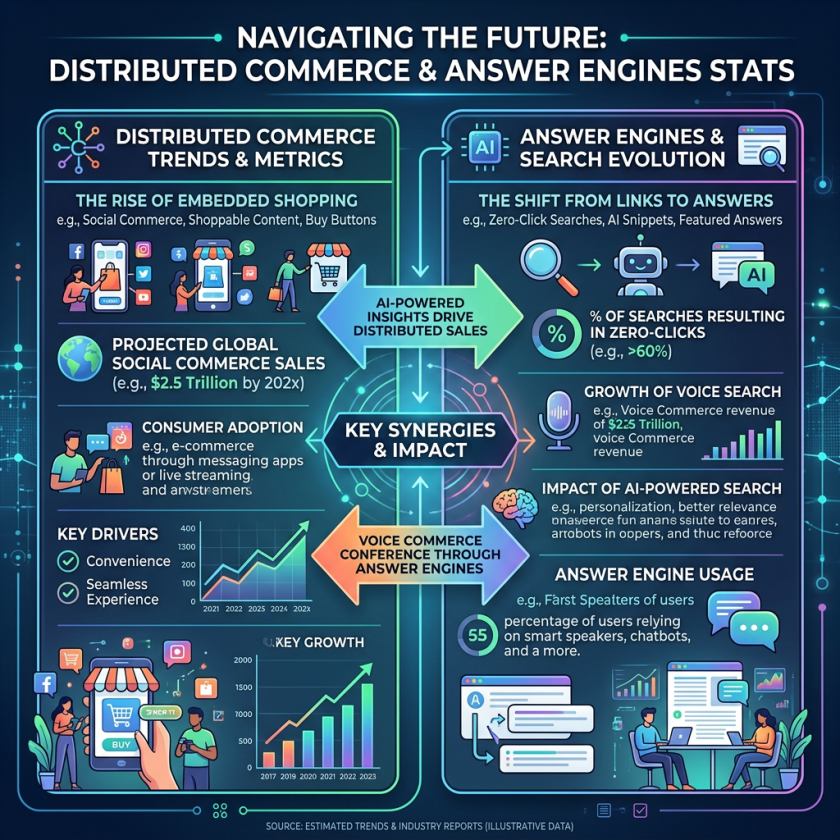
Distributed commerce is here — and is already reshaping how consumers discover and buy. In fact, 62% of US and UK online adults who regularly use answer engines rely on them to research products and recommendations, while 40% use them specifically to discover products, per Forrester’s Consumer Voices Market Research Online Community (MROC), March 2026.
Algorithms in social commerce, answer engines, and connected devices are replacing merchant intuition. It’s no surprise that, per Forrester’s Digital Business and Strategy Survey, 2026, 57% of digital business strategy decision-makers are prioritizing new commerce strategies, including distributed commerce. But the economics are far more complex than the growth hyperbole suggests. To achieve long-term success and profitability with distributed commerce, as a leader, you must:
- Change your thinking: design a commerce strategy for machine sellers. Platforms are setting the rules for content, data, and speed. For example, product feeds in emerging AI ecosystems can require updates as frequently as every 15 minutes, with new attributed tailored to algorithmic discovery. This requirement creates an always-on demand for content variation, localization, and optimization across fragmented ecosystems, where the platforms control the traffic and the measurement. Brands may see early conversion lifts — but delivering high quality content across a spectrum of distributed commerce over the long-term requires intentional planning and design.
- Design time-bound playbooks: replace always-on channel strategies with test-and-scale playbooks. Being profitable requires adopting campaign-based strategies aligned to specific channels and use cases. Why? Distributed commerce is inherently fragmented: some channels reward create storytelling, while others prioritize structured product data and intent matching. Savvy brands are also sequencing how and when they invest — testing channels, then doubling down only where performance proves sustainable.
- Pressure-test every channel: only scale the investments that pass the right profit margins. Winners in distributed commerce will be those companies that pressure-test before they scale. This is a business model shift, not a channel decision. Leaders must evaluate every channel across four dimensions: financial upside, operational feasibility, content readiness, and macroeconomic resilience. This rigor is crucial to determine whether what looks like incremental reach is preserving —or eroding!— margins and brand equity.
If you are a Forrester client interested in discussing the evolution of your commerce strategy for humans and agents, book an inquiry or guidance session with my colleagues Joe Cicman, Emily Pfeiffer, or myself. We are available to discuss with you topics such as: commerce strategy, distributed and dynamic commerce strategies, agentic commerce, and commerce services provider selection.
When Algorithms And LLMs Become Sellers, Your Commerce Strategy Must Change
Enjoyed this article? Sign up for our newsletter to receive regular insights and stay connected.