
An editorial overview of the week’s key themes in IT Management
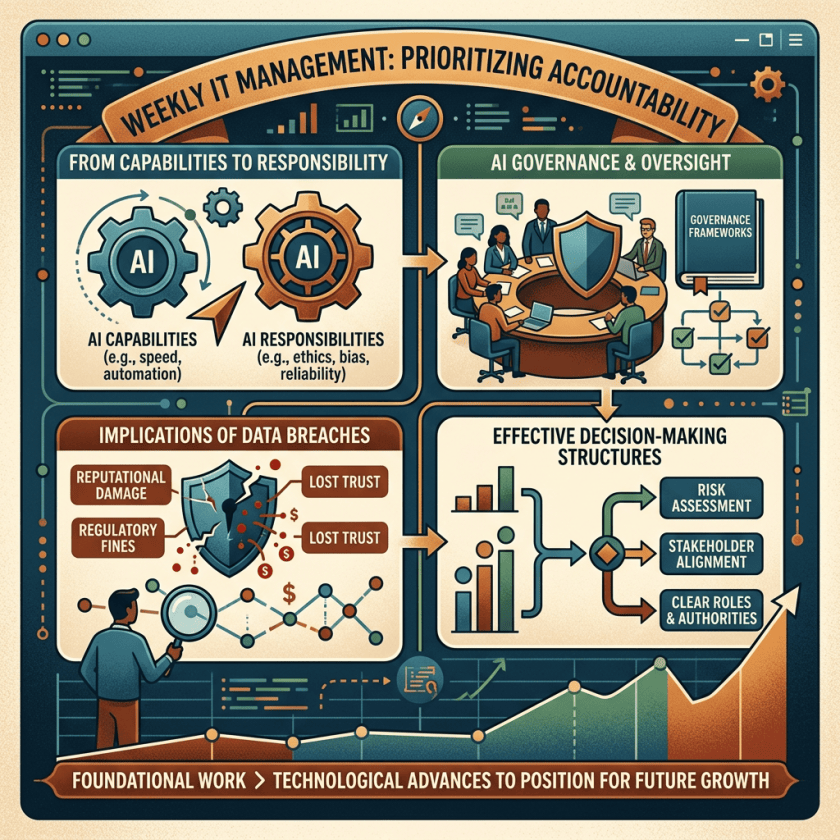
If a single word could summarise this week in IT management, it would be accountability. Across fourteen stories, the centre of gravity moved away from what AI can do and toward who answers for it — who decides, who funds, who escalates, and who is left holding the risk when an autonomous system behaves in a way nobody modelled. The technology questions have largely been settled. The operating-model questions have not.
The week’s sharpest reminder of that gap came from the security side. A breach at Hugging Face prompted uncomfortable questions about whether weak escalation paths and unclear decision rights inside AI organisations are becoming an industry-wide pattern rather than an isolated lapse. The useful question for enterprise leaders is not whether they could suffer a similar incident but whether their own governance can force a pause when a known risk surfaces — before a technical issue becomes an enterprise-level exposure. That framing pairs naturally with a level-headed assessment of how AI is actually changing cyberattacks, and how it is not: the speed and realism of phishing have jumped, but the underlying attack methods have not been reinvented. The spending implication is unglamorous and correct — harden identity, access, and anti-phishing first, then wrap proportionate controls around enterprise and shadow AI use.
Governance without a workable model for experimentation simply becomes a brake, which is why the week’s most practical leadership story was Barracuda’s CIO describing a deliberately flexible approach to responsible AI. The tension is familiar: encourage people to try things, but not so freely that unmanaged spend, shadow tooling, and policy gaps outrun compliance. Several stories this week suggested that the resolution lies in simplification rather than in more policy. One argued that AI adoption is a standardisation problem before it is a technology problem — fund integration and data trust early, or spend the next three years scaling fragmented processes and low-value customisation at machine speed.
Nowhere is the intent-versus-output distinction clearer than in application modernisation. A thoughtful piece on why AI can rewrite code but cannot recover intent identified the real constraint on accelerated rewrites: discovery effort collapses, but validating why a system behaves as it does still depends on scarce human experts and architectural guardrails. Speed on the generation side without capacity on the validation side is not modernisation; it is faster accumulation of undocumented decisions.
The agentic-AI conversation matured noticeably this week. Rather than asking whether agents work, the discussion turned to what it takes to scale pilots into an enterprise capability with named accountability, workflow redesign, and integration readiness — the difference between a portfolio of interesting demos and something that shows up in the operating budget. A profile of an entrepreneur building agents that plan ahead for unfamiliar conditions pushed the same question further out: at what point do systems that handle genuine novelty become investable enterprise capabilities rather than research with an unclear liability profile? And a provocative argument for treating AI as an actual member of the team — present in planning, review, and steering forums — reframed the opportunity as redesigning how decisions get made, not merely making individuals faster. That is a change-management and data-exposure question long before it is a licensing one.
Running underneath all of it is infrastructure and money. The shift from training to inference turns memory, storage, and networking choices into a portfolio and governance exercise rather than a component-buying one, with workload-specific ROI and sourcing flexibility mattering more than headline specifications. Meanwhile, observability has quietly become a CIO control point — the telemetry layer that informs funding, vendor decisions, and where human judgement must stay in the loop as automation expands.
On the commercial side, two pieces made the same argument from different angles: value is won or lost after signature. Workday economics are shaped by renewals, expansion, and AI add-ons far more than by the initial discount, which makes lifecycle commercial governance the difference between predictable budgets and annual surprises. Similarly, the reminder that XaaS does not entitle anyone to a bigger budget landed on benefits realisation: unless the operating model retires legacy cost quickly and controls variable consumption, transformation overlap simply eats portfolio capacity.
Finally, the week asked who will be doing this work. Evidence suggests the next generation of CIOs will reach the role by a different path — less technology stewardship, more enterprise orchestration, with data and business fluency in the succession pipeline and burnout as a live risk when responsibilities expand faster than funding. One level up, an examination of the half-life of board expertise made the uncomfortable point that oversight can age faster than strategy. Boards assembled for a previous decade’s risks may not be equipped for the AI, cyber, and data decisions now arriving quarterly.
Taken together, the week describes an industry that has stopped debating AI’s capability and started building the scaffolding around it: decision rights, escalation paths, commercial discipline, telemetry, and succession. None of that is exciting, and all of it is what determines whether the next two years produce compounding capability or expensive fragmentation. The organisations that look fastest in 2027 will mostly be the ones that did this unglamorous work in 2026.
Full post index for this week:
- The Hugging Face hack could indicate cultural issues at OpenAI · September 11, 2026
- How Barracuda’s CIO developed a flexible strategy for responsible AI · September 11, 2026
- AI Can Rewrite Code, But It Cannot Recover Intent · September 11, 2026
- Why observability has become essential to the CIO’s job · September 11, 2026
- Why Smart Workday Buyers Negotiate Beyond The Subscription · September 11, 2026
- The room where it happens: Why CIOs should make AI a member of the team · September 11, 2026
- Facilitating AI integration with simplicity at scale · September 10, 2026
- Architecting memory and storage in the AI era · September 10, 2026
- The next generation of CIOs will take a different path to the top · September 10, 2026
- Scaling agentic AI pilots across the enterprise · September 10, 2026
- How AI is changing cybersecurity threats (and how it isn’t) · September 10, 2026
- The Half-Life of Board Expertise · September 10, 2026
- CIOs: XaaS Doesn’t Mean You Need Bigger Budgets · September 10, 2026
- This AI entrepreneur is developing agents that can plan ahead for the unexpected · September 10, 2026
Browse the full IT Management archive at genesis-aka.net/information-technology/management/
Enjoyed this article? Sign up for our newsletter to receive regular insights and stay connected.