

The architectural point is straightforward: if a workflow step merely forwards data between managed services, a Lambda hop is usually technical debt rather than value. In the bank-account example, the original design used 13 functions, but several did little more than start executions, query DynamoDB, enqueue failures, or publish events. Replacing those transfers with direct Step Functions and API Gateway integrations trims latency, reduces components, and narrows failure points without sacrificing the workflow’s business intent.
The mechanism matters because each removed function eliminates its own packaging, permissions, logging, tracing, and cold-start behavior. The source shows that a handful of simple handlers carried far more boilerplate than logic, and warming still left the workflow around two to three seconds, while cold starts pushed it near ten. After direct integrations and synchronous execution options were introduced, the flow dropped to roughly 1.5 seconds warmed and 3 seconds cold, while also shedding 11 functions and their associated fees.
The tradeoff is not that Lambda becomes obsolete, but that it should be reserved for genuine computation, parsing, or complex branching. The text is explicit that Textract output parsing, address validation against a third-party API, and nontrivial business rules can still justify code. The practical risk is over-optimizing into tight cloud coupling without enough test coverage; Step Functions Local and mocked integrations are needed to preserve confidence. The result is a leaner architecture, not a universal simplification recipe.
- Optimize for performance by reducing the latency between services
- Optimize for costs operability and sustainability, by avoiding unnecessary components and reducing workload footprint
- Optimize for resiliency by removing potential point of failures
- Optimize for security by minimizing the attack surface
Workflow example and initial architecture
Figure 1 shows a typical workflow for the creation of an online bank account. The customer fills out a registration form with personal information and adds a picture of their ID card. The application then validates ID and address, and scans if there is already an existing user by that name. If everything checks out, a backend application will be notified to create the account. Finally, the user is notified of successful completion. Figure 1. Bank account application workflow
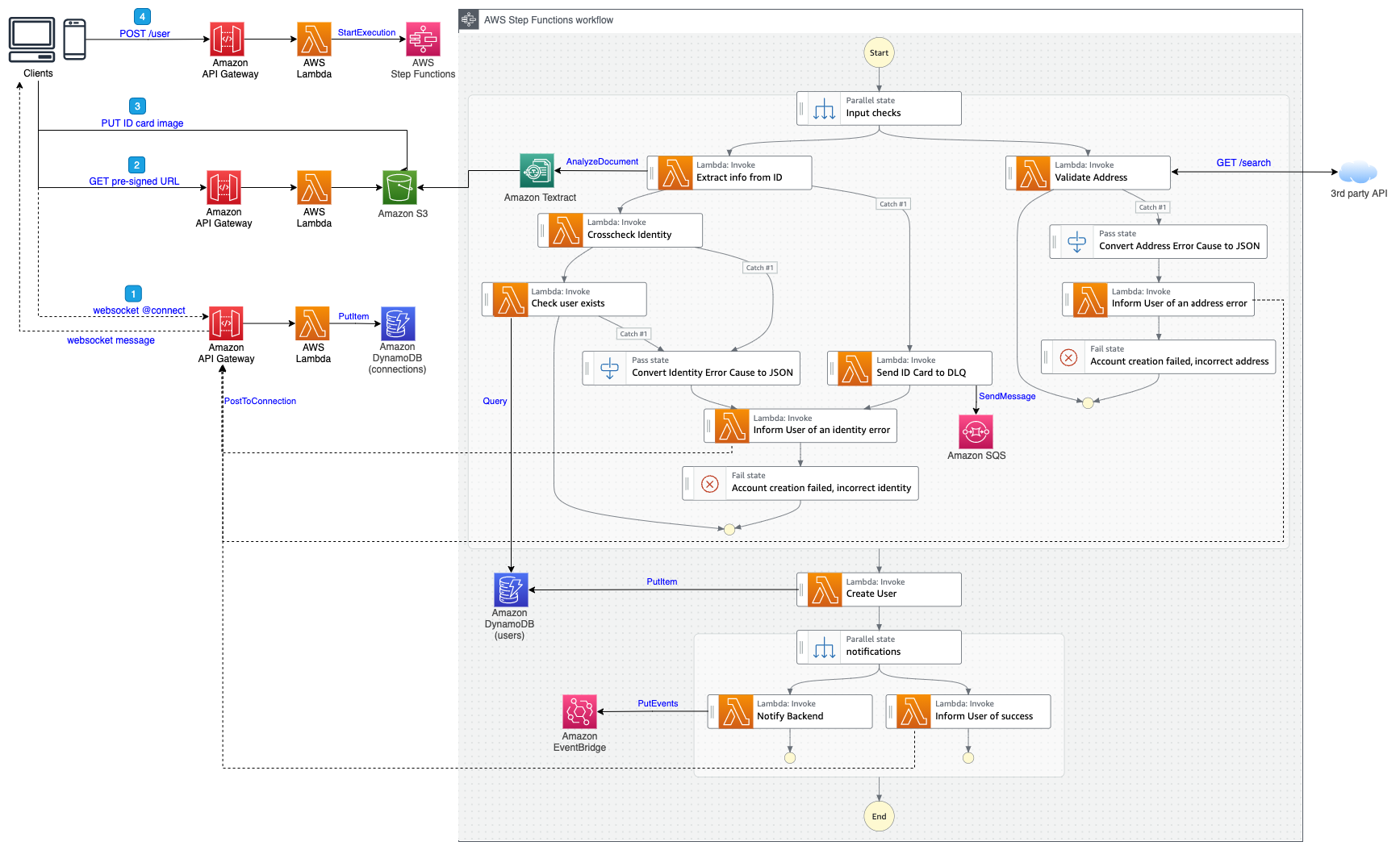 Figure 2. Initial account creation architecture
- One function to execute the Step Functions state machine
- Two functions to perform create, read, update, and delete (CRUD) operations on Amazon DynamoDB
- Two functions to send messages on Amazon Simple Queue Service (Amazon SQS) or EventBridge
- One function generates a presigned URL to upload ID card pictures to Amazon Simple Storage Service (Amazon S3)
- One function uses the Amazon Textract API to extract information from the ID card
- One function verifies the identity of the user against the information extracted from the ID card
- One function performs simple HTTP request to a third-party API to validate the address
connect, message, and disconnect) and notifications to the user.
Opportunities for improvement
If you further analyze the code of the five basic functions (seestartWorkflow on GitHub, for example), you will notice that there are actually three lines of fundamental code that start the workflow. The others 38 lines involve imports, input validation, error handling, logging, and tracing. Remember that all this code must be tested and maintained.
import os
import json
import boto3
from aws_lambda_powertools import Tracer
from aws_lambda_powertools import Logger
import re

logger = Logger()
tracer = Tracer()

sfn = boto3.client('stepfunctions')

PATTERN = re.compile(r"^arn:(aws[a-zA-Z-]*)?:states:[a-z]{2}((-gov)|(-iso(b?)))?-[a-z]+-\d{1}:\d{12}:stateMachine:[a-zA-Z0-9-_]+
quot;) if ('STATE_MACHINE_ARN' not in os.environ or os.environ['STATE_MACHINE_ARN'] is None or not PATTERN.match(os.environ['STATE_MACHINE_ARN'])): raise RuntimeError('STATE_MACHINE_ARN env var is not set or incorrect') STATE_MACHINE_ARN = os.environ['STATE_MACHINE_ARN'] @logger.inject_lambda_context @tracer.capture_lambda_handler def handler(event, context): try: event['requestId'] = context.aws_request_id sfn.start_execution( stateMachineArn=STATE_MACHINE_ARN, input=json.dumps(event) ) return { 'requestId': event['requestId'] } except Exception as error: logger.exception(error) raise RuntimeError('Internal Error - cannot start the creation workflow') from error  Figure 3. X-Ray traces when Lambda functions are warmed
 Figure 4. X-Ray traces when Lambda functions are cold
Improving the initial architecture
Direct integration with Step Functions
Step Functions can directly integrate with some AWS services, including DynamoDB, Amazon SQS, and EventBridge, and more than 10,000 APIs from 200+ AWS services. With these integrations, you can replace Lambda functions when they do not provide value. We recommend using Lambda functions to transform data, not to transport data from one service to another. In our bank account creation use case, there are four Lambda functions we can replace with direct service integrations (see large arrows in Figure 5):- Query a DynamoDB table to search for a user
- Send a message to an SQS queue when the extraction fails
- Create the user in DynamoDB
- Send an event on EventBridge to notify the backend
 Figure 5. Lambda functions that can be replaced
- To extract information from the ID card, we use Amazon Textract. It is available through the SDK integration in Step Functions. However, the API’s response provides too much information. We recommend using a library such as amazon-textract-response-parser to parse the result. For this, you’ll need a Lambda function.
- The identity cross-check performs a simple comparison between the data provided in the web form and the one extracted in the ID card. We can perform this comparison in Step Functions using a
Choicestate and several conditions. If the business logic becomes more complex, consider using a Lambda function. - To validate the address, we query a third-party API. Step Functions cannot directly call a third-party HTTP endpoint, but because it’s integrated with API Gateway, we can create a proxy for this endpoint.
Direct integration with API Gateway
API Gateway also provides service integrations. In particular, we can start the workflow without using a Lambda function. In the console, select the integration type “AWS Service”, the AWS service “Step Functions”, the action “StartExecution”, and “POST” method, as shown in Figure 6. Figure 6. API Gateway direct integration with Step Functions
{ "stateMachineArn":"arn:aws:states:eu-central-1:123456789012:stateMachine: accountCreationWorkflow", "input":"$util.escapeJavaScript($input.json('$'))"}
We can go further and remove the websockets and associated Lambda functions connect, message, and disconnect. By using Synchronous Express Workflows and the StartSyncExecution API, we can start the workflow and wait for the result in a synchronous fashion. API Gateway will then directly return the result of the workflow to the client.
Final optimized architecture
After applying these optimizations, we have the updated architecture shown in Figure 7. It uses only two Lambda functions out of the initial 13. The rest have been replaced by direct service integrations or implemented in Step Functions. Figure 7. Final optimized architecture
 Figure 8. X-Ray traces for the final architecture
Testing
Testability is an important consideration when building your workflow. Unit testing a Lambda function is straightforward, and you can use your preferred testing framework and validate methods. Adopting a hexagonal architecture also helps remove dependencies to the cloud. When removing functions and using an approach with direct service integrations, you are by definition directly connected to the cloud. You still must verify that the overall process is working as expected, and validate these integrations. You can achieve this kind of tests locally using Step Functions Local, and the recently announced Mocked Service Integrations. By mocking service integrations, for example, retrieving an item in DynamoDB, you can validate the different paths of your state machine. You also have to perform integration tests, but this is true whether you use direct integrations or Lambda functions.Conclusion
This post describes how to simplify your architecture and optimize for performance, resiliency, and cost by using direct integrations in Step Functions and API Gateway. Although many Lambda functions were reduced, some remain useful for handling more complex business logic and data transformation. Try this out now by visiting the GitHub repository. For further reading:Enjoyed this article? Sign up for our newsletter to receive regular insights and stay connected.