
In this article, I’ll share strategies for tailored preparation that helped me land my dream job. Understanding the broad spectrum of ML roles—by job responsibility and specialization—can significantly refine your interview strategy and boost your confidence. These insights will equip you to tackle your next ML interview with precision.
Let’s dive in. But first, a quick disclaimer.
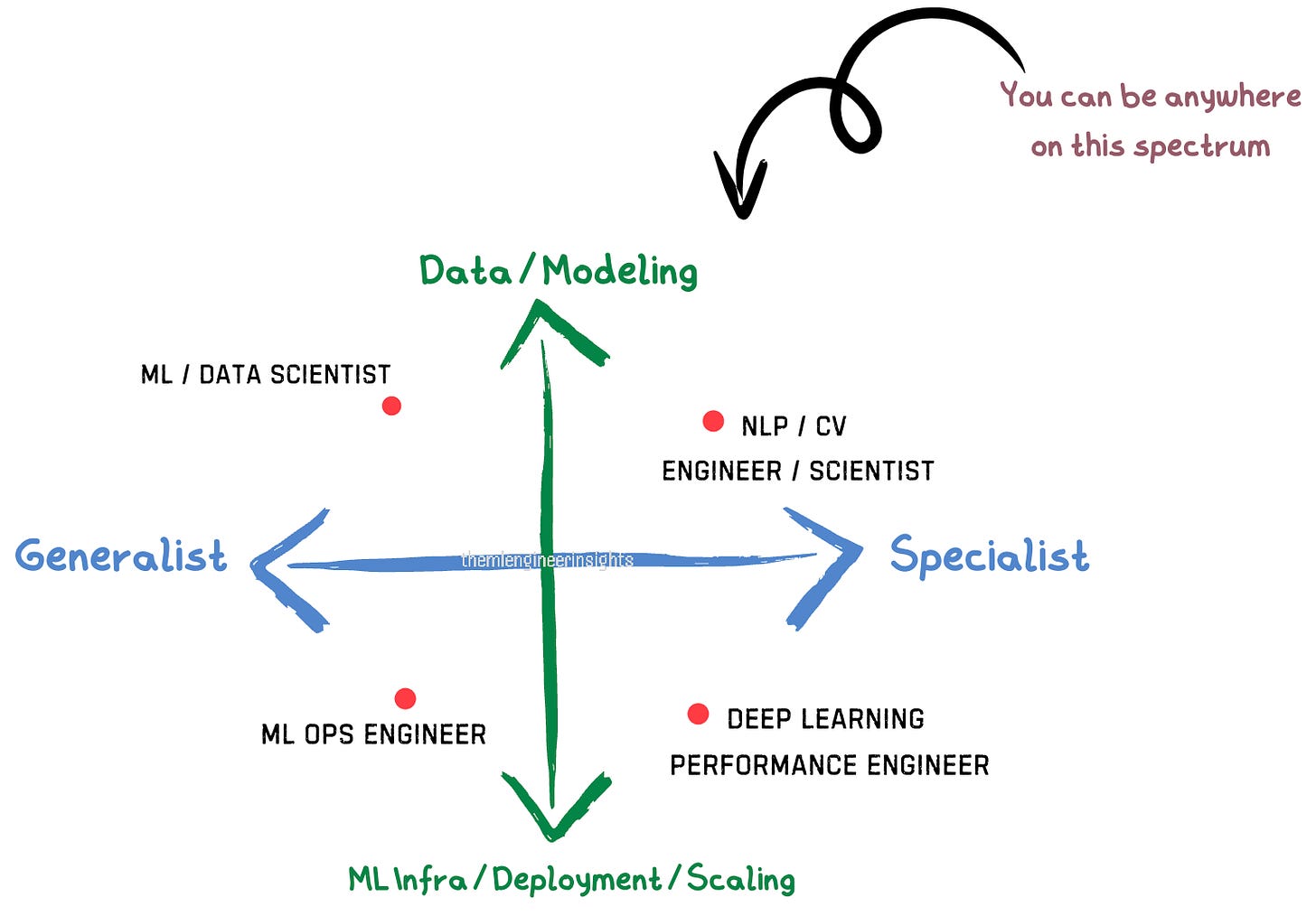
ML roles can vary widely based on their primary technical responsibilities and area of specialization.
1. Technical Responsibility:
- Data Analysis / Modeling:
- Skills: Data analysis, feature engineering, model development and training, statistical analysis, experiment design.
- ML Infrastructure / Deployment / Scaling :
2. Area of Specialization:
- Generalist:
- Specialist:
- Skills: Deep expertise in the chosen domain (such as Natural Language Processing (NLP), Computer Vision (CV), or industry-specific areas like self-driving cars and robotics), advanced knowledge of domain-specific tools.
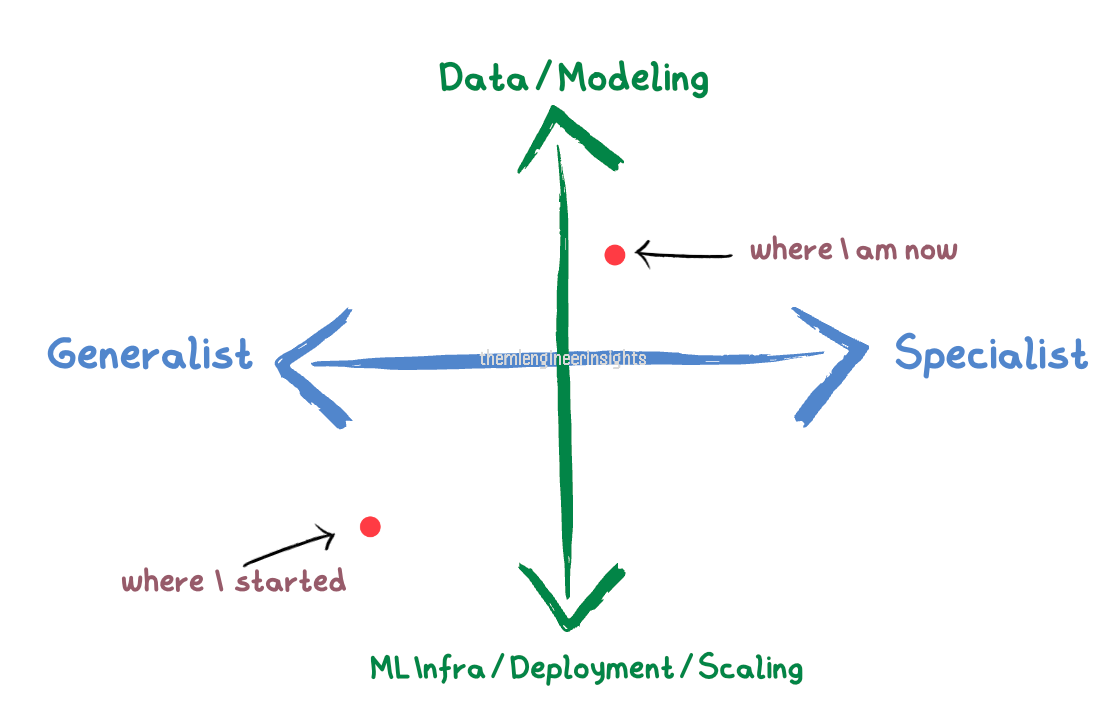
Note: Careers are dynamic. You may specialize in one area or shift to a generalist role based on company needs and your goals. For example, I began as a software engineer in a Search Ads ML team, then specialized in Search and NLP through side projects.
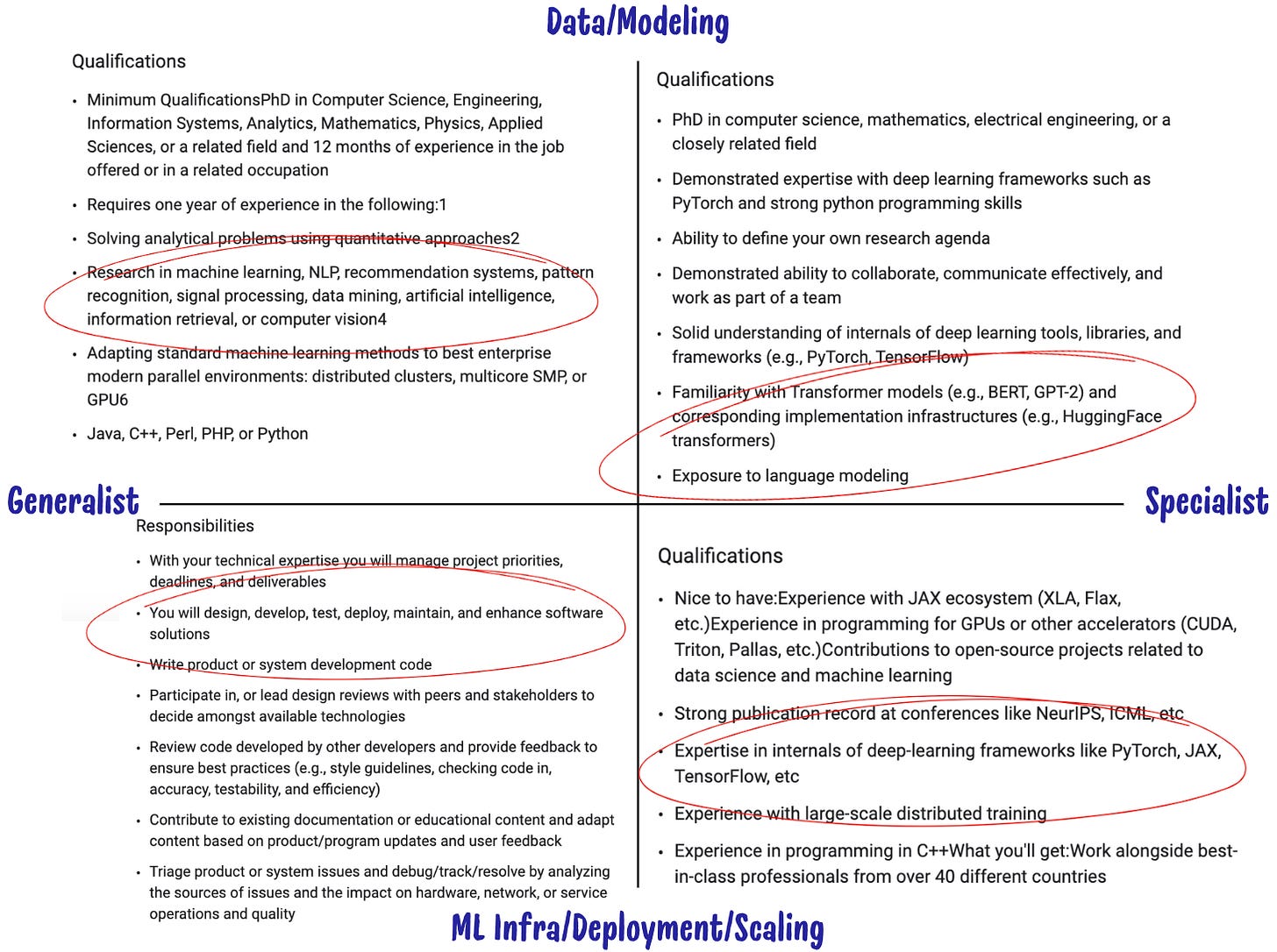
Decoding Job Descriptions
Now that you understand the spectrum of ML roles, you can identify the true responsibilities of the role from its job description. Job descriptions often lack details, so always seek out more information from recruiters.
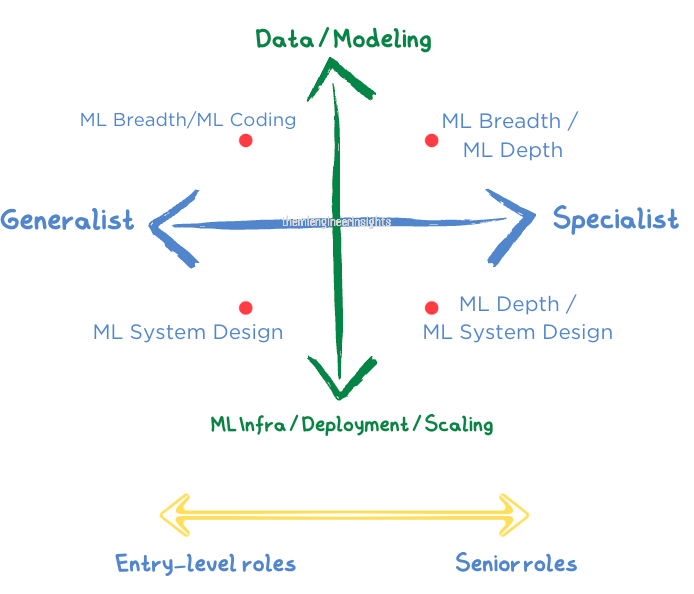
Before diving in preparation strategy, let’s refresh the 4 ML rounds that we discussed in my previous article (check it out for more details).
The Four Types of Rounds:
- 📚 Machine Learning Breadth: This round tests your broad knowledge across various ML topics.
- 🔍 Machine Learning Depth: This round focuses on specialized topics and detailed case studies, from your past projects and/or specific domain knowledge.
- 🛠️ Machine Learning System Design: This round evaluates your ability to design scalable ML systems.
- 💻 Machine Learning Coding: In this round, you’ll tackle coding challenges around basic algorithms.
Start with the Fundamentals, ensure you have a solid grasp of the basics and you can start preparing this even before applying for interviews. This foundation is crucial no matter which ML role or level you’re targeting. Now, let’s dive into tailored strategies.
Data/Modeling Roles
- Pay attention to team/job-specific fundamentals. Example, Google Search interview will focus on search-related questions, not computer vision. If unsure, ask the recruiter directly.
- Examples:
- For generalist roles requiring Deep Learning, understand multi-layer perceptrons, backpropagation, CNNs, RNNs, and LSTMs.
- For specialist roles like NLP positions, familiarize yourself with word2vec (asked to me in a ML breadth round for NLP role), word embeddings, and transformers.
- Examples:
- Research Company Blogs and Papers: Many companies have ML blogs that provide insights into their work, Some popular blogs I follow:
- As roles become more specialized, the focus shifts heavily toward domain-specific knowledge. Note that most senior roles require some specialization.
Resources for some common area of specializations:
- Ranking/Recommendations: Critical for Search (Google, Amazon, Microsoft Bing, Airbnb), Discovery (Facebook, Instagram, TikTok, Pinterest, Netflix), and more. Generally have the most opportunities and jobs availability.
ML Services and Infrastructure Roles
- Prepare specifically for the team/company you’re interviewing for as interviews are often around company tech stack.
- Highly Recommended Course: Educative.io’s ML System design
Examples:
- Streaming Services (e.g., Netflix): Study video recommendation systems and related questions. Example: Exponent’s article on predicting watch time.
- Search/Recommendations Roles: Focus on user content feed recommendations and other common questions such as “Recommend restaurants on a food delivery app” or “Design user feed”
- Ads: Understand ad ranking and related challenges like multi-stage ranking. Recommended: Snapchat Engineering’s article on ad systems.
As you navigate the journey of preparing for ML interviews, it’s essential to track your progress and learnings. Keep a journal or use digital tools to document:
- The previous interview questions
- The papers/blogs you’ve studied
- Key bullet points from your research
Consistent tracking not only helps you stay organized but also boosts your confidence as you see your knowledge and skills grow. It took me time to realize its value, but now I consistently maintain a Google Doc for this purpose.
Remember, ML research advances rapidly, and new breakthroughs can change interview questions so keeping track is key.
Good luck with your interview preparation, and keep pushing forward!
- ML:
- Career and Leadership:
Enjoyed this article? Sign up for our newsletter to receive regular insights and stay connected.