
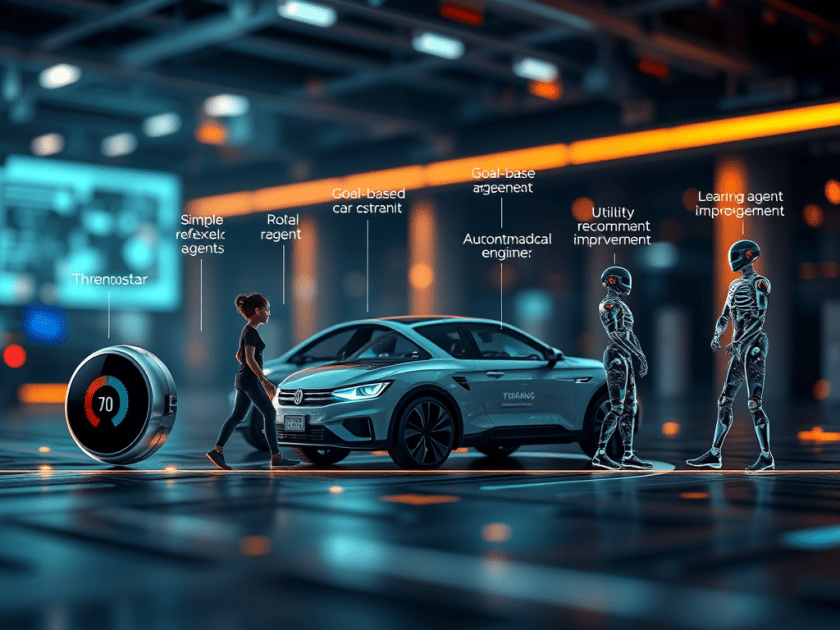
The Different Types of AI Agents — and How They’re Transforming the Way We Work?
Artificial Intelligence (AI) is no longer a futuristic concept — it’s the engine quietly powering productivity, creativity, and decision-making across industries. But not all AI is built the same. Behind every “smart” system lies an AI agent — an entity that perceives its environment, makes decisions, and takes actions to achieve goals.
Let’s explore the different types of AI agents, how they differ, and where you’ll see them in action.
Simple Reflex Agents
How they work: These are the most basic AI agents. They act only on current inputs without considering history or context — like a reflex.
Example:
- A thermostat that turns on the heater when the temperature drops below a set point.
- Rule-based bots that automatically reply to common customer queries.
Use Cases:
- IoT devices (e.g., smart lighting or HVAC systems)
- Basic automation workflows
- Entry-level chatbots
Takeaway: Great for repetitive, predictable tasks — fast but not adaptive.
Model-Based Reflex Agents
How they work: These agents maintain an internal model of the world — they understand how things change and act accordingly.
Example:
- A self-driving car tracking not just the road but also how nearby vehicles are likely to move.
- A network security system that monitors and predicts potential breaches.
Use Cases:
- Autonomous robots
- Predictive maintenance in manufacturing
- Adaptive process automation
Takeaway: Smarter than simple reflex agents — they use context to make better decisions.
Goal-Based Agents
How they work: Goal-based agents think in terms of objectives. They evaluate possible actions to decide which moves get them closer to their goal.
Example:
- Route optimization in delivery apps like Uber or DoorDash.
- AI assistants that plan your day based on meeting goals, energy levels, and deadlines.
Use Cases:
- Navigation and logistics
- Planning and scheduling
- Strategic game AI
Takeaway: Designed for purpose-driven decision-making — great for complex, multi-step problems.
Utility-Based Agents
How they work: These agents don’t just aim for a goal — they measure how desirable each outcome is and choose the one with the highest utility (satisfaction).
Example:
- A recommendation engine (like Netflix or Spotify) suggesting what you’ll most likely enjoy.
- Financial portfolio optimization algorithms balancing risk and return.
Use Cases:
- Recommender systems
- Personalized AI assistants
- Decision-support tools
Takeaway: Useful when multiple good options exist and trade-offs must be managed intelligently.
Learning Agents (Agentic AI)
How they work: Learning agents improve over time by analyzing past experiences. They can adjust strategies, optimize performance, and even create new capabilities autonomously.
Example:
- ChatGPT-style systems that refine answers based on feedback.
- Autonomous testing agents that self-learn how to break or improve software.
- AI copilots that learn your preferences for writing, coding, or design.
Use Cases:
- Adaptive customer support
- Autonomous software testing
- Self-learning recommendation engines
- AI copilots for business and creative workflows
Takeaway: The most powerful and dynamic form — forming the foundation of Agentic AI, where systems act with autonomy, memory, and adaptability.
Where We’re Headed: The Era of Agentic AI
The next wave — Agentic AI — combines all the above. These agents can:
- Understand goals, context, and feedback
- Plan and execute multi-step actions
- Learn continuously from data and human input
- Collaborate with other agents or humans in real time
We’re already seeing this in:
- AI-driven software engineering (e.g., code agents debugging autonomously)
- Business automation (AI agents scheduling, summarizing, and analyzing work)
- Customer service (AI agents handling full end-to-end cases, not just FAQs)
Final Thoughts
AI agents are no longer tools — they’re becoming collaborators. Whether it’s optimizing logistics, improving patient outcomes, or helping us code and create faster, understanding the type of AI agent you’re working with helps unlock its full potential.
As AI evolves, the most successful organizations will be those that blend human intuition with intelligent agents — creating a future where technology doesn’t replace us but amplifies what we can do.
Enjoyed this article? Sign up for our newsletter to receive regular insights and stay connected.