

The VanEck Emerging Markets Bond Fund was up 3.88% in December, compared to 4.12% for its benchmark. Egypt (dollar-denominated) was the biggest outperformer, along with Chile (local- and hard-currency) and Colombia (local-currency). Thailand, Indonesia, and Romania (all local-currency) were the underperformers. We increased exposure to some Asian local markets that lagged in late 2023 such as Indonesia and Malaysia. In Latin America we are set to increase our exposures in local-currency, particularly Chile and Brazil. We intend to keep duration in line with the benchmarks. The Fund ended December with carry of 7.0%, yield to worst of 8.9%, duration of 6.2, and nearly 50% of the Fund in local currency. Our biggest exposures are Mexico (local and hard), China (primarily hard), and Malaysia (primarily local). View here for PDF version of this blog.
| Average Annual Total Returns* (%) as of December 31, 2023 | |||||||
| 1 Month | 3 Month | YTD | 1 Year | 3 Year | 5 Year | 10 Year | |
| Class A: NAV (Inception 07/09/12) | 3.88 | 8.36 | 10.91 | 10.91 | -0.79 | 4.14 | 1.80 |
| Class A: Maximum 5.75% load | -2.09 | 2.13 | 4.53 | 4.53 | -2.73 | 2.92 | 1.20 |
| Class I: NAV (Inception 07/09/12) | 3.81 | 8.43 | 10.97 | 10.97 | -0.49 | 4.46 | 2.10 |
| Class Y: NAV (Inception 07/09/12) | 3.80 | 8.40 | 11.03 | 11.03 | -0.57 | 4.39 | 2.03 |
| 50% GBI-EM/50% EMBI | 3.97 | 8.63 | 11.95 | 11.95 | -3.31 | 1.46 | 1.71 |
* Returns less than one year are not annualized.
Expenses: Class A: Gross 2.55%, Net 1.22%; Class I: Gross 2.51%, Net 0.87%; Class Y: Gross 2.91%, Net 0.97%. Expenses are capped contractually until 05/01/24 at 1.25% for Class A, 0.95% for Class I, 1.00% for Class Y. Caps excluding acquired fund fees and expenses, interest, trading, dividends, and interest payments of securities sold short, taxes, and extraordinary expenses.
The performance data quoted represents past performance. Past performance is not a guarantee of future results. Investment return and principal value of an investment will fluctuate so that an investor’s shares, when redeemed, may be worth more or less than their original cost. Performance may be lower or higher than performance data quoted. Please call 800.826.2333 or visit vaneck.com for performance current to the most recent month ended.
The “Net Asset Value” (NAV) of a Fund is determined at the close of each business day, and represents the dollar value of one share of the fund; it is calculated by taking the total assets of the fund, subtracting total liabilities, and dividing by the total number of shares outstanding. The NAV is not necessarily the same as the ETF’s intraday trading value. Investors should not expect to buy or sell shares at NAV.
The Fed-pause-induced rally appears overdone – be cautious on duration. Fed fund futures are pricing in about double the amount of 2024 cuts than the median of the Fed’s “dot plot”. This remains the key challenge going into 2024 – an easing cycle is already priced. That it all “happened” in just the last two months of 2023 underlines the vulnerability of this goldilocks scenario. Because of the centrality of US interest rates to global asset prices, “everything” rallied in November and December following the stronger dovish turn in the US bond market. Especially emerging markets (EM) local currency, whose central banks generally hiked interest rates earlier and more than their developed markets (DM) counterparts.
Nothing about the US fiscal stance looks likely to adjust – the path of annual fiscal deficits around 6%-8% for the next several years appears set-in-stone, regardless of political outcomes. Fed Chair Powell, unusually, raised the “unsustainability” of US finances as a challenge for monetary policy, allowing the market to actually consider the implications rather than ignore them. At the least, this cautions us against duration – neutral to our benchmark is about as high as we see appropriate. This is of course especially true for investment-grade/low-spread/high-quality bonds that are much more like US Treasury proxies following the end-of-2023 rally.
Speaking of debt sustainability, look out for our upcoming white paper entitled “Fiscal Dominance: The Clarifying Lens”, in which we conclude that the perceived-to-be-safe DM bond markets face much more challenging headwinds than do the perceived-to-be-risky EM bond markets.
Seeing Red – the Israel/Hamas conflict is only contained temporarily; expect steady escalation and increasing focus on a global “stagflation” scenario. What was most unusual about the market reaction to the October 7 attacks was the collapse in oil prices. Underneath that market reaction was a successful effort on the part of the US and its regional allies to prevent conflict expansion (though not to prevent escalation, to our eye). It was why we held our noses (because Egypt has serious long-term debt-sustainability issues) and accumulated positions in Egypt’s dollar-denominated bonds after they sold off on back of the conflict – financial support for Egypt from the IMF and bilateral lenders would be increased as a result of the conflict, we surmised. The bonds have rallied, discounting this erstwhile (to us) stability. Note that the position in Egypt was not especially material, it’s in our benchmark, and we are citing it only to be very precise about our reasoning.
This absence of conflict expansion was anomalous. Following reported attacks on shipping by Houthi forces in Yemen (which specifically referenced the Israel/Hamas conflict), we now see the conflict as expanding and escalating. The US’s Operation Prosperity Guardian represents to most actors direct US support for Israel (whether that perception is correct or not is irrelevant to our point), which greatly complicates US plans. First, US regional allies find it hard to position their US-guided foreign policy stances with their own populations (part of the reasoning behind increased support from US and regional allies for Egypt going into recent elections). More important, US Central Command communications now include “Iran-backed” descriptors of Houthi forces. Again, the true degree of Iranian involvement is irrelevant for our point – from a game theory standpoint, the descriptor means it is a fact for US planners and Iran, by definition, has to accept the label. The actuality that a Maersk ship was reportedly attacked after Operation Prosperity Guardian is also obviously even more destabilizing.
All of this is a good reminder that while most asset prices are linked to US economic developments (recession risk in particular), EM issuers are often commodities exporters and thus have an additional argument (against US High Yield or US Investment Grade, for example) in 2024 if a “stagflation” scenario materializes. Crudely, US high yield is a function of US recession risk, while EM is less of a function. More specifically, to us the above translates into caution on duration and attraction to curated carry, which can cushion a bumpy year and may still generate returns. Even more specifically, we are looking at reducing exposure to high-rated, long-duration dollar-denominated bonds (in Chile, Poland, and the Gulf) and increasing exposure to higher-carry, shorter-duration bonds (in Chile and Poland). Many of the higher-rated, long-duration dollar-denominated bonds are US Treasury proxies right now. Many of the high-carry, neutral-duration local-currency denominated bonds are supported (or not) by more than just the US economic trajectory.
What a difference a perspective-change can make. Everyone is focused on the magical 365-day period that ends December 31 because…astronomy! This obviously masks non-astronomical cycles and phenomena so we thought we’d compare 2023 to the past two years (2022 and 2023). A lot jumps out. Initially, one could look at 2023 and note that all bonds performed well, with EM happening to perform best. But if you include 2022, one sees that over the entire period EM bonds also performed better. So, the key conclusion seems to us to be not that all bonds simply rallied in 2023 with EM happening to be the highest beta winner. In down markets, like the one experienced in 2022 EM also outperformed (see Exhibit 1). Something else (i.e., something other than pure beta) is driving returns. We argue in our white paper on fiscal dominance (which will be published later this month) that what is driving EM returns is superior fundamentals relative to their bond premia.
Exhibit 1 – EM Bonds Performed Better in Both Bond Bull and Bear Markets
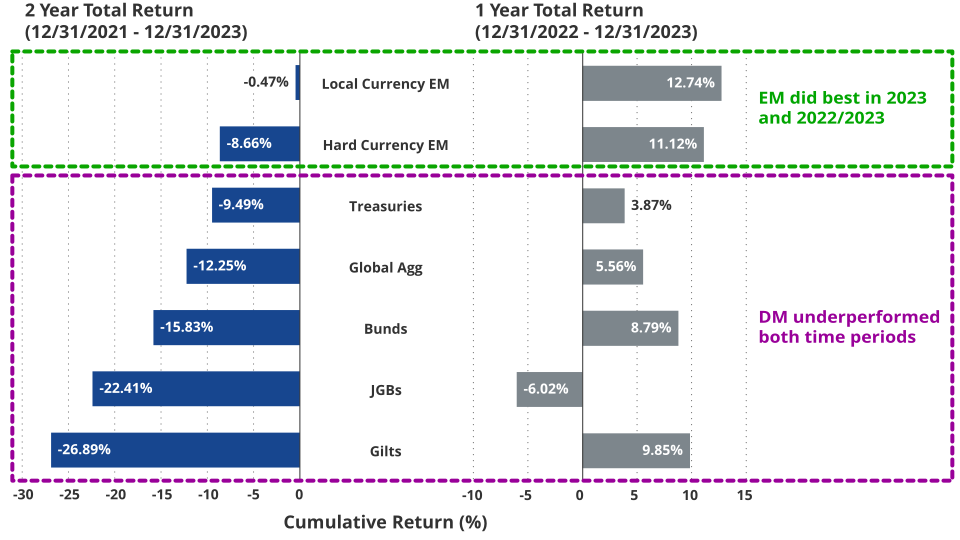
Source: J.P. Morgan and ICE Data Indices. Local Currency EM is represented by J.P. Morgan GBI-EM Global Diversified Index; Hard Currency EM is represented by J.P. Morgan EMBI Global Diversified Index; Treasuries represented by ICE BofA US Treasury Index; Bunds represented by ICE BofA German Government Index; Global Agg represented by ICE BofA Global Broad Market Index; JGBs represented by ICE BofA Japan Government Index; Gilts represented by ICE BofA UK Gilt Index.
EXPOSURE TYPES AND SIGNIFICANT CHANGES
The changes to our top positions are summarized below. Our largest positions in December were Mexico, Brazil, Malaysia, Colombia, and Indonesia:
- We increased our local currency exposure in Malaysia and Indonesia. The key factors in both countries were successful disinflation, FX correlation with China’s rebound, and the currencies lagged reaction to the Fed’s dovish pivot. In terms of our investment process, this improved the technical test score for both countries.
- We also increased our hard currency sovereign exposure in Suriname. The country successfully completed the debt restructuring process (both with the official and private sectors), delivering the new bonds to investors. In addition, the IMF completed the fourth review of its Extended Fund Facility program with Suriname. In terms of our investment process, both developments improved the policy test score for the country.
- We reduced our local currency exposure in South Africa, Mexico, and Brazil. Brazil’s reduction mostly reflected the monthly price action, but in Mexico we became concerned about stretched positioning (it was a very popular long both in rates and FX), as well as the country’s exposure to the US election cycle. This worsened Mexico’s technical test score. As regards South Africa, the key reasons were domestic political (elections) and fiscal issues, as well as the country’s exposure to China’s growth hiccups. These factors worsened the country’s technical, economic, and policy test scores.
- We also reduced our hard currency sovereign exposure in Bahrain and Angola. The main negatives in Bahrain (especially as regards the technical test score) were the US growth downturn and its negative impact on oil demand to which Bahrain is very sensitive at these spread levels. In Angola, we noted less attractive valuations, and no obvious positive market catalysts (including a lack of upside in oil prices), which worsened the country’s technical test score. It also has a high breakeven oil price.
- Finally, we reduced our hard currency corporate exposure in Israel. Geopolitical tensions in the region show no signs of abating. Israel’s policy framework is rock solid, but local assets might be exposed to geopolitical hiccups for many months to come. The bonds were priced for perfection.
Enjoyed this article? Sign up for our newsletter to receive regular insights and stay connected.