
Joe Raedle/Getty Images News
Costco (NASDAQ:COST) (NEOE:COST:CA) stock has fallen following the release of its second-quarter earnings report last Friday. While Costco continues to command a loyal, indeed almost devout, following among its membership-plan customer base, there are increasing concerns that the stock price has run ahead of the fundamentals.
The stock fell $60 to $725 on Friday, and down to $722 in after-hours trading. The question is whether this represents the beginning of a correction or a buying opportunity. After taking a look at Costco, I am not opening a position at this time. However, my research did lead me down a very different path than some other analysts. Simply put, I don’t believe the prevailing consensus about how Costco makes money is correct.
After reviewing the most recent earnings report, I will then turn to this question.
Costco Market Position And Strategy
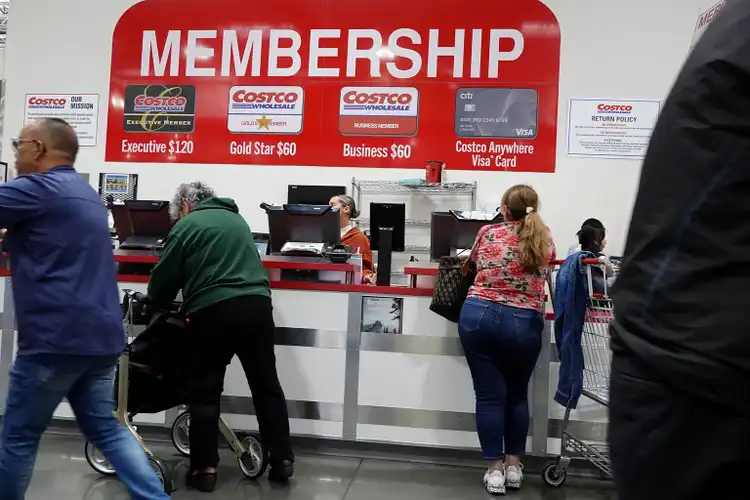
One of the things at the center of Costco’s reputation is its low prices, anchored in turn by its membership-fee only style business plan. Unlike Amazon (AMZN) whose Prime program is optional but not required for shopping online, and unlike Walmart (WMT) and Target (TGT) who for many years did not even have membership programs – they are both in the game now, with Target’s official launch of Circle 360 upcoming on April 7 – Costco has from the beginning said that a membership plan is an absolute requirement to even cross the threshold of their stores.
This dual revenue stream has led directly to Costco’s pricing advantage, for which it has over the years become rightly famous. Costco has been found by at least some to have a substantial price advantage over even Amazon, not just now, but for many years prior.
Those prices, in turn, have helped Costco to maintain its position as one of the fastest growing retailers in the country despite its status as the third largest retailer in America, behind only Walmart and Amazon. At 11.4% revenue growth over the past five years, Costco still trails well behind Amazon at 19.8%, but it is far ahead of Walmart, Target, Dollar Tree (DLTR) and even Dollar General (DG) as well.
So Costco came into the report with generally higher expectations than most retailers.
Earnings Report
Costco’s earnings report was not so much alarming for what it contained as what it portended. The earnings themselves were actually pretty good. Costco beat expectations on same-store sales by 5.6% Y/Y as well as EPS estimates by $0.16 at $3.92. They did, however, miss expectations on total revenue growth. While revenue did grow, coming in at $58.4 billion, that was over $700 million below expectations.
That alone was enough to jolt the stock because, as amazing as it sounds, four decades after going public, Costco remains a growth stock. Even after Friday’s decline, Costco trades at a 46 annualized trailing P/E. That’s a high bar to clear, since profits would have to more than double just to justify the current share price, let alone any future profits. Any shortfall in revenue, therefore, tends to panic investors, since growth is what they’re banking on.
What was interesting about the market’s reaction was that, according to the prevailing understanding of Costco’s business model, the reaction to a revenue shortfall shouldn’t have been nearly so violent. After all, another number Costco beat expectations on was membership income, which according to the general consensus is where Costco gets all its profit. If Costco’s revenue shortfall stems entirely from lower sales of merchandise, but it’s still selling as many memberships as before, well, that should be all that matters, right?
Market Disappointment
It is possible that the reaction stemmed from Costco’s failure to announce a hike in the fee for those memberships, which it hasn’t done in a while now and which many investors were expecting to hear at this earnings call. It is now approaching seven years since Costco’s last hike, and that is already longer between hikes than it usually takes.
It is also possible that the market simply assumes that merchandise sales correlate with memberships, and that a shortfall in one must inevitably lead eventually to a fall in the other.
However, I submit that there is a third possibility, as well. The market may simply be reflecting the fact that in fact, Costco’s profit isn’t entirely membership-based, after all.
Memberships And Merchandise
Costco’s membership fees certainly do play a central role in its business strategy, and certainly, one of the core components of that strategy is selling merchandise at a lower markup.
However, the “profits are all membership fees” story has become somewhat overplayed, although the larger point it seeks to convey about how Costco is unique from other retailers is accurate. Nevertheless, in the first quarter earnings ending in November, Costco reported $1.08 billion in membership fees but $2.11 billion in pretax profit. Barely half of Costco’s profit came from fees. The other half came from merchandise sales, the only other revenue category Costco reports. In the second quarter report that just came out, the percentage was actually below half, $1.11 billion out of $2.24 billion.
Those weren’t flukes, either. In the annual report it submitted last year – Costco’s fiscal year ends in August – Costco reported that its $8.5 billion in pretax profit was only $4.6 billion fee-based. The year before it was $4.2 billion out of $7.8 billion.
Altogether, Costco’s membership fees usually make up only around 50-55% of its pretax profit, plus or minus a few points.
An Alternative Model: Membership And SG&A
I would go even further, however, and question whether it is really this high. Costco divides its primary costs into just two components, as well: Merchandise Costs and SG&A. The categories are self-explanatory, but the key point is this: Costco does not assign any non-Cost of Goods Sold expenses to Merchandise costs, with the very limited exception of some employees who are not in general operations but assigned to a specific product category like fresh food. All of the stores’ costs, including employee salaries and other operating expenses, that’s all in SG&A.
Some of those expenses like the number of employees needed to run the store during open hours might well scale with sales, and so be considered properly a cost of merchandise sales, even if they’re not categorized as such. But rent, electricity payments, nightly cleaning, etc., are not. These are, of course, fixed costs, just like the membership is a fixed fee.
It is difficult to say for certain what percentage of SG&A exactly those costs represent. Looking at Costco’s numbers, we can see that in the most recent quarter it reported $1.11 billion in membership income, while SG&A came to $5.24 billion. So membership revenue is equal to 21.2% of SG&A costs. How does that compare to store fixed costs?
Like I said, it’s hard to say for sure, but I think that probably tracks pretty closely. Energy is usually estimated to represent somewhere between 4% and 9% of a retail store’s costs, though Costco’s relatively short operating hours may alter that somewhat. Rent is lower for suburban locations than for urban ones.
However, industry studies have generally found that labor, while far and away the largest expense category, tops out at around 70% of total operating costs for retail stores. And remember that some of that labor – security, overnight cleaning, etc., – doesn’t necessarily scale directly with unit sales, either. So while some of the non-labor costs may scale with sales after all, some of the labor costs don’t.
Assuming that the crossover between the two groups more or less cancels out, then 30% of costs are fixed. SG&A also includes the corporate headquarters, which is not a store operating cost at all and doesn’t fall cleanly into either category. Depending on how much of the total SG&A pie you think that takes up, the final number for fixed store costs may be more or less than 21% of total SG&A, but it seems likely it would land close to that number, give or take a point or two in either direction.
The way Costco’s business model actually seems to work, then, is like this: Costco opens a store and uses the membership fees it generates to cover the store’s fixed costs, the ones I described above that don’t scale with sales. They then generate smaller, but still significant, margins on each piece of merchandise they sell, and in a familiar strategy, make up the lower margins on volume.
In other words, Costco makes all its profit off of the goods it sells, just like any retailer without a membership program does.
The Real Secret Sauce Of Membership
This is not to say that there is nothing special about Costco’s membership program. There certainly is, but the membership fee should be understood as one cog of a multi-pronged strategy that is used, not to directly generate profit, but to lower prices. Typical stores without membership fees have to spread their non-merchandise costs across the body of the store’s sales to recoup them, which means they take higher margin on each item sold. Good for them.
But the higher price, in the ultra competitive world of retail, means that they are more likely to lose the said sale to another company charging a lower price on that particular item. This can in turn push margins and prices on the remaining sales even higher to amortize fixed costs over a smaller base, quickly becoming a negative spiral.
Costco’s membership fees are significant not because they generate substantial profit, but because they align the company’s cost structure better with their consumers costs. Instead of pricing goods above their optimum price to recoup costs embedded in the stores, Costco recoups those fixed costs separately and then prices merchandise lower, ensuring that it will be more likely to be the price leader for more categories of goods.
In short, Costco’s real strategy in adopting membership fees is to ensure that its prices for each additional merchandise it sells is closer to its marginal cost, making the whole operation more efficient for both consumer and retailer. And it usually does this without having to pay shipping, like Amazon does. No wonder Costco has been able to match Amazon in price for so long.
Modeling Future Growth
The reason I think this matters is because Costco stock is currently pricing in a very large growth multiple. In order to determine if that multiple is justified, we need to know how much growth is likely to add to the bottom line. If membership and sales are equally contributing to profit, then doubling sales to the same membership base would not increase profits nearly as much as selling the same number of goods per account to twice as many account holders. If membership is where all profits come from, then obviously merchandise sales do little to nothing for profit.
That would suggest that Costco’s profit in North American operations – which still represents over 80% of its store footprint – caps out at around one membership fee per household at most, with 135 million households in the United States.
And potentially a good deal less than that. If we deduct rural households where Costco doesn’t have stores, low-income households who may struggle to justify a membership, and half of single-occupant households who can split an account with another one-person household, while adding 15 million Canadian households at the same proportions, the number declines to roughly 80-100 million, depending on exactly how large the low-income effect you plug in is.
First Quarter Data
One small complication here is that Costco actually hasn’t released its official 10-Q filing to the SEC for second quarter yet. What was released last week was more of a headlines-only press release. As of first-quarter, Costco currently musters 72 million paid memberships worldwide. Technically, 12 million of those are business memberships, not households. But since a membership entitles one to unlimited sales, presumably business owners can bundle in their own purchases as well, so it might be a mistake to count on double-dipping in the case of those households.
Even assuming Costco gains an additional international member for every four North American ones, in line with its store footprint ratio, that would cap out memberships at 100-125 million.
Under the membership profit hypothetical, then, a P/E of 46 is a very steep hill to climb for shareholders because Costco can’t even double its memberships. Greater penetration of international markets could always be factored in to make up the difference, but that needs to be weighed against the probability that penetration in North America will probably be considerably below 100% even among qualified households.
Altogether, the membership profit scenario leaves little chance of decent returns and a lot of risk, considering how much growth is already baked into the share price.
Scenario #2: Merchandise Sales Profit Model
On the other hand, if I am right that memberships are essentially just fixed cost defrayment and merchandise sales are where the entirety of the profit is really to be found, then profit growth is more properly assessed in terms of merchandise sales growth.
In that case, Costco’s large growth multiple could well prove to be justified. Costco reported an annualized run rate of $234 billion of revenue in the past quarter. That is barely one-third of Walmart’s revenues at a time when revenue growth remains strong and Costco isn’t even competing in some of the categories Walmart does, like home delivery – Costco’s Instacart (CART) partnership represents, according to the CFO, only ~1.5% of sales.
If Costco sales are capable of tripling or even more – Walmart may not represent the peak of Costco’s sales, since Walmart’s pricing strategy may not be as efficient as Costco’s – then a doubling of share price doesn’t seem so difficult.
If we assume that Costco’s current 5-year CAGR of 11.4% continues, then Costco’s sales will take just over 10 years to triple. In 20 years, they will be 8.66x today’s level. At a constant profit margin and assuming that memberships scale with store footprint, Costco would outperform a standard 7% annual compounding investment by roughly 2.23x – almost exactly identical to its current premium.
This scenario is a little better than the memberships one, but it still doesn’t quite make Costco a buy in my book. Essentially, under this scenario, all the growth is priced in, leaving little chance of beating the broader market and still some considerable downside risk if execution falters.
The only plausible scenario for further gains would be if we plug in some additional international growth over and above the baseline growth rate. That certainly isn’t impossible, but even so, I think it merely balances the scales with the risks that North American execution will fall short. I still don’t see a potential outsized return unless everything goes right, which is not a particularly compelling buy thesis.
Potential Competitive Adjustments
When I say execution risk, I’m not just talking in the abstract. Precisely because Amazon and Costco have had such success with membership programs, competitors are moving to emulate them. With Target’s announcement that it is getting in the game as well, Big Four – Walmart, Target, Costco and Amazon – all have membership programs. It’s too soon to say if the former two shall be as successful as the latter, but clearly, like most successful innovations, membership programs are continuing to attract competitors and emulators.
Investment Summary
I am well aware that this is a rather idiosyncratic way of looking at Costco – my merchandise sales thesis is not in accordance with the prevailing consensus. Ordinarily, that would make me excited because it would suggest the possibility that the market was mis-pricing an asset. But after looking at this asset, the valuation just seems a very high mountain to climb, even though I agree Costco appears to be a very strong company with a lot of future profit potential – albeit for different reasons.
I rate Costco a Hold.
Enjoyed this article? Sign up for our newsletter to receive regular insights and stay connected.