

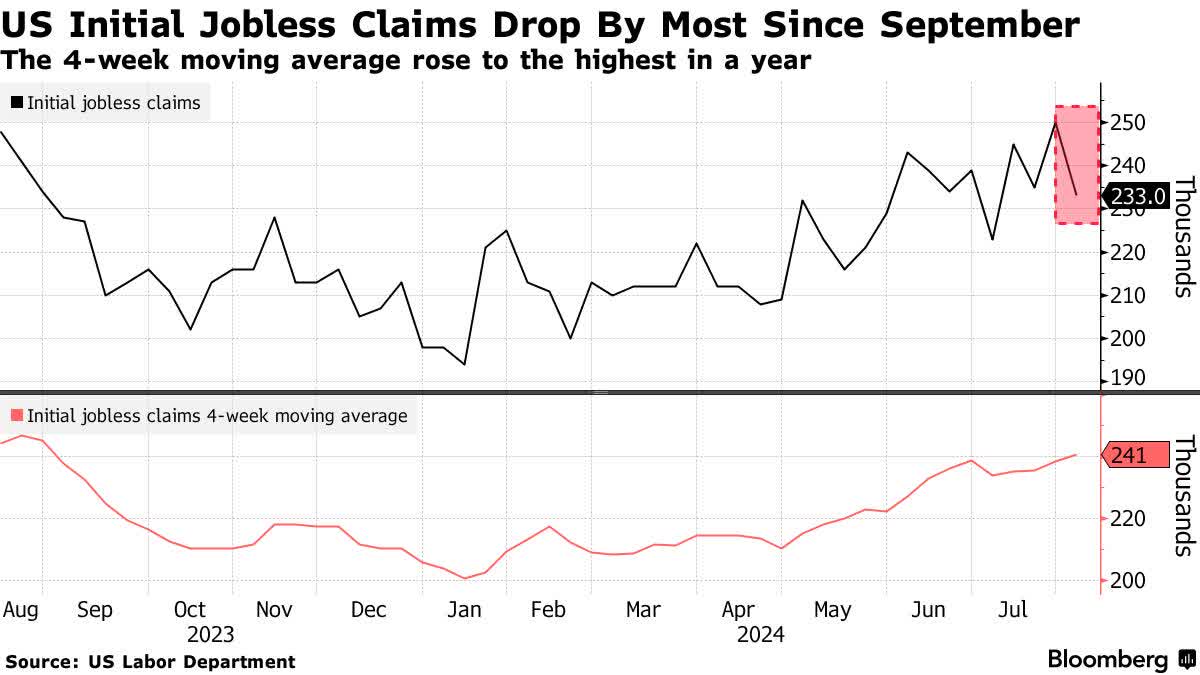
The major market averages soared yesterday on recognition that the labor market is not deteriorating to the alarming degree that was assumed following last week’s jobs report for June. Initial unemployment claims fell sharply to 233,000, which was below the 240,000 expected and 250,000 we saw last week. That eased concerns that a recession is upon us, as indicated by the triggering of the Sahm Rule. It also lowered the probability that the Fed would act drastically by cutting short-term rates by as much as 50 basis points at its next two meetings in September and November. There is still a stronger likelihood that it will act with a half-point cut in September, but Fed officials are already pushing back on that expectation, indicating that the labor market is not as weak as last week’s report suggested.

Finviz
For a change, I agree with Fed officials. The June jobs report was undoubtedly influenced by Hurricane Beryl in that the number of workers who could not work or were working part-time soared to five times the number we saw the previous month. I think the storm also adversely impacted hours worked and wages. We should see a snap back in those numbers when the next jobs report arrives. As for the increase in the number of continuing unemployment claims, which has been consistent the past few months, it is only back to pre-pandemic levels.
Bloomberg
I have preached ad nauseam that soft landings are balancing acts between just enough growth to prolong the expansion combined with just enough softness in the economic data to tame the elevated rate of inflation. It is no easy task for the Federal Reserve because its officials must not only ease off the brakes of restrictive monetary policy at just the right time, but also manage consumer and investor expectations about inflation and economic growth.
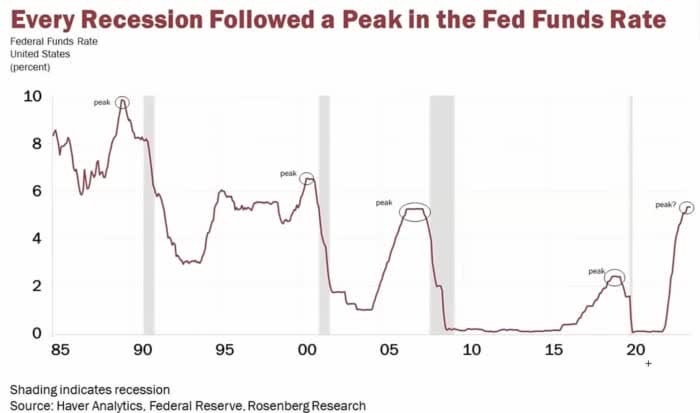
If consumers do not think the Fed will be successful in bringing the rate of price increases down, they run the risk of losing credibility. Consumers could recoil, employers would be forced to lay off workers, and the economy would run the risk of contraction. The same thing can happen if the Fed is too aggressive in its battle with inflation, and restrictive policy forces consumers to cut back, which would also lead to a deterioration in the labor market, feeding back into less spending and a recession. This is why most rate-hike cycles result in recessions. In fact, every recession followed a peak in the Fed Funds rate.
MarketWatch
Yet not every peak in the Fed Funds rate was followed by a recession, which is the situation I see in front of us now. Note the period from 1995 through 1998 in the chart above, which was arguably the last time we had a soft landing. That was a mid-cycle slowdown in the economy during the expansion from the early 1990s through 2000, and I think we are in the middle of a similar scenario today.
This outlook is even more controversial given that it is a contentious election year. Every high-frequency economic data point is likely to be scrutinized by both sides of the aisle with one assuming the worst and the other the best. The truth usually lies somewhere in between. If the weight of evidence in the data suggests an economic contraction is approaching, I intend to respond with another shift in investment strategy, but this time from offense to defense. We are not there yet.
Lots of services offer investment ideas, but few offer a comprehensive top-down investment strategy that helps you tactically shift your asset allocation between offense and defense. That is how The Portfolio Architect compliments other services that focus on the bottom-ups security analysis of REITs, CEFs, ETFs, dividend-paying stocks and other securities.
Enjoyed this article? Sign up for our newsletter to receive regular insights and stay connected.