
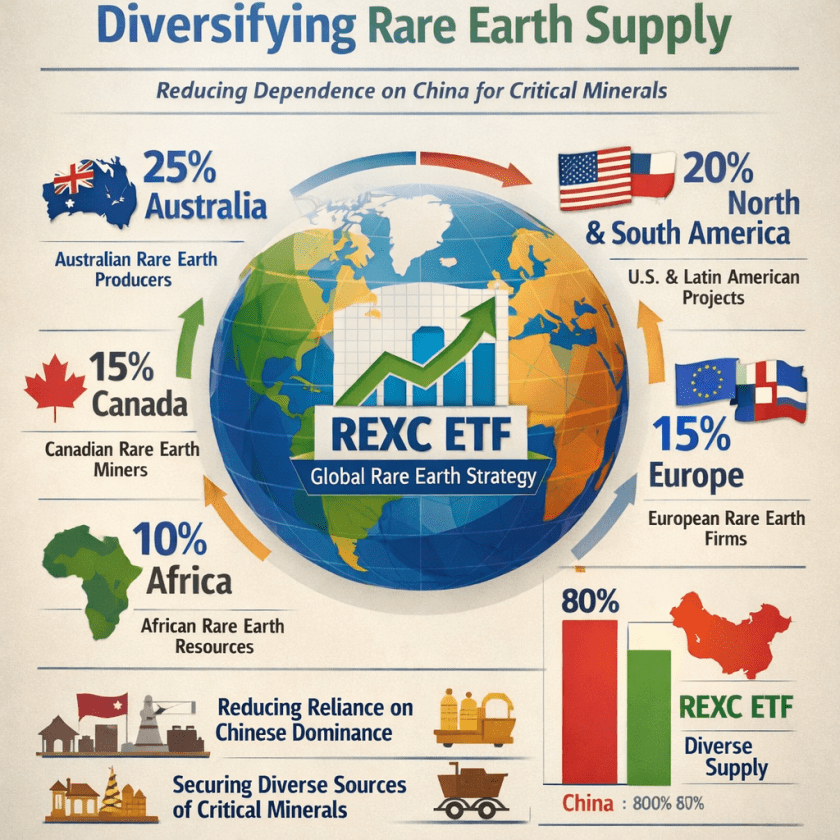
REXC is less about a broad materials allocation and more about a specific supply-chain judgment. By screening out China-domiciled companies, the fund turns rare earths into a geopolitical and industrial-policy theme rather than a simple mining bet. For ETF investors, that matters because the portfolio is built around where processing, refining, and magnet production sit in the value chain—not just where ore is dug up.
The construction also changes the risk profile in a way that is easy to overlook. A concentrated basket of 34 holdings can offer clearer exposure to the theme, but it can also make single-company news, local permitting issues, and execution setbacks more visible in the fund’s day-to-day behavior. That is especially relevant in a segment where many businesses are smaller, more specialized, and more dependent on capital access than large diversified miners.
Because the strategy is rules-based, the index matters as much as the label. Investors should pay attention to how the underlying methodology defines “rare earths” exposure, which parts of the supply chain qualify, and how often holdings may change as companies move in or out of the eligible universe. In a niche ETF, those details can shape concentration, turnover, and the practical costs of maintaining the exposure.
For long-term allocators, REXC is best understood as a targeted satellite position: a way to express a view on non-Chinese critical-mineral infrastructure while accepting the trade-off between strategic relevance and higher single-theme risk. The fund’s appeal depends on whether that policy-linked exposure belongs in the portfolio at all, and at what size.
Breaking the Monopoly
Quite simply, innovation doesn’t happen without rare earths. These elements are necessary for production of innovative technological advancements from electric vehicle (EV) motors, wind turbines, missile guidance systems, and smartphones. Historically, China has held a controlling interest in rare earth mining as well as processing and refining capacity. This near-monopoly creates greater risk as trade friction or export restrictions from Western sanctions can disrupt global supply chains for high-tech industries outside of China. “China dominates the rare earth market by controlling roughly 70% of global mining, over 90% of refining capacity and the vast majority of magnet production,” noted Jacob White, Sprott’s Director of ETF Product Management, in a report: Rare Earths as a National Security Asset: Why Ex-China Supply Matters. By excluding Chinese companies, REXC gives investors exposure to burgeoning rare earths ecosystems in other parts of the globe. This includes miners, processors, and recyclers in jurisdictions like Australia, Canada, and the United States. Source: Sprott Asset Management. In 2026, economic security goes hand in hand with national security. Governments across the G7 are pouring billions into subsidies to fund domestic critical mineral projects to ensure they are dependent on their own supply chains. REXC is poised to capture these legislative tailwinds. Regulatory measures like the U.S. Inflation Reduction Act are prioritizing non-Chinese sourcing for EV tax credits. This can include sourcing from companies found within REXC’s portfolio—those focused on mining, separation, refining or production of rare earths.Pure-Play Exposure
However, for investors who wish to avoid the risk associated with Chinese state-owned enterprises, REXC is a compelling option with its pure-play exposure. The fund specifically targets minerals that will see exponential demand grow as the world electrifies and other technological advancements proliferate. The fund is heavily diversified, providing exposure across large, medium, and small companies. At the same time, it has a high-conviction portfolio of 34 companies (as of April 14). For the latest standardized performance and holdings of Sprott Rare Earths Ex-China ETF, please visit REXC. Past performance is no guarantee of future results. By removing China exposure, REXC seeks to mitigate the risk from geopolitical uncertainty and regulatory shifts. REXC provides a tactical tool for investors who believe that the future of energy independence hinges on a supply chain that begins and ends outside of Chinese borders.Disclosures
An investor should consider the investment objectives, risks, charges, and expenses carefully before investing. To obtain a Prospectus, which contains this and other information, contact your financial professional or call 888.622.1813. Read the Prospectus carefully before investing, which can also be found by clicking one of the links below. Past performance is no guarantee of future results. One cannot invest directly in an index. Funds that emphasize investments in small/mid-cap companies will generally experience greater price volatility. Diversification does not eliminate the risk of investment losses. ETFs are considered to have continuous liquidity because they allow an individual to trade throughout the day. A higher portfolio turnover rate may indicate higher transaction costs and may result in higher taxes when Fund shares are held in a taxable account. These costs, which are not reflected in annual fund operating expenses, affect the Fund’s performance. Sprott Asset Management USA, Inc. is the Investment Adviser to the ETFs. ALPS Distributors, Inc. is the Distributor for the ETFs and is a registered broker-dealer and FINRA Member. ALPS Distributors, Inc. is not affiliated with Sprott Asset Management USA, Inc. or VettaFi. Exchange Traded Funds (ETFs): SETM, LITP, URNM, URN, COPP, COPJ, NIKL, SGDM, SGDJ, SLVR, GBUG, METL, and REXCPhysical Bullion Funds:PHYS, PSLV, CEF, and Original Postlatinum-and-palladium/" target="_blank" rel="noopener" shape="rect">SPPP. Gold and precious metals are referred to with terms of art like store of value, safe haven and safe asset. These terms should not be construed to guarantee any form of investment safety. While “safe” assets like gold, Treasuries, money market funds and cash generally do not carry a high risk of loss relative to other asset classes, any asset may lose value, which may involve the complete loss of invested principal.
Enjoyed this article? Sign up for our newsletter to receive regular insights and stay connected.