
For ETF investors, the word choice matters because the cash flow label can signal a very different tax and portfolio experience. A “dividend” from a corporation and a “distribution” from a partnership may both put cash in an account, but the legal structure behind them can change how income is reported, when taxes are recognized, and how much administrative friction appears at tax time. That makes the wrapper as important as the headline yield.
Investors should also separate cash paid from cash earned. High distributions can reflect the economics of the underlying business, but they can also reflect capital structure, commodity exposure, or return-of-capital mechanics. For long-term portfolios, the key question is not simply whether an ETF or security pays income, but whether that income is supported by durable cash generation and fits the investor’s tax situation.
In practice, the biggest decision is often concentration management. Income-focused allocations can drift toward a narrow set of sectors, especially when yield is concentrated in energy-linked assets or other cyclical businesses. Rebalancing rules, position sizing, and holding-period expectations help prevent an income sleeve from quietly becoming a bet on one industry or one tax regime.
That is why investors comparing dividends and distributions should think beyond the headline payout. Useful questions include: How is the fund structured? What reporting comes with ownership? Does the income stream complement the rest of the portfolio, or does it add a layer of concentration and complexity that must be monitored over time?
Key Takeaways
- Corporate dividends represent cash payouts from C-corporations, while distributions stem from partnership entities.
- Corporate dividends face double taxation at both the corporate and shareholder levels. In contrast, MLPs use a pass-through structure to avoid entity-level federal taxes.
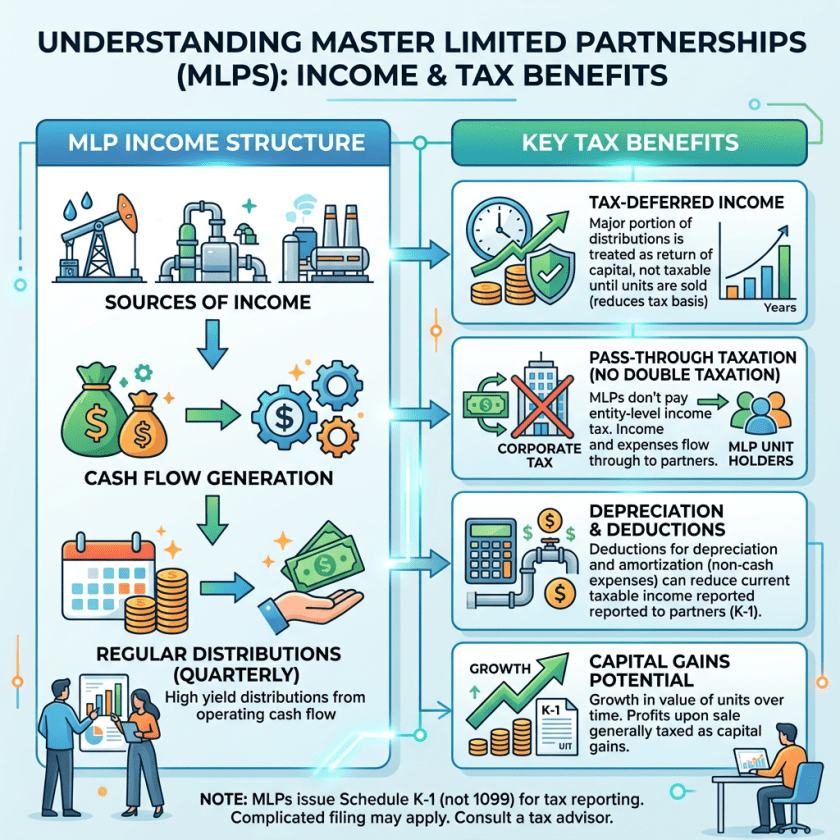
- MLP distributions are tax-deferred, meaning investors generally delay tax payments until they sell their units, though they must manage annual Schedule K-1 filings.
Understanding Dividends vs. Distributions: Corporate Dividends Double Taxation
Dividends are the most common form of cash payout distributed by traditional C-corporations. A C-corporation is a traditional business structure that is legally separate from its shareholders, so these payments are subject to double taxation. The firm first pays corporate income tax on profits, and then individual shareholders pay tax on those same distributions. Fortunately, qualified dividends — typically paid by U.S. companies or international firms on major U.S. exchanges — are taxed at lower long-term capital gains rates. Conversely, nonqualified dividends are generally treated the same as other forms of income and taxed at an individual’s higher income rate.MLP Distributions: The Pass-Through Advantage
Income from MLPs is called distributions because of their partnership structure. MLPs are predominately found in the energy sector. Unlike C-corporations, MLPs are pass-through entities. This means they generally pay zero federal income taxes at the entity level, provided 90% or more of their gross income is derived from qualifying sources. This structure allows MLPs to distribute a larger portion of their cash flows directly to investors compared to C-corporations. Notably, it also provides tax-advantaged income: Entity-level taxes are avoided, so investors bypass double taxation entirely.Dividends vs Distributions: Navigating MLP Tax Deferred Income and K-1 Filings
Furthermore, MLP distributions are tax-deferred, meaning that taxes are not paid on the distributions until the investor sells their position. Each year, MLP unitholders receive a Schedule K-1 detailing their portion of the partnership’s income and deductions. Unitholders pay personal income tax on the net income assigned to them, which qualifies for a 20% qualified business income deduction. Historically, this assigned net income is modest relative to the actual cash distributions received. Unitholders may also face state income taxes in states where the MLP operates, though minimum income thresholds often shield smaller positions from out-of-state filing requirementsEnjoyed this article? Sign up for our newsletter to receive regular insights and stay connected.