
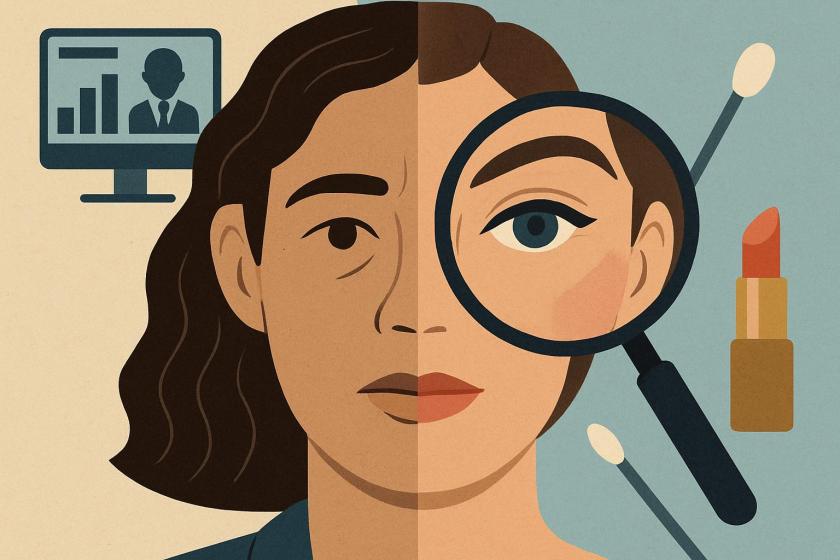
What this kind of research can and cannot tell us matters more than the headline claim. Studies linking attractiveness to income often capture a mix of appearance, confidence, grooming, social class, and workplace norms, so it is hard to isolate any one factor. That means a result associated with looks should not be read as proof that changing facial features will reliably change earnings.
For readers considering cosmetic procedures, the practical question is not “does beauty pay?” but “what exactly is being changed?” A procedure may alter how polished, rested, or professionally put-together someone appears, which can affect first impressions in image-sensitive settings. But that is not the same as creating a durable advantage across every job, and the effect may be smaller where performance is easy to measure or appearance matters less.
There is also a psychological trade-off that is easy to miss. Some people experience cosmetic work as relief from self-consciousness, which may help them show up more confidently in public-facing roles. Others may find that the benefits fade, shift into new insecurities, or invite more appearance monitoring. In other words, a procedure can change behavior and mood without necessarily changing objective outcomes in a predictable way.
The broader takeaway is about uncertainty and opportunity cost. Time, money, recovery, and maintenance all matter, especially when the return is mostly social and hard to measure. For many people, the more evidence-informed question is not whether a procedure can “pay for itself,” but whether the likely gains outweigh the risks, stress, and competing uses of those resources.
“It’s the beauty we’re born with that basically we’re stuck with. You’d have to sort of restructure your entire facial skeleton to make a difference.”“Beauty raises happiness,” wrote economists Daniel Hamermesh and Jason Abrevaya in an uncomfortable 2011 paper. For the most part, this is not because being beautiful in itself makes people happy, although that is a small factor, but rather because “personal beauty improves economic outcomes — incomes, marriage prospects, and others — that increase happiness.” The title of Hamermesh’s book is Beauty Pays. Hamermesh, a professor emeritus at the University of Texas at Austin, lays out exactly how much. Using data from the 1970s that matched appearance ratings with salary, he found that above-average-looking women earn 8% more than their average peers, while below-average-looking women earn 4% less. (If it is any consolation, lookism transcends gender: Above-average men get less of a bump than pretty women do, but they are penalized significantly more for looking worse.) Over the course of their working lives, and adjusted for inflation, above-average-looking workers earn $344,000 more than their below-average compatriots. You might think this could be because beautiful people have higher self-esteem or more winning personalities or are smarter or taller or otherwise superior in ways that only correlate with looks — but it isn’t. “The beauty thing,” Hamermesh assures me on the phone, “is quite independent.” Therefore, you should consider being beautiful. The trouble is that you already have your face. You can absolutely cut it, lift it, shape it, laser it, and inject it. Whether all or any of this will make you objectively “more beautiful” is less clear. The data is scant on the before-and-after lives of people who’ve made cosmetic tweaks, for the obvious reason that “you can’t really randomize people into getting a procedure like that,” says Olga Shurchkov, an economics professor at Wellesley who once attempted a similar study, but with makeup, randomly applied. (“We didn’t pursue it — it was too expensive.”) But what we do know does not suggest a new and lumpless nose will do much to make you rich. One Korean study looked at the beauty scores of people who had come to plastic surgeons inquiring about various procedures, comparing their initial photographs with computer-generated images of what their faces would hypothetically look like after the requested work was done. On average, surgery gave women a 0.52 beauty bump — half a step on a 5-point scale. But when researchers looked at the surgery’s effect on income, they found that “overall, the monetary return to plastic surgery is either economically small or statistically not different from zero.” The average benefits, they concluded, were “not large enough to justify the surgical costs,” let alone the pain and risk.
“Knowing the rules to follow and following them shows you have the knowledge, you have the money, and you have the time. And those things are all valued.”“It’s the beauty we’re born with that basically we’re stuck with,” Hamermesh tells me over the phone. A duckling won’t become a swan, but with significant effort, could reap marginal benefits as a slightly prettier duck. This ought to be, in some sense, freeing. “You’d have to sort of restructure your entire facial skeleton to make a difference,” which would be deeply unsettling, even if it were possible. This should be permission to think less about the definition of your cheekbones. (I think about my cheekbones all the time.) Yet when it feels like their career, or their love life, or just the way they move through the world, is on the line, plenty of people spin the roulette wheel anyway — even if it’s ultimately impossible to precisely untangle the mess of forces that determine the outcome of anybody’s life. Jane, a 32-year-old journalist, started making adjustments last year — Kybella, to dissolve the fat under her chin, Botox in her frown lines, and a “teeny bit” of upper lip filler. “It’s not like I’ve gotten a promotion or a new boyfriend or something,” she tells me. But when she sees herself on camera, she no longer spirals. She doesn’t think about her chin anymore. If, by reshaping her chin, Jane has become “more comfortable” putting herself “out there in a forward-facing way,” then isn’t she better at her forward-facing job? If she were promoted tomorrow, it wouldn’t be because of the Kybella — but it wouldn’t not be. Yet there’s another way to think about this. Perhaps ideas and expectations about how one ought to appear in public, and the limits of what’s possible, are evolving faster than the speed of peer-reviewed research. Like good haircuts and well-maintained cuticles, something like Botox has been effectively reclassified as grooming. Unlike your God-given bone structure, grooming is, at least in theory, under your control: With enough money, time, and effort, you can “portray a certain image,” says Rae Nudson, author of All Made Up: The Power and Pitfalls of Beauty Culture.
“I do get special attention from it, not necessarily because of how it looks, but because it gives us something to talk about.”Appearing well-maintained is not the same as looking rich, she clarifies, but the two are so entangled it is nearly impossible to parse. “Knowing the rules to follow and following them shows you have the knowledge, you have the money, and you have the time,” she says. “And those things are all valued.” When they isolated attractiveness from grooming, sociologists Jaclyn Wong and Andrew Penner Original Postii/S0276562416300518#:~:text=Further%2C%20while%20both%20conventional%20wisdom%20and%20previous,only%20half%20of%20the%20premium%20for%20men" target="_blank" rel="noopener noreferrer" shape="rect">found the earnings gap between above-average-looking workers and regular-looking ones was drastically reduced. For women, it was gone. For men, it was halved. Grooming mattered more, in both cases, than free-floating hotness. “Being attractive is not enough,” they concluded. “It is doing attractiveness appropriately that proves one’s deservingness and is what gets rewarded in the labor market.” This concept is intuitive to ambitious women. None of the women I spoke to for this story framed their cosmetic work — Botox, mostly — in terms of objective beauty. “You want to look fresh,” says Michelle, a 52-year-old in finance. For a while, she stopped getting Botox, but went back to it. “I didn’t feel as fresh.” An actress and producer, Chloe, who is 36, describes her post-Botox face not as younger but as “sparkly.” “It just makes the rest of your face look glowier,” she tells me. She doesn’t think it’s changed what roles she gets considered for, and she is quick to add that she specifically doesn’t get it when she’s actually performing (a frozen forehead is no acting tool), but she is acutely aware that it allows her to project a certain kind of success — specifically, the glowy kind. “I’m the kind of person who buys fancy clothes and then occasionally returns them,” she says. “I rent shit.” Botox is, for her, a way to appear, if not more beautiful, then more polished and better-resourced. Looking “refreshed,” she notes, “suggests that you are not running yourself ragged, that you have the luxury of prioritizing your health, your beauty, your rest.” “I think it’s part of the whole package of presenting yourself in a certain way,” says Sarah, the physician. The clothes, the makeup, the Botox — this is how you win the game. Cosmetic dermatology has also become a point of bonding with female higher-ups. “They, like, girl talk with me about it,” she says. “I think I do get special attention from it, not necessarily because of how it looks, but because it gives us something to talk about.” More than beauty — although she does believe it helps — Sarah’s commitment to Botox has given her membership to a very professionally useful club. Likewise, in the status-conscious neighborhood where she works, most of her patients, she estimates, are getting some kind of work done. “If patients identify you as being someone more like them, then it’s easier for them to open up to you medically,” she says. Still, just because there is a return on the investment doesn’t mean it is necessarily the best possible deal. You could do lots of things to improve your lifetime earning potential. You could learn another language, invest in some secret passion project, go on a drug-assisted spiritual quest that results in a lucrative revelation; you could invest your facelift money in index funds. “Suck it up and take advantage of the things that you are good at,” Hamermesh told me, somewhat hauntingly. In earnings, as in life, “there are so many other things that matter.”
Enjoyed this article? Sign up for our newsletter to receive regular insights and stay connected.