
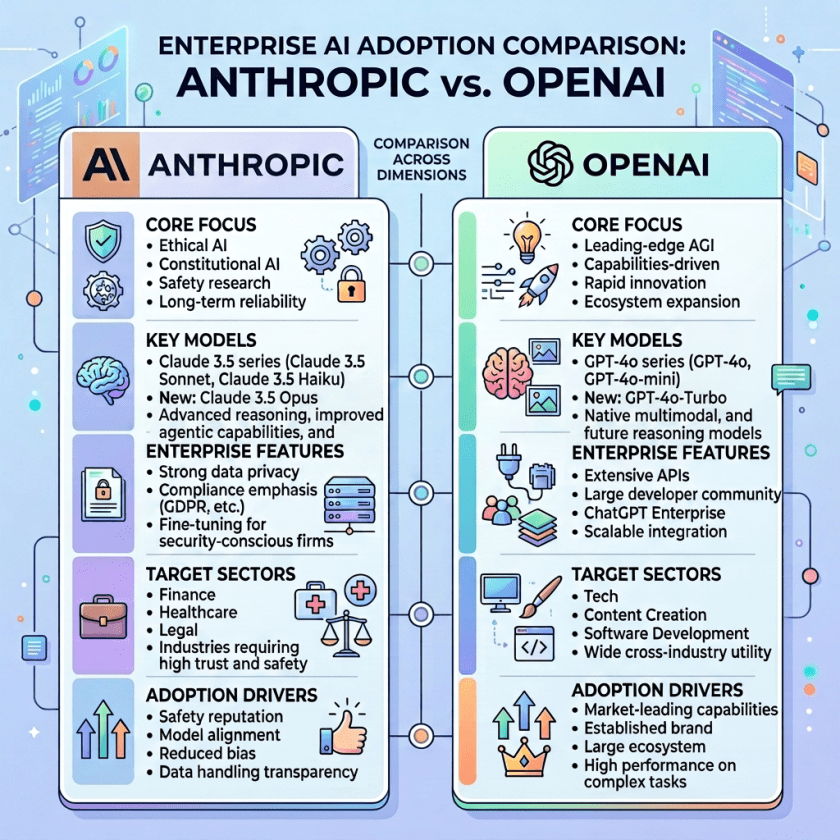
The management issue here is not which frontier model is “winning” this quarter. For enterprise leaders, the more durable decision is how to avoid turning a shifting vendor race into a long-lived operating model dependency. That makes model choice a governance problem as much as a technology one: who approves use cases, who accepts risk, and who owns the right to switch suppliers when the market moves.
AI portfolios are starting to look more like application portfolios than platform bets. CIOs should expect different models, pricing structures and hosting patterns to coexist across the enterprise. The trade-off is flexibility versus standardisation: more options can improve task fit and cost control, but they also raise demands on architecture, procurement, legal review and support. The practical next question is whether the organisation has a clear decision framework for when a team can choose a model locally and when enterprise-wide reuse is mandatory.
Consumption management is becoming a finance and productivity discipline, not just a technical one. Usage-based pricing can hide waste until spend becomes material, so attribution by team, workflow and business outcome matters early. Leaders should be asking which workloads justify premium models, which can be routed to lower-cost services, and how value will be measured when AI is embedded in everyday work rather than launched as a standalone project.
The most important inflection may be agentic capability. Once tools can search, call services or execute code, the control question changes from “does it answer correctly?” to “what can it do, and who can stop it?” That raises the bar for guardrails, logging, human approval points and incident response. CIOs should press vendors and internal teams on one question: what happens when the model is not only wrong, but active?
Security first, everything else second
Before performance, pricing, or features enter the conversation, CIOs say AI platforms must first pass security and governance tests. “Our work depends on strict client confidentiality, so a platform has to clear a few non-negotiable bars before it is even a candidate,” Leslie said. “Client data is never used to train models, interactions are not exposed to human review, and data stays on U.S. infrastructure. Those constraints define the feasible set; everything else is a choice within it.” Eric Pace, head of AI at Cox Business, the commercial services division of Cox Communications, put it similarly. “Security is non-negotiable for us,” Pace said. “Given the amount of critical infrastructure we manage, we have to start with risk and whether a solution fits within our security, legal, data privacy and governance requirements. If it introduces risks that we would not be comfortable standing behind, it is not worth pursuing.” At Lowenstein Sandler, a national law firm, the bar is just as high. “Security and confidentiality aren’t one factor among several,” said the firm’s chief information and innovation officer, Maureen Naughton. “They are the threshold test.”The model isn’t the moat
With security and governance requirements met, CIOs say performance matters — but not in the way much vendor marketing suggests. The gap between leading models is thin and constantly shifting. Betting on today’s benchmark winner is a short-term play at best. “The durable advantage was never the model — the models are the easy part,” said Jeremy Bruck, partner at management and technology consulting firm West Monroe. “The advantage is in a company’s data assets, context, workflows, controls, and how fast they are able to turn a signal into action.” Cornerstone Research built a model-agnostic stack on purpose. “The frontier is moving too fast to wire our architecture to any single vendor; the lock-in risk is real, and the gap that looks decisive today may be gone in two quarters,” Leslie said. Rather than picking a single winner, several CIOs describe running a portfolio of AI platforms matched to different use cases.Multiple models serving distinct roles
“We don’t approach this as picking a single winner,” said Naughton of Lowenstein Sandler. “We think of them as occupying distinct lanes rather than competing for one seat.” This approach is becoming the norm. “The continuous model leapfrogging has helped companies accept that the rate of change is only going to accelerate,” said West Monroe’s Bruck. “Companies are no longer focused on ‘smartest model’ but instead on modular platforms that reduce switching costs as new solutions emerge.” Ramp’s Kharazian sees the same pattern in spending data. “The evaluation is moving from ‘Which AI vendor should we use?’ to ‘Which model should do this task, at what cost?'” he said. “That pushes companies toward multi-vendor setups, routing, open source models, and inference platforms.”Freedom within a framework
Developer enthusiasm has been the driving force behind AI adoption. But CIOs say that bottom-up demand works best when there are AI guardrails in place. Pace of Cox Business describes the approach as “freedom within a framework.” The company provides a governed set of model options across on-prem and cloud environments, and within that framework, teams have flexibility to choose what works best for their use case. “Developer preference does play a role, particularly in model selection,” Pace said. “The key is that all of this happens inside a broader governance framework that we view as an enabler, not a constraint” The dynamic is similar at Cornerstone Research. “Our data scientists are strong and opinionated; they run their own evaluations and hold real views on model performance,” Leslie said. “That input is indispensable.” But a full evaluation also requires IT to assess security and legal to vet confidentiality terms — and those reviews don’t happen on their own. “The job of leadership is not to overrule the technical judgment bubbling up from the team,” Leslie argued. “It’s to make sure the whole evaluation actually happens.” At Lowenstein Sandler, Naughton frames it as a design principle: “The healthiest version of this is governance setting the boundaries,” she said, “and the front line driving the priorities.”Watching the meter: How CIOs manage consumption
Governance solves one problem. Costs create another. “AI is the fastest-growing spend category we’ve ever observed,” said Ramp’s Kharazian. “The average business is spending 13x more on tokens than it was in January 2025.” Usage-based pricing means CIOs can see exactly what they’re spending, but not always what they’re getting for it. As adoption scales, CIOs are developing new disciplines for managing consumption without stifling value. The first move, said West Monroe’s Bruck, is tying spend to outcomes. “You can’t manage what you can’t attribute,” he saids, “so disciplined enterprises track which team, workflow, and increasingly which person is driving spend, tied to a unit of business value, before they try to spend less.” Pace takes a value-first approach to cost management at Cox Business. “When AI helps someone work through years of backlog in weeks, the conversation shifts from controlling cost to asking what more we can enable,” he said. Kharazian sees three trends emerging:-
Visibility: Separating subscriptions, APIs, and inference platforms.
-
Model-task fit: Matching cheaper models to simpler work.
-
Controls: Setting alerts, spending limits and tracking attribution before the bill arrives.
What CIOs are asking now: AI model evaluation shifts from outputs to actions
A year ago, CIOs were wondering whether AI tools actually worked. That question is largely settled. “Our criteria have matured toward integration depth, security posture, governance fit, and increasingly readiness for more agentic capabilities — meaning tools that take actions rather than just generate text,” said Naughton. “The bar has moved from novelty to durability.” When AI systems can take actions, the evaluation changes entirely. “Once a system can search the web, call external services, write and run its own code, you have to ask a different class of question,” said Cornerstone’s Leslie. “What guardrails exist? What can we stop it from doing inside our environment?” The old test was about what the model produces. “The new test is also about what the model does,” Leslie said. “That is a genuinely harder problem.” Model selection still matters. But for CIOs, so does building architecture that can adapt when the leaderboard flips again — because it will.Enjoyed this article? Sign up for our newsletter to receive regular insights and stay connected.