
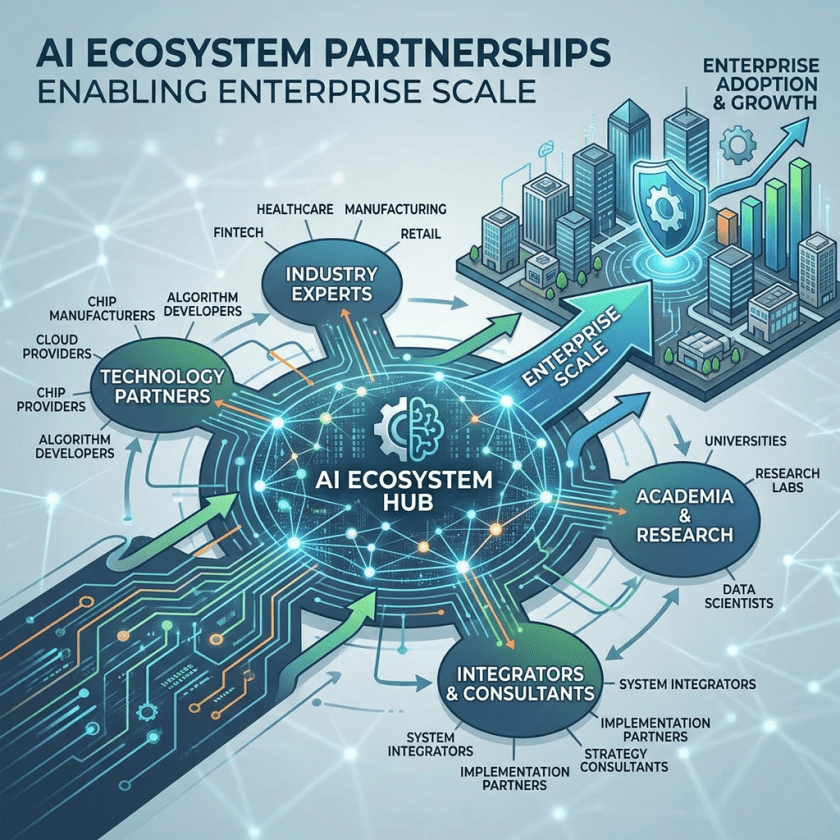
Ecosystem partnerships are not just a faster procurement route; they force a decision about where enterprise control should sit. CIOs and transformation leaders need to separate what must be standardised centrally — identity, data access, observability, security and deployment controls — from what can remain domain-specific. Without that line, partnership-driven scale can drift into shared complexity rather than shared capability.
The management issue is operating model, not model choice. A reusable AI platform only delivers value if there is clear ownership for reference architectures, approval of “golden paths,” and exceptions for specialist tools. That means defining who can approve partner integrations, who funds common services, and who carries accountability when a use case crosses business-unit boundaries. The next question is whether the organisation is prepared to govern AI as a product portfolio, not as a series of isolated projects.
There is also a capital allocation trade-off. Ecosystem reuse can reduce duplicated engineering and speed delivery, but only if leaders are willing to invest upfront in shared foundations that may not map neatly to one business case. Portfolio governance should therefore test for platform leverage: which investments unlock multiple use cases, which are one-off bets, and which dependencies create hidden technical debt. That makes benefits tracking more important than headline pilot counts.
Finally, partnerships improve resilience only when optionality is preserved. A tightly integrated ecosystem can simplify governance, but it can also create concentration risk if the enterprise cannot swap components, add niche providers or adapt to changing regulatory demands. Leadership teams should ask: Where is vendor substitution realistic? Which integration points are strategic? What service levels, audit rights and exit provisions protect the enterprise if the ecosystem no longer fits? Those questions determine whether scale becomes durable advantage or a new form of dependency.
For many organizations, the focus has been on demonstrating where AI can create value in practical, controlled environments. Pilots have helped show what is possible, often within a single business function, a limited data environment or a narrow operational use case.
However, moving from experimentation to enterprise-wide deployment changes the challenge fundamentally. At scale, AI is no longer just a model or an application. It becomes an operating challenge.
Hidden complexity of AI at scale
This is where the real complexity begins. Success in pilot mode does not translate directly into production. The architectures, processes and governance structures that may be acceptable for a proof of concept rarely hold up when AI must run reliably across regions, business units and core workflows.
What appears manageable in isolation becomes significantly harder when performance, resilience, security, compliance and lifecycle management all need to work together in a repeatable way.
Related:My AI governance framework is a blast radius: Advice from a CEO
That complexity extends well beyond the model itself. Production AI depends on a broader set of enterprise capabilities: data pipelines, compute infrastructure, orchestration layers, integration with existing applications, identity and access controls, observability, monitoring and model lifecycle management. For technology leaders, the challenge is not simply deploying more AI but also creating an environment in which it can be governed, operated and continuously adapted over time.
Why fragmentation slows progress
Many organizations are trying to meet that challenge one use case at a time. Individual teams build what they need to solve an immediate problem, often creating their own pipelines, controls, integration patterns and monitoring processes. That may accelerate initial deployment, but it can also create a fragmented AI estate made up of one-off architectures and duplicated engineering effort. Over time, the result is mounting technical debt, inconsistent governance and slower progress toward enterprise scale.
One of the most significant barriers to AI adoption is not a lack of experimentation or ambition, but the absence of a repeatable operating model. Without shared foundations, organizations risk spending too much time rebuilding common services and too little time applying AI to create differentiated value. Engineering teams become consumed by the mechanics of deployment rather than the outcomes the business is trying to achieve.
Ecosystems in practice
This stage is precisely where ecosystems become strategically important. An ecosystem approach gives organizations a way to move beyond isolated AI builds and toward a scalable model. Rather than assembling every layer of the stack independently, enterprises can use ecosystem partnerships to establish common platforms, reusable reference architectures and pre-integrated capabilities that reduce engineering overhead while improving consistency across deployments.
Related:The Week of July 6–10: What happened, what matters, what’s next
In practice, scaling through ecosystems often comes down to four priorities:
-
Implementing a shared enterprise AI platform with standardized data access patterns, deployment pipelines, monitoring and security controls, so teams are not rebuilding the same foundations for every use case.
-
Establishing reusable reference architectures so new initiatives begin with proven blueprints rather than greenfield designs.
-
Creating approved "golden paths" using pre-integrated partner capabilities so common environments can be deployed faster, with less integration overhead and greater confidence in governance.
-
Maintaining architectural flexibility to incorporate niche providers where they add differentiated value, without disrupting the broader enterprise environment.
This does not mean standardizing everything into a rigid stack. In fact, the opposite is true. The most effective ecosystem strategies combine a stable foundation with the flexibility to evolve.
Related:What it takes to deploy physical AI at scale
Core platforms can provide common services such as data access patterns, security controls, deployment pipelines and observability. Around that core, organizations need the ability to incorporate experienced providers, domain-specific tools and emerging model capabilities without redesigning the architecture each time the market shifts.
That balance matters because the AI landscape is moving too quickly for closed approaches. Models are evolving, infrastructure choices are diversifying and niche providers are delivering differentiated capabilities in areas such as retrieval, orchestration, governance and industry-specific intelligence. Organizations need enough standardization to scale responsibly, but enough modularity to adapt.
In practice, that means building interoperable architectures that support both enterprise control and ecosystem optionality.
Scaling AI is not simply a matter of funding more pilots or expanding infrastructure. It requires a deliberate shift from bespoke experimentation to an enterprise operating model built for reuse, resilience and change. Ecosystem partnerships can accelerate that shift by helping organizations reduce duplication, adopt proven deployment patterns and access specialized capabilities without carrying the integration burden alone.
No single organization can build and maintain the entire AI stack at the speed the market now demands. The organizations that scale AI most effectively will be those that treat ecosystems not as an add-on, but as a core part of their AI strategy. That creates the shared foundations, flexibility and speed needed to turn AI from a series of experiments into enterprise-wide advantage.
Enjoyed this article? Sign up for our newsletter to receive regular insights and stay connected.